
Zashiki-warashi: The Child Spirit of Old Tōno Houses
座敷童子(ざしきわらし) Zashiki-warashi ASCII: Zashiki-warashi
Pronunciation: zah-SHEE-kee wah-RAH-shee
In Tōno Monogatari, an unfamiliar child crosses the corridor of an old house — and the family that shelters the spirit is said to prosper.
Quick Facts
- Habitat
- House
- Region
- Tōno, Iwate
- Recorded period
- Tōno Monogatari (1910), modern folklore collections
- Nature
- Helpful
- Danger rating
The danger rating is an editorial summary made for readability. It is not an objective measure found in folklore sources.
Watch the Short
What is Zashiki-warashi?
Zashiki-warashi joins zashiki, the formal tatami room of a traditional house, with warashi, an old word for a child. The name belongs to a spirit of old houses in and around Tōno, in Iwate Prefecture, and it is one of the rare yokai whose presence a family might actively welcome.
The account featured here is tale 17 of Tōno Monogatari (“The Legends of Tōno”), the landmark collection Yanagita Kunio compiled from Tōno oral tradition and published in 1910. It states that some old families’ houses shelter a spirit called zashiki-warashi, and that this spirit often looks like a child of about twelve or thirteen. The same short tale then gives two household encounters — and closes with the remark that houses where the spirit lives are said to flourish.
Appearance
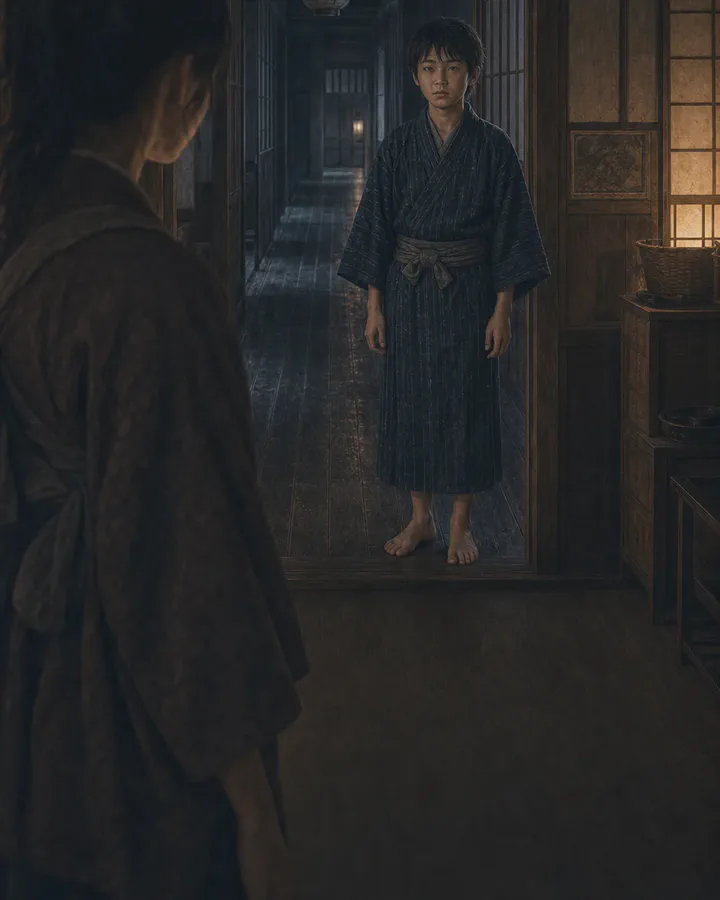
In tale 17 the zashiki-warashi is simply an unfamiliar child inside a house where no child should be. A daughter home from school met a boy in the corridor. Nothing about him glows, floats, or distorts; the strangeness lies entirely in the fact that he cannot be accounted for.
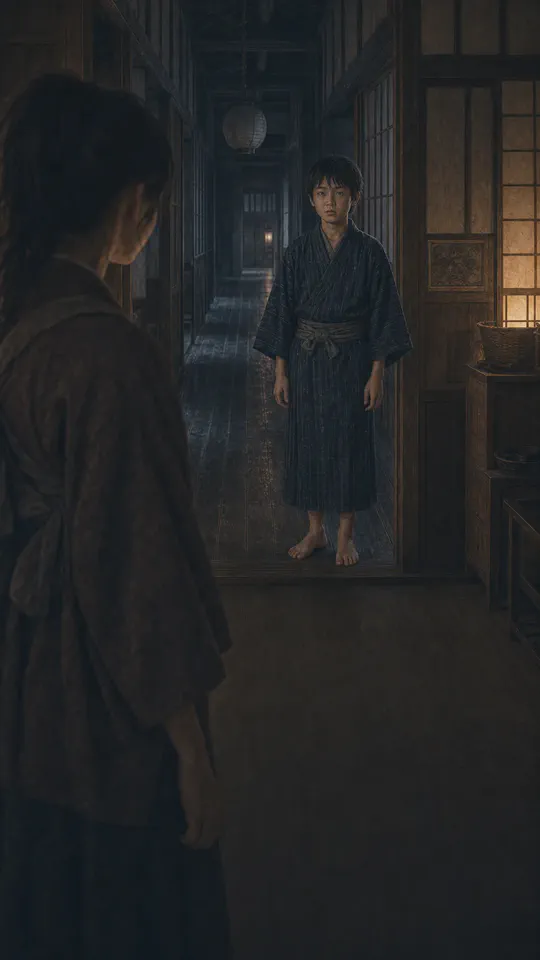
Our illustration follows that account: a boy of about twelve or thirteen in a dark indigo kimono, barefoot, standing in an ordinary lamplit corridor. The widely reproduced image of a small child in a bright red kimono is a modern convention rather than a detail of this record, and collected accounts from Iwate differ on the spirit’s sex, age, and looks — so no single appearance should be treated as the documented standard.
Behavior and abilities
The recorded behavior is quiet to the point of anticlimax, which is exactly its power:
- Appearing in corridors. In one house, the returning daughter met an unknown boy in the hallway and was startled precisely because no visitor had entered.
- Sounds in empty rooms. In another house, a mother sewing alone heard paper rustling and someone sniffing in the next room — a room that stood empty, in a house where the men were away.
- Bringing fortune. The tale ends by noting that families whose houses shelter the spirit are said to enjoy wealth and standing.
The zashiki-warashi of these records does not chase, curse, or harm anyone. It is treated less like an intruder than like a small resident god.
Folklore accounts and regional variations
Tōno Monogatari was taken down from the storytelling of a Tōno native and published in 1910, and it remains the best-known written source for this spirit. But the tradition is wider than one book: folklore databases hold zashiki-warashi records from multiple houses and villages, and they do not agree on details. Some describe girls rather than boys, different ages, different names for the same class of house spirit, and different signs of its presence.
A separate tale in the same collection — tale 18 — links the departure of two zashiki-warashi from a prosperous house to that family’s sudden ruin. The connection between the spirit’s departure and a household’s decline belongs to that particular story and to stories like it; it is not a rule stated in every account, and this article keeps the two tales distinct.
Weaknesses and countermeasures
No countermeasure is documented, and the sources give no reason to want one. Tale 17 records no charm, no exorcism, and no method of removal — only sightings, sounds, and the reputation of the houses involved. If anything, the folklore reverses the usual question: the risk is not how to drive the spirit out, but what its leaving might mean.
Traditional folklore and later imagery
Documented tradition. A house spirit of old Tōno families, often seen as a child of about twelve or thirteen, known through quiet sightings and unexplained small sounds, and associated with the prosperity of the household. Details vary from record to record.
Later imagery. Modern fiction and tourism have given the zashiki-warashi a fixed mascot form — usually a small child in a red kimono with a bobbed haircut — and turned the fortune motif into a guarantee, with inns and games promising luck to anyone who spots one. These are living extensions of the folklore, and they have almost nothing in common with the 1910 record, where the spirit is stranger, quieter, and never on display.
Sources and further reading
- Primary text Tōno Monogatari (遠野物語) (external link) Yanagita Kunio (1910); Aozora Bunko edition Tale 17 records a spirit of old Tōno houses often seen as a child of about twelve or thirteen, sounds in an empty room, and prosperity tied to the spirit's presence.
- Library Tōno Monogatari bibliographic record (external link) National Diet Library Search Bibliographic record for Yanagita Kunio's 1910 collection.
- Fieldwork collection Zashiki-warashi account, record 1461362 (external link) International Research Center for Japanese Studies One collected account; sex, age, appearance and names vary across records.
- Fieldwork collection Zashiki-warashi account, record 1370017 (external link) International Research Center for Japanese Studies One collected account; do not generalize its details nationwide.
- Fieldwork collection Zashiki-warashi account, record 2180290 (external link) International Research Center for Japanese Studies One collected account; do not generalize its details nationwide.
Related yokai
Bakeneko
化け猫(ばけねこ)
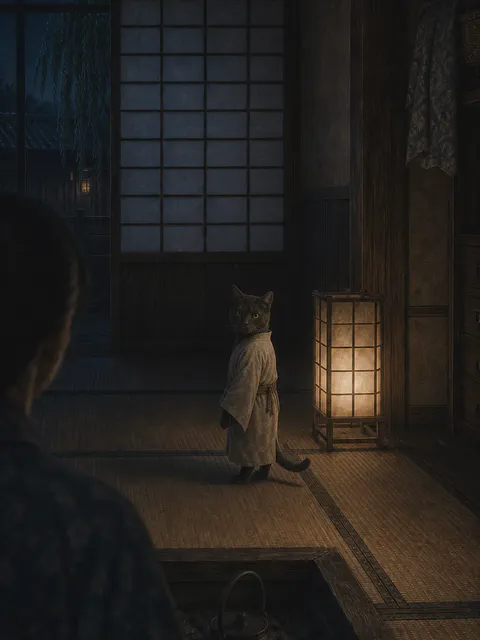
Stories of old cats that speak, perform, dress like people or take human form—and the separate cat yokai they keep getting confused with.
Rokurokubi
轆轤首(ろくろくび)
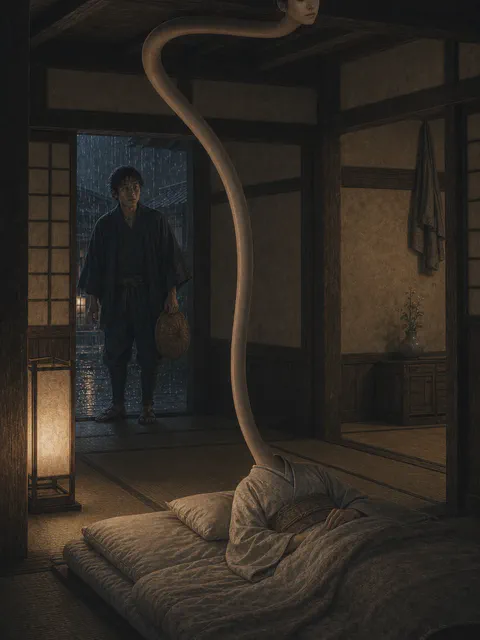
A seemingly human figure whose neck stretches at night—and one name that once covered more than one uncanny form.