Yuki-onna: The Woman in the Snow
雪女(ゆきおんな) Yuki-onna ASCII: Yuki-onna
Pronunciation: yoo-kee ohn-nah
A pale woman seen on winter roads, sometimes deadly, sometimes harmless, and never described the same way everywhere.
Quick Facts
- Habitat
- Snow, Mountain, Road
- Region
- Japan
- Recorded period
- Edo period, Meiji period, modern folklore collections
- Nature
- Mixed
- Danger rating
The danger rating is an editorial summary made for readability. It is not an objective measure found in folklore sources.
Watch the Short
What is Yuki-onna?
Yuki-onna means “snow woman.” Stories under that name appear in snowy regions across Japan, usually describing a female figure encountered in winter, on a mountain path, or during a blizzard. Beyond that shared setting, the accounts do not agree.
In some tellings she is a deadly apparition whose breath or presence brings fatal cold. In others she appears and vanishes without harming anyone. A local story may warn a traveler not to speak to her, while another treats her as a snow spirit rather than a hunter. Yuki-onna is therefore best understood as a family of regional winter traditions, not one character with a fixed set of rules.
Appearance
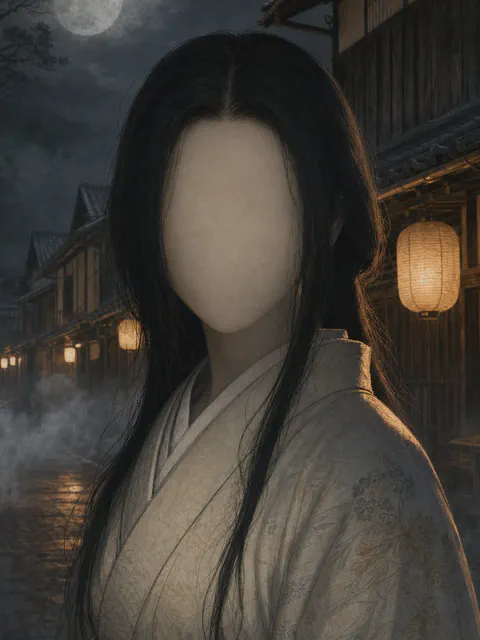
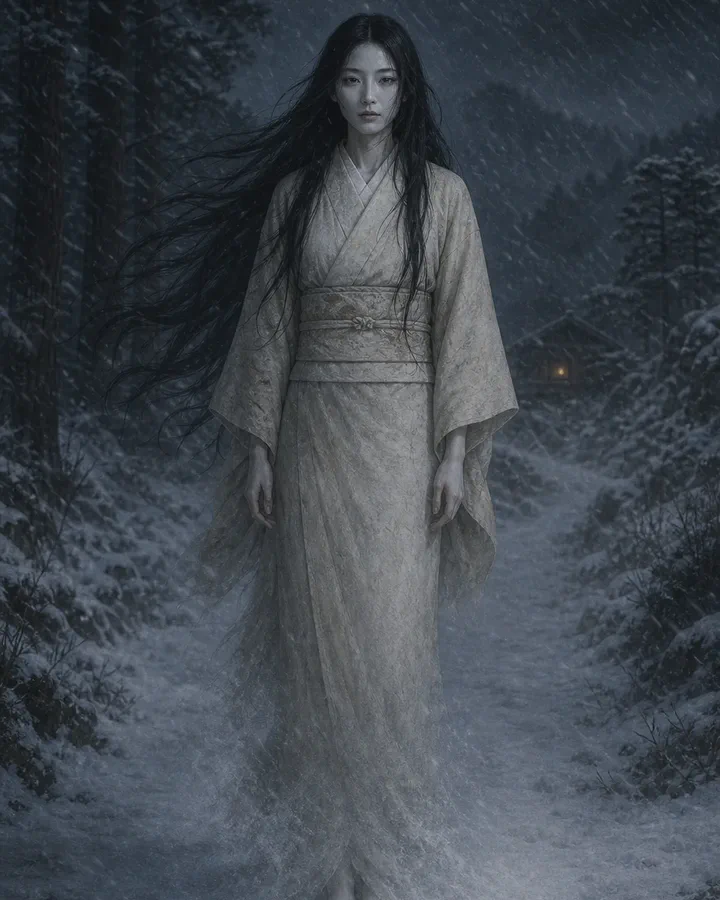
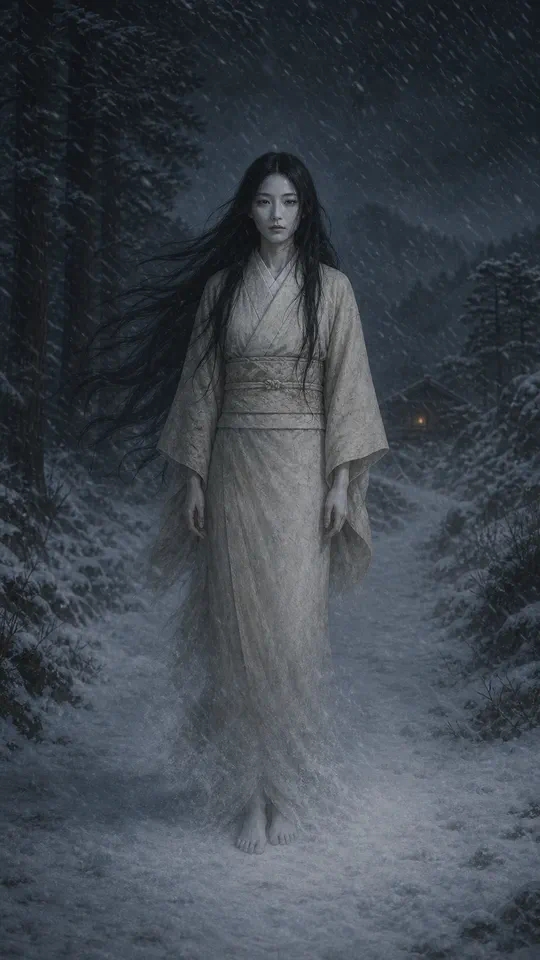
Collected accounts often describe a pale, slender woman wearing white or a single light-colored garment. Against deep snow, the figure may be difficult to distinguish from the landscape until she moves or comes close. Some records emphasize an unnaturally pale face; others describe a woman who disappears as soon as she is noticed.
Modern images often give yuki-onna perfect white bridal clothing, blue light, ice crystals, or an elaborate frozen crown. Those choices make the character immediately readable as a fantasy “ice woman,” but they are not a universal description from folklore. A plain white garment and the visual uncertainty of a person standing in a storm are closer to many recorded encounters.
Behavior and abilities
The most dangerous yuki-onna traditions make cold itself the threat. She may freeze a traveler, drain life with an icy breath, or appear when exposure has already placed someone near death. In other accounts, the encounter is defined not by an attack but by disappearance: the woman is seen on the road, approached, and suddenly gone.
One Miyagi account describes a slender, pale-faced woman in white during a blizzard and warns against calling out to her. A Niigata example describes a pale woman in a single white garment who vanishes. A Nagano record, however, describes a snow-associated female spirit that does no harm. These differences are not minor details; they show why no single behavior should be presented as the nature of every yuki-onna.
Folklore accounts and regional variations
The most famous yuki-onna story in English appears in Lafcadio Hearn’s Kwaidan (1904). In Hearn’s version, yuki-onna kills one woodcutter with her icy breath but spares the younger Minokichi on the condition that he never speak of what he saw. She later lives with him as his human wife. Years later, he breaks the promise and tells the story; she reveals her identity and leaves, sparing him again for the sake of their children.
Hearn identified the tale as one heard from a farmer in the Chōfu area of Musashi Province. It became enormously influential, but it is a literary retelling of one tradition, not a master version for all of Japan. The marriage, the broken promise, and the children belong to that famous telling. Most regional snow-woman accounts contain no marriage at all.
Folklore database records from Miyagi, Niigata, Nagano, Akita, Tottori, and other areas preserve different names, appearances, dangers, and outcomes. Reading them together reveals a repeated winter encounter motif, not a single biography.
Weaknesses and countermeasures
No consistent weakness or banishing method is documented across yuki-onna traditions. The warning not to call out belongs to particular accounts and works as a cautious response in a snow-road story, but it is not a nationwide rule.
Yuki-onna tales also overlap with the real danger of winter travel. Becoming lost, disoriented, or exhausted in a blizzard can be fatal without any supernatural cause. Folklore gives that danger a face, but the stories do not provide one reliable ritual that makes the mountain safe.
Traditional folklore and later imagery
Documented tradition. Regionally different female apparitions or spirits encountered in snow. Some are deadly, some merely vanish, and some are explicitly harmless. White clothing and a pale face occur in several records, but behavior and narrative role vary widely.
Later imagery. Modern fiction frequently combines Hearn’s human-wife plot with the powers and appearance of a fantasy ice sorceress. It may also treat “leaves no footprints” as a universal test. That image is atmospheric, but it is not a rule shared by all records; the folklore database even includes an account in which tracks remain after the figure disappears. Our short video uses missing footprints as a cinematic sign of strangeness, not as a claim about every yuki-onna tradition.
Sources and further reading
- Database Database of Folklore and Yokai Phenomena (怪異・妖怪伝承データベース) (external link) International Research Center for Japanese Studies Use individual records; do not generalize one local account nationwide.
- Primary text Kwaidan: Stories and Studies of Strange Things — “Yuki-Onna” (external link) Lafcadio Hearn (1904); Project Gutenberg edition Hearn's influential literary retelling of a Musashi Province tradition; do not treat its marriage and broken-promise plot as universal.
- Fieldwork collection Yuki-onna account from Miyagi, record C0411196-000 (external link) International Research Center for Japanese Studies Describes a pale, slender, white-clad woman in a blizzard and a warning not to call out.
- Fieldwork collection Yuki-onna account from Niigata, record 1231385 (external link) International Research Center for Japanese Studies Describes a pale woman in a single white garment who vanishes.
- Fieldwork collection Harmless snow-woman account from Nagano, record 1232102 (external link) International Research Center for Japanese Studies A regional example in which the snow-associated female spirit causes no harm.
- Fieldwork collection Snow-woman account involving footprints, record 0700375 (external link) International Research Center for Japanese Studies Useful counterexample to the modern assumption that yuki-onna never leaves tracks.
Related yokai
Tengu
天狗(てんぐ)
A mountain being associated with flight, impossible voices, disappearances, and more than one familiar face.