
Yamawaro (山童): The Mountain Child Who Breaks Twigs All Night
Kyushu's hairy helper of woodcutters and charcoal burners, the kappa that climbs the mountain in autumn, and the rice balls it works for
山童(やまわろ) Yamawaro ASCII: Yamawaro
Also known as: Yamawarawa, Yaman-tarō, Seko
Pronunciation: yah-mah-wah-roh
Yamawaro (山童, “mountain child”) is the child-sized, hairy mountain spirit of Kyushu, above all of Kumamoto. A record of 1950 from Ashikita tells of a charcoal burner sleeping in the mountains who was kept awake all night by a yamawaro snapping brushwood, until he went home for an amulet of the Great Shrine, after which it never came again. Across Kyushu the yamawaro helps with mountain work for a wage of rice balls or sake, punishes anyone who forgets to pay, and in many districts is the kappa itself, gone up into the mountains at the autumn equinox and back to the river in spring.
Quick Facts
- Habitat
- Mountain, Forest, River
- Region
- Japan, Kumamoto (Ashikita, Yatsushiro, Kuma), Fukuoka, Ōita, Miyazaki, Kagoshima
- Recorded period
- Wakan Sansai Zue (1712), Edo yokai scrolls and prints (1737–1776), Kyushu folklore records (1930–1986)
- Nature
- Mixed
- Danger rating
The danger rating is an editorial summary made for readability. It is not an objective measure found in folklore sources.
Watch the Short
What is Yamawaro?
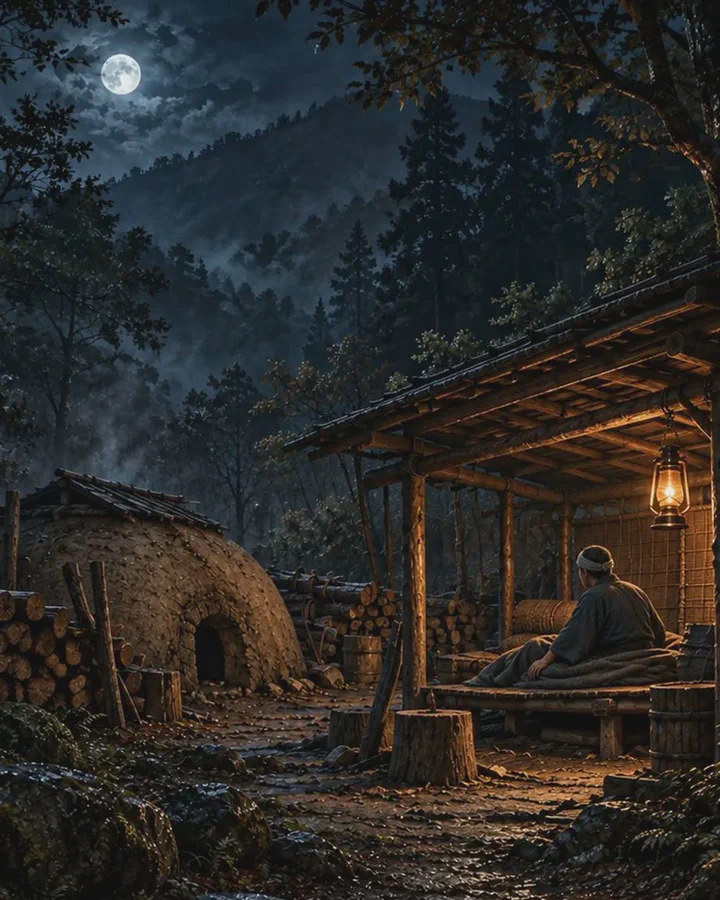
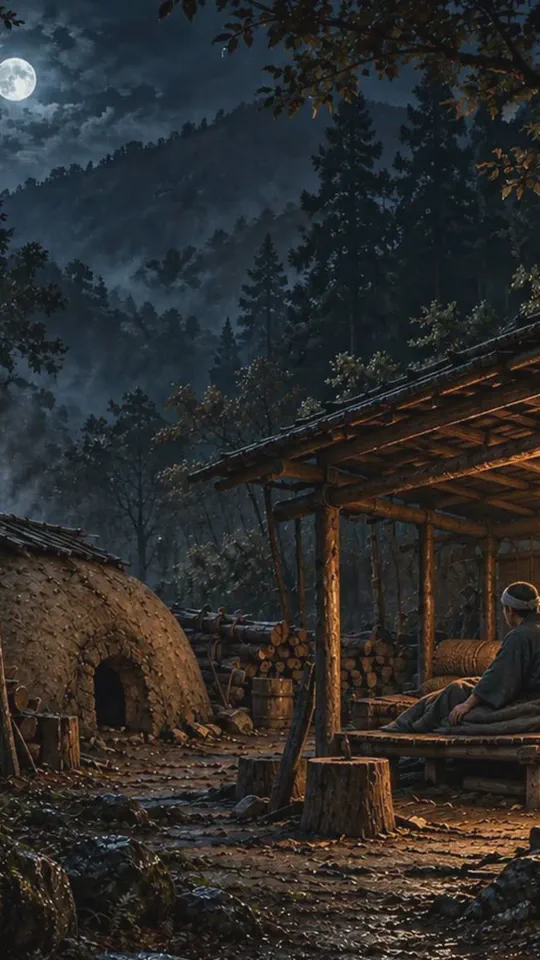
A charcoal burner in Ashikita, in the south of Kumamoto, is sleeping in the mountains beside his kiln. All night something keeps snapping small branches near him, and he cannot sleep. It is a yamawaro. He goes home, comes back with a paper amulet of the Great Shrine, and from that night the thing does not come. The man who told this in 1950 added the rule the charcoal burners of the district lived by: never build your kiln on a yamawaro’s path.
The yamawaro of Ashikita was a neighbour. It lived in groups in the hills close to the villages, ate wild bayberries, cried with a whistling hyū-hyū, walked upright on two legs, and made sounds like speech that nobody could understand. It kept company with woodcutters, fishermen and charcoal burners, and the ones it helped paid it in sake. As long as the thanks were not forgotten, it did no harm.
What does yamawaro mean?
The name is written 山童: yama, mountain, and waro or warawa, a child. The mountain child. In Ashikita it was also the yamanmon, the mountain thing, or the yaman-wakkashi, the mountain youth; in the Kuma district it was yaman-tarō or yamanbo; in Miyazaki and Ōita it is seko, and in one Aso village people used that name on purpose, because saying “yamawaro” made them angry. An encyclopedia of 1712 described it for readers who would never go to Kyushu: deep in the mountains there, a creature like a child of about ten, with long persimmon-brown hair on its head and fine hair over its whole body, a short trunk and long legs, walking upright and speaking.
The kappa goes up the mountain
In much of Kyushu the yamawaro is not a separate creature but a season. At the spring equinox the yamawaro go down into the rivers and become garappa, the kappa of the region; at the autumn equinox they come back up into the mountains and are yamawaro again. Around the equinox, people in Ashikita said, thousands of them came down the mountain in a line, chattering as they went. The route they took was called the osaki, and no kiln and no house could be built across it.
The dates move with the district. In Fukuoka the kappa climbed the mountain for the winter and the river water cleared behind them. In the Kuma district the river Tarō and the mountain Tarō changed places on the first day of the second month, Tarō’s first day; around Minamata the change came on the first day of the sixth month. In Miyazaki the mountain Tarō was the mountain god himself, and the swap with the river Tarō fell on the same second-month date. The folklorist who first gathered these accounts read the whole pattern as the older belief in a god who is the field god in summer and the mountain god in winter, wearing a kappa’s and a yamawaro’s body in turn.
Wages
The yamawaro works, and it expects to be paid. Give it rice balls and it will help carry great trees down the mountain. Promise it five measures of sake and it will do the work of two men. Always carry sacred sake into the mountains: when a tree sawn clean through will not fall, a yamawaro is holding it, and the thing to do is pour out the sake and ask. The payment must be the thing promised, and it must come after the work; pay first and the yamawaro eats and runs.
Forgetting is dangerous. A farmer whose lost tobacco pouch was found by a yamawaro was warned that a favour unpaid in sake brings thousands of them to shake the house. A charcoal burner found dead in a stream, his body covered in scratches, was said to have done something to one. A man came home with his clothes in shreds and said he had wrestled one. And at night, on the paths by the streams, they follow: four or five of them, the size of four-year-olds, coarse-haired, with webbed hands and long nails, grabbing a man’s legs and putting out his lantern. What they wanted was the rice balls at his belt. He threw them, they ate every one, and a dog howled and they fled.
Appearance
A child of four, or ten, covered in hair, walking upright, with a whistling cry. In the Ashikita account its hands are webbed and its nails long. The 1712 encyclopedia gives it persimmon-brown hair and long legs; a later edition of the same book adds a round face, red hair hanging over the eyes, pointed ears like a dog’s, and a single eye above the nose. The picture scrolls of the Edo period, from 1737 onward, paint it as a one-eyed child holding leafy branches, and the print of 1776 shows a hairy, grinning figure in a skirt of grass beside a waterfall, with a branch in its hand. The people who met it at night in Kumamoto mostly did not see it at all: they heard the twigs, and the whistle, and felt the hands.
Behavior and abilities
- It breaks twigs all night. The Ashikita record’s one act: snapping brushwood beside a sleeping man until morning.
- It works for food. Rice balls, sake, a measure promised and paid afterward.
- It holds trees up. A sawn tree that will not fall is in its grip.
- It travels in thousands. Down the mountain at the equinox, along a path where nothing may be built.
- It copies sounds. Tree-felling, songs heard by day and sung at night.
- It bathes. In the charcoal burner’s tub, leaving a foul oily scum.
- It punishes. Scratches, shredded clothes, a shaken house, for those who forget to pay.
Weaknesses and countermeasures
The amulet of the Great Shrine, brought from home, which ended the twig breaking in 1950. Dogs, which the yamawaro fear and which sense them first: when a dog freezes on a mountain path, pour out sake and ask the yamawaro’s leave to hunt. A carpenter’s ink line strung around the work site, or a saw stood upright, keeps them out of the hut. Incense ash from the household altar calms a horse they have been riding all night. And the oldest countermeasure of all, which is not a charm: pay what you promised, after the work, in the thing you said.
Documented tradition and later imagery
Documented tradition. The encyclopedia entry of 1712 on the hairy mountain child of Kyushu; the one-eyed child with branches in the yokai scrolls from 1737 and the print of 1776; and the field records of the twentieth century, above all from Ashikita in Kumamoto in 1950: the twigs snapped all night, the amulet, the kilns kept off the path, the equinox processions, the rice balls and sake, the webbed hands in the dark, with parallels from Yatsushiro, Kuma, Minamata, Fukuoka, Ōita, Miyazaki and Kagoshima.
Later imagery. Modern yokai guides take the one-eyed child of the Edo scrolls as the yamawaro’s face, and the equinox exchange with the kappa as its defining trick. The Kumamoto records are less tidy and more unsettling. The yamawaro there has no fixed face, because nobody saw it; it has a cry, a wage, a path, and a grudge, and the charcoal burner who built his kiln in the wrong place found out which.
Sources and further reading
- Fieldwork collection Yamawaro, record 2180235 (Ashikita, Kumamoto) (external link) International Research Center for Japanese Studies Maruyama Manabu, "The yamawaro of Ashikita in Higo", Minkan Denshō 14(8), 1950, p. 19: a yamawaro snaps brushwood all night beside a sleeping charcoal burner; an amulet of the Great Shrine stops it; kilns are kept off its path.
- Fieldwork collection Yamawaro, record 2180226 (Ashikita, Kumamoto) (external link) International Research Center for Japanese Studies Same article, pp. 17–18: yamawaro become garappa in the river at the spring equinox and yamawaro again in the mountains in autumn; thousands come down in a line; the osaki route where no kiln or house may stand.
- Fieldwork collection Yamawaro, record 2180241 (Ashikita, Kumamoto) (external link) International Research Center for Japanese Studies Same article, pp. 20–21: four or five yamawaro the size of four-year-olds, coarse-haired with webbed hands and long nails, follow a man at night, put out his lantern, eat his rice balls and flee at a dog's howl.
- Fieldwork collection Yamawaro, record 2200001 (Ashikita, Kumamoto) (external link) International Research Center for Japanese Studies Minzoku 1, February 1950, p. 4: yamawaro live in groups near the villages, eat bayberries, whistle, walk upright, keep company with woodcutters, fishermen and charcoal burners, and are repaid with sake.
- Fieldwork collection Yamawaro and kawatarō, record 2470196 (Kagoshima) (external link) International Research Center for Japanese Studies Mukashibanashi Densetsu Kenkyū 21 (2000), pp. 119–120: give them rice balls and they carry great trees; yamawaro in the mountains in winter, kawatarō in the river in summer.
- Fieldwork collection Kappa and yamawaro, record 0030087 (Fukuoka) (external link) International Research Center for Japanese Studies Ashinaka 37 (1953), pp. 24–25: kappa leave the river for the mountain in winter, the water clears, and a kappa gone up the mountain becomes a yamawaro.
- Fieldwork collection Yamawara and kappa, record C4410005-000 (Ōita) (external link) International Research Center for Japanese Studies Ōita prefectural history, folklore volume (1986), pp. 357–358: the names yamawara, yama-aro and seko, and the kappa that climbs the mountain at the autumn equinox in many districts.
- Fieldwork collection Yamawaro, record 1720014 (Tōyō, Yatsushiro) (external link) International Research Center for Japanese Studies Nihon Minzokugaku 93 (1974), p. 4: baby-sized and hairy, likes azuki rice, thanked with stonefish and sake, bathes in the charcoal burner's tub, and is kept out by an ink line strung round the site.
- Library Wakan Sansai Zue, middle volume (1885 edition), chapter 40 on strange creatures (external link) National Diet Library Digital Collections The 1712 encyclopedia's entry on the yamawaro of Kyushu, a hairy child of about ten with persimmon-brown hair, long legs and speech.
- Museum Yamawaro from Gazu Hyakki Yagyō (File:SekienYamawarawa.jpg) (external link) Wikimedia Commons Toriyama Sekien's print of 1776, a hairy grinning figure in a grass skirt beside a waterfall with a leafy branch in its hand; no text beyond the name.
- Museum Yama-warau from Sawaki Sūshi's Hyakkai Zukan (File:Suushi Yama-warau.jpg) (external link) Wikimedia Commons The 1737 scroll's one-eyed child holding leafy branches.
- Database Yamawaro (山童) (external link) Wikipedia (Japanese) Regional names, the 1712 description and its later edition, the exchange dates in Kuma and Minamata, the wage rules, sound mimicry, bathing, and the one-eyed figure of the Edo pictures, with its printed sources.
- Reliable secondary Yamawaro (山童), Nihon Kokugo Daijiten (external link) Shōgakukan, via Kotobank Dictionary entry: an imaginary animal of the deep mountains of Kumamoto, said to be the kappa gone into the mountains in autumn; cites the 1712 encyclopedia.
- Database Yōkai Dangi (妖怪談義) (external link) Wikipedia (Japanese) Yanagita Kunio's essay on the kappa's crossing, which reads the seasonal exchange as the alternation of the field god and the mountain god.
Where it was recorded
- 1950
Ashikita (Higo), Kumamoto
Folklore record
A yamawaro snaps brushwood all night beside a sleeping charcoal burner; an amulet of the Great Shrine stops it; no kiln on its path
- 1951
Tōyō, Yatsushiro (former Kawamata village), Kumamoto
Folklore record
Yamawaro help with mountain work, sing by night the songs heard by day, and bathe in the hut's tub, leaving an oily scum
- 1953
Fukuoka, Fukuoka
Folklore record
Kappa leave the river and climb the mountain for the winter, where they become yamawaro
- 1986
Ōita, Ōita
Folklore record
Called yamawara, yama-aro or seko; in many districts the kappa that climbs the mountain at the autumn equinox
- 1999
Koyu district, Miyazaki
Folklore record
The mountain Tarō, also called yamawarō, is the mountain god and changes places with the river Tarō on the first day of the second month
- 2000
Kagoshima, Kagoshima
Folklore record
Give them rice balls and they help carry great trees; yamawaro in the mountains in winter, kawatarō in the river in summer
Places named in the records behind this article. Coordinates are approximate. View on the map
Where to see it
- The Kappa Landing Stone at Yatsushiro 河童渡来之碑(徳渕の津) Site
Related yokai
Kappa
河童(かっぱ)
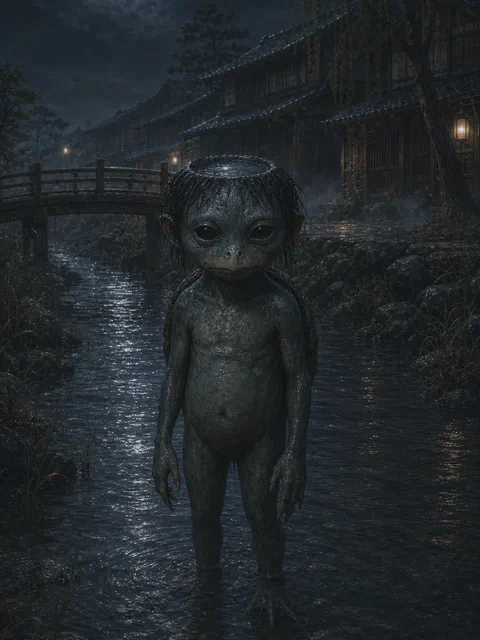
A child-sized water yokai whose strength lives in the water held by the dish on its head.
Yamabiko
山彦(やまびこ)
The echo in a Japanese valley was heard as an answer before anyone drew the thing answering — and when painters finally gave it a body, they produced a small animal that is neither quite a dog nor quite a monkey.


Ippon-datara
一本だたら(いっぽんだたら)
In the Kii mountains a one-legged thing leaves enormous single tracks in the snow — and Yanagita Kunio, reporting them, declined to conclude a one-legged creature from footprints alone.