
Yamauba: The Mountain Woman Who Came to Reclaim Her Sandal
山姥(やまうば) Yamauba ASCII: Yamauba
Also known as: 山婆, やまんば
Pronunciation: yah-mah-oo-bah
A man carries a woven object home from the hills, and that night a woman's voice demands the return of her ashinaka.
Quick Facts
- Habitat
- Mountain, Forest, House
- Region
- Tsuruoka (Yamagata), Tokushima, Miyazaki, Kōchi, Kyoto, Kagawa
- Recorded period
- 1943 folklore record, postwar folklore records, modern folklore collections
- Nature
- Mixed
- Danger rating
The danger rating is an editorial summary made for readability. It is not an objective measure found in folklore sources.
Watch the Short
What is Yamauba?
Yamauba means “mountain woman” or “mountain crone.” The name belongs to a wide family of traditions rather than one monster with a fixed body, behavior, and origin. Depending on the region and account, a Yamauba may frighten a traveler, ask a household for something, lend valuable dishes, help with work, or receive an offering.
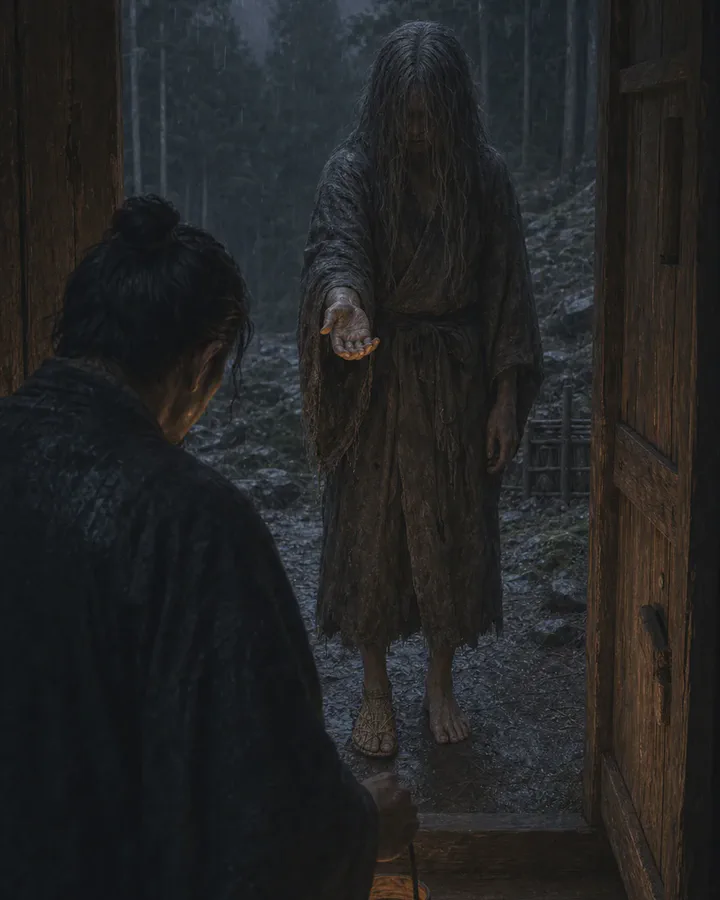
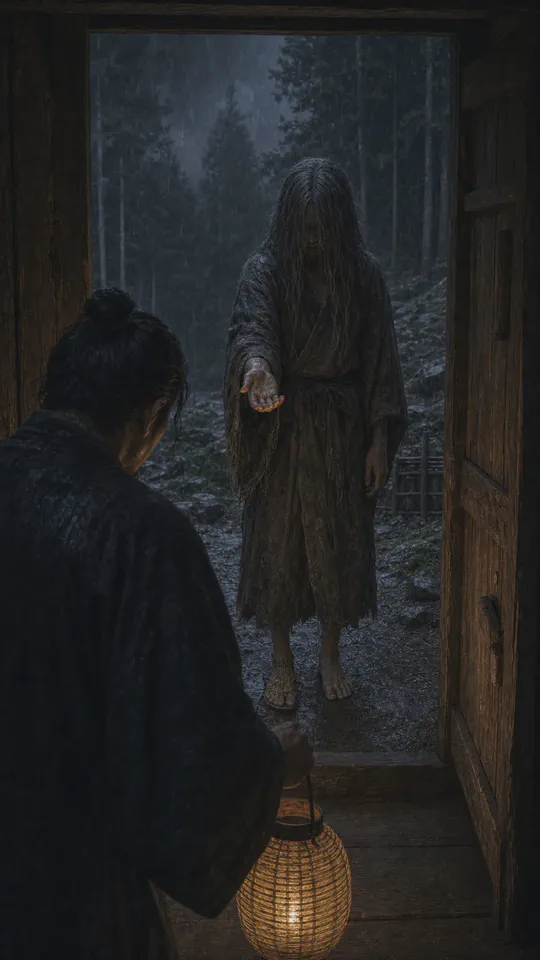
The account featured in our short video was published in 1943 and catalogued for Tsuruoka in Yamagata Prefecture. A man finds a newly woven object in the hills and hangs it beside his back door. That night, a woman’s voice comes to the house and demands, “Give back my ashinaka.” The object he carried home was the Yamauba’s short woven sandal.
The story turns a small act of taking into a tense encounter. The visitor does not need to break down the door or display supernatural violence. She knows where the missing object has gone, and she has come to claim it.
Appearance
The 1943 Yamagata record does not describe the woman’s face, age, clothing, hair, or body. It therefore cannot prove that Yamauba always appears as a wild-haired old woman, a fanged cannibal, or a witchlike figure.
Our illustration gives the unseen voice a restrained visual form: an older mountain woman with rain-soaked gray hair and worn clothing stands outside the farmhouse. Her face remains in shadow. One foot wears the same short woven sandal found in the hills, while the other is bare. These details explain the object being reclaimed without adding horns, claws, blood, or an attack.
Historical and modern art has given Yamauba many other appearances. Some images show an elderly woman with loose hair; others make her maternal, comic, terrifying, or nearly human. Each picture belongs to the work it was made for. There is no single face behind them.
Behavior and abilities
The adopted Yamagata account records a limited sequence:
- A man takes a newly woven object from the mountain. He does not initially recognize it as an ashinaka.
- The owner follows it home. A woman’s voice arrives at the back door that night.
- She demands its return. The record centers on ownership and recognition, not a documented assault.
- The mountain is not an empty storehouse. The encounter implies that an ordinary-looking object may already belong to someone beyond the village.
The account does not say that the Yamauba enters the house, eats the man, casts a spell, or punishes him after the sandal is returned. Adding those events would replace the collected story with a more familiar horror stereotype.
Folklore accounts and regional variations
Other records show why Yamauba cannot be reduced to a single role. A 1962 Tokushima account describes a Yamauba visiting a village to ask for a fire source. A Miyazaki record published in 1992 says she lends household dishes but does not show her face. A Kōchi record from 1975 describes a mountain woman who helps with work.
A Kyoto account published in 1982 records offerings of mochi sent down a mountain stream. A 1984 Kagawa record preserves advice for surviving an encounter: behave as though nothing unusual has been seen. Each example has its own place, action, and relationship between the mountain presence and the human community.
These differences do not cancel one another. They reveal a broad category of mountain-woman traditions shaped by local landscapes and expectations. The helpful lender, the visitor seeking fire, and the owner reclaiming her sandal should remain distinct rather than being forced into one biography.
Weaknesses and countermeasures
No consistent weakness or universal countermeasure is documented in the sources used for this article.
Returning the ashinaka is the natural resolution implied by the Yamagata account, but the record does not establish a general ritual for defeating every Yamauba. The Kagawa advice to behave as if nothing unusual has been seen comes from a different region and a different encounter. It would be no help at all to the man with a voice at his door.
Weapons, Buddhist objects, magic words, or fire are not established as universal defenses here. The recurring practical lesson is more modest: do not assume that an unfamiliar object found in the mountains is free to take.
Traditional folklore and later imagery
Documented tradition. The 1943 Yamagata account tells of a stolen ashinaka and a woman’s voice demanding its return. Other regional records describe a Yamauba seeking fire, lending dishes, helping with work, receiving food, or requiring a traveler to conceal their reaction.
Later imagery. Popular depictions often combine Yamauba with cannibalism, fangs, impossible mouths, witchcraft, or a single tragic origin story. Some of those motifs have their own literary and artistic histories, but they are not required by the six records used here. Nor should “mountain woman” become a caricature of real older women or rural residents.
The quiet force of the Yamagata story lies in restraint: rain at the back door, a voice asking for one small object, and the discovery that the mountain has remembered what was taken from it.
Sources and further reading
- Fieldwork collection Yamauba and the ashinaka from Tsuruoka, Yamagata, record 1231301 (external link) International Research Center for Japanese Studies The adopted 1943 account: a man takes a newly woven object from the hills, and a woman's voice comes to his back door demanding the return of her ashinaka.
- Fieldwork collection Yamauba seeking a source of fire in Tokushima, record 0730051 (external link) International Research Center for Japanese Studies A 1962 regional account in which a Yamauba comes to a village for fire.
- Fieldwork collection Yamauba lending household dishes in Miyazaki, record C4510115-000 (external link) International Research Center for Japanese Studies A regional account in which Yamauba lends dishes but does not show her face.
- Fieldwork collection Yamauba helping with household work in Kōchi, record 1480100 (external link) International Research Center for Japanese Studies A 1975 regional account showing a helpful mountain-woman tradition.
- Fieldwork collection Mochi offered to Yamauba in Kyoto, record 0700257 (external link) International Research Center for Japanese Studies A 1982 regional account involving mochi sent down a mountain stream.
- Fieldwork collection Advice for a Yamauba encounter in Kagawa, record 0470087 (external link) International Research Center for Japanese Studies A regional account advising a person to act as though nothing unusual was seen.
Related yokai
Tengu
天狗(てんぐ)
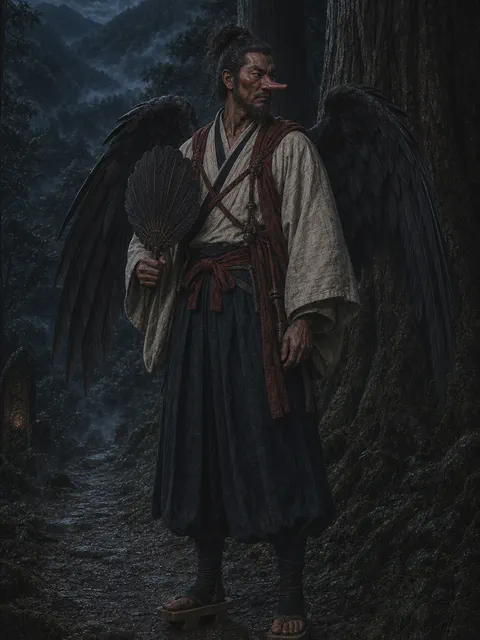
A mountain being associated with flight, impossible voices, disappearances, and more than one familiar face.

Yuki-onna
雪女(ゆきおんな)
A pale woman seen on winter roads, sometimes deadly, sometimes harmless, and never described the same way everywhere.
Zashiki-warashi
座敷童子(ざしきわらし)
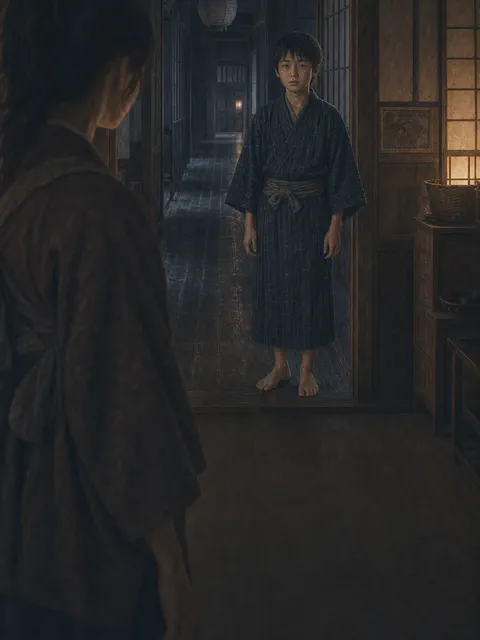
In Tōno Monogatari, an unfamiliar child crosses the corridor of an old house — and the family that shelters the spirit is said to prosper.