
Yamabiko: The Sound Came First
山彦(やまびこ) Yamabiko ASCII: Yamabiko
Also known as: 幽谷響
Pronunciation: yah-mah-BEE-koh
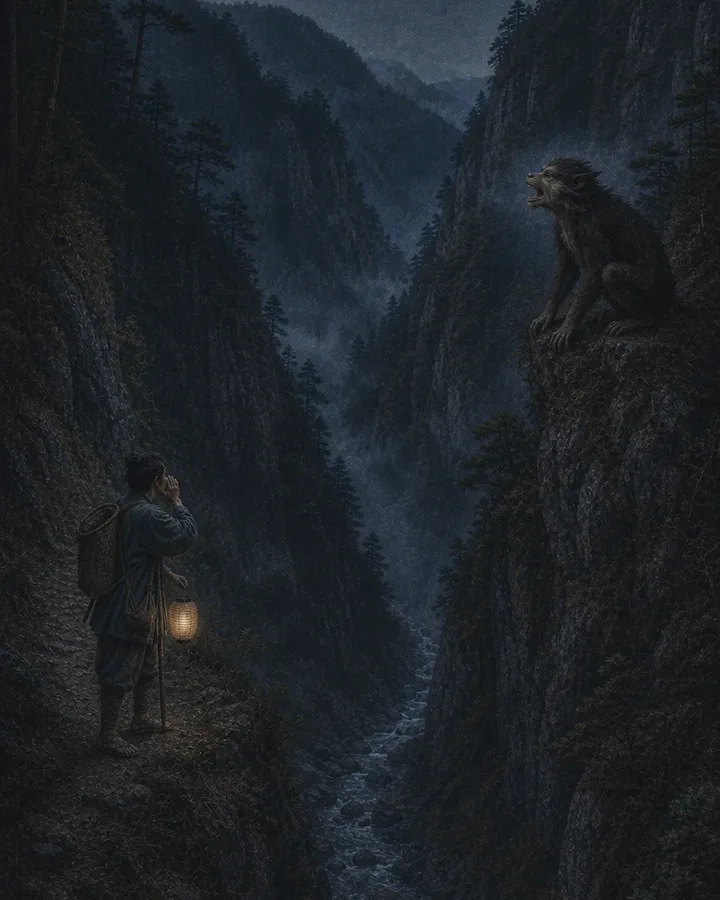
The echo in a Japanese valley was heard as an answer before anyone drew the thing answering — and when painters finally gave it a body, they produced a small animal that is neither quite a dog nor quite a monkey.
Quick Facts
- Habitat
- Mountain, Forest
- Region
- Kusuyama in Hashikami, Hata district, Kōchi
- Recorded period
- Sawaki Sūshi's Hyakkai Zukan (1737), Toriyama Sekien's Gazu Hyakki Yagyō (1776), Tabi to Densetsu (1942)
- Nature
- Unknown
- Danger rating
The danger rating is an editorial summary made for readability. It is not an objective measure found in folklore sources.
Watch the Short
What is Yamabiko?
Call out in a valley and something calls back. That happens. It has always happened, it happens to everyone, and it is the most reliably reproducible strange experience available to a person on foot in mountains.
Yamabiko is the word for it — and also the word for whatever is doing it.
Japanese kept both meanings in one term without ever quite separating them. The sound is an echo. The sound is also an answer. Modern Japanese still uses yamabiko for the acoustic phenomenon, and the dictionary definition does not require you to believe anything. But underneath the word is an older reading in which the mountain, or a spirit in the trees, or something you cannot see, is returning your voice deliberately.
Behavior and abilities
- It repeats. Whatever you say comes back. That is the entire observable behaviour and it is the same for everyone.
- It is never located. No account has anyone find the thing that answered.
- It responds only to you. The echo requires you to speak first, which makes the encounter feel transactional in a way that most yokai encounters are not.
- In one record it does not repeat at all. See below.
The voice at Kusuyama
There is a collected record that does not fit the tidy version, and it is worth more than the tidy version.
In 1942 the folklorist Katsurai Kazuo published material from Kusuyama in Hashikami, Hata district, in Kōchi, in the periodical Tabi to Densetsu. The yamabiko there is not described as a copy of your voice. It is a terrible voice heard suddenly in the deep mountains, by day or by night.
Nobody has to call out first. It simply arrives.
That is a different thing from an echo. It is a sound with no cause, in a place where you are alone, and the word attached to it is the same word people use for the harmless trick a valley plays.
Appearance
For most of its life this creature had no appearance at all. It was a sound.
Then painters gave it one. Sawaki Sūshi’s Hyakkai Zukan, a scroll of 1737, carries a small shaggy animal, and Toriyama Sekien painted the same kind of figure in his Gazu Hyakki Yagyō of 1776 under the name 幽谷響 — which reads yamabiko but writes out as something closer to “the sound answering from the deep valley.”
The animal is difficult to name on purpose. It has the build of a dog and the posture and hands of a monkey and settles as neither. Sekien gave it no substantial caption, so there is no text telling us what it does or where the idea came from.
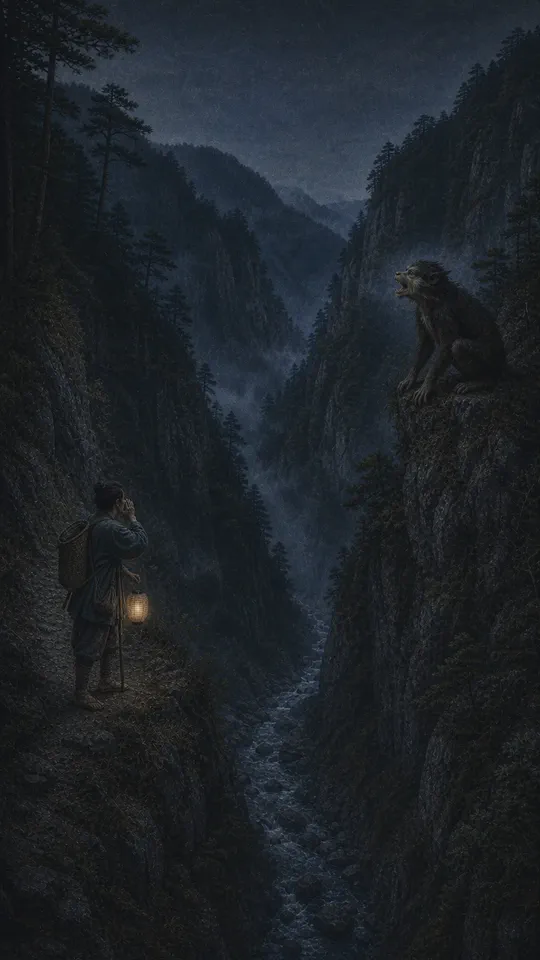
Our illustration puts it where the pictures put it: across the gorge, high up, too far away to reach, with its mouth open.
What the order of events means
This is the part worth holding onto.
The sound came first. People heard the valley answer for as long as people had been walking into valleys. The explanations — a mountain spirit, a kodama in the trees, an unseen beast — came after the experience, as attempts on it. And the small dog-monkey animal came after those, in the eighteenth century, when artists were assembling illustrated catalogues and every entry needed a picture.
Sawaki painted one in 1737 and Sekien painted one in 1776, which means the figure was already a lineage rather than one man’s invention. But it is still a late arrival. A creature was reverse-engineered from a noise, because a catalogue of monsters cannot have a blank page.
Weaknesses and countermeasures
None are recorded, and here the silence is structural rather than accidental.
There is nothing to defend against and nothing to reach. The thing is across a valley, or in the trees, or simply nowhere, and the encounter ends when you stop making noise. Every other creature in these files can in principle be met. This one is defined by never being met — the whole experience is one of distance that does not close.
The Kusuyama voice is the exception that makes the point. It is frightening precisely because it removes the one comforting feature of an echo, which is that you started it.
Documented records and later imagery
Documented records. The word for the returning voice in a valley, carried in Japanese as both the acoustic fact and an answering presence; a small dog-or-monkey animal painted in Sawaki Sūshi’s 1737 scroll and again in Sekien’s 1776 collection under the name 幽谷響, with no substantial caption; and Katsurai Kazuo’s 1942 record from Kusuyama in Kōchi of a terrible voice heard suddenly in the deep mountains, day or night.
Later imagery. The animal has won, as the drawn version usually does. Modern collections file Yamabiko as a small yokai that lives in mountains and mimics people, with the dog-monkey design settled and the mimicry treated as its power.
The older situation is better. There was a sound, everyone had heard it, nobody could point at it, and several centuries of people tried to say what it was. The animal on the ledge is not the answer. It is the last in a long series of guesses, and the only one that could be painted.
Sources and further reading
- Library Toriyama Sekien's Illustrated Night Parade of the Demon Horde (external link) National Diet Library Image Bank Overview of Sekien's four illustrated collections, including the 1781 Konjaku Hyakki Shūi that carries the Shinkirō plate.
- Fieldwork collection Yamabiko (山彦) entries (external link) International Research Center for Japanese Studies Includes Katsurai Kazuo's record from Kusuyama in Hashikami, Hata district, Kōchi, published in Tabi to Densetsu in 1942: a terrible voice heard suddenly in the deep mountains, by day or by night.
- Museum Sawaki Sūshi, Hyakkai Zukan (百怪図巻), 1737 Fukuoka City Museum The painted scroll that precedes Sekien and carries the same dog-or-monkey yamabiko figure, showing the image was a lineage rather than one artist's invention. Consulted as the held scroll; no stable public URL recorded.
- Library Tabi to Densetsu (旅と伝説) (external link) National Diet Library Search The folklore periodical carrying the 1929 Mizuho account, in volume 2 number 7.
Related yokai
Kodama
木霊(こだま)
Kodama can mean both a presence within an old tree and the echo that returns from a mountain — but Japanese tradition gives it no single fixed body.
Okuri-inu
送り犬(おくりいぬ)
A 1936 Gifu account describes a mountain dog that follows a traveler all the way to his door — and leaves only after salt and a word of thanks.