Wanyūdō: The Burning Wheel With a Human Face
輪入道(わにゅうどう) Wanyūdō ASCII: Wanyudo
Pronunciation: wah-nyoo-DOH
In Toriyama Sekien's 1779 picture book, a single ox-cart wheel rolls through the night by itself — and anyone who sees it is said to lose their soul.
Quick Facts
- Habitat
- Street, Road
- Region
- Japan
- Recorded period
- Konjaku Gazu Zoku Hyakki (1779)
- Nature
- Harmful
- Danger rating
The danger rating is an editorial summary made for readability. It is not an objective measure found in folklore sources.
Watch the Short
What is Wanyūdō?
Wanyūdō joins wa, a wheel, with nyūdō, a word for a man who has taken Buddhist orders — here best read as “wheel monk.” It is one of the great picture-book yokai of the Edo period: its defining appearance is a print in Toriyama Sekien’s Konjaku Gazu Zoku Hyakki (“The Illustrated One Hundred Demons of the Present and Past, Continued”) of 1779.
Sekien draws a single ox-cart wheel with a huge man’s head at its hub, turning through the dark on its own, with no cart, no ox, and no driver. His caption adds the detail that makes the image dangerous rather than merely strange: whoever sees the wheel is said to lose their soul.
Appearance
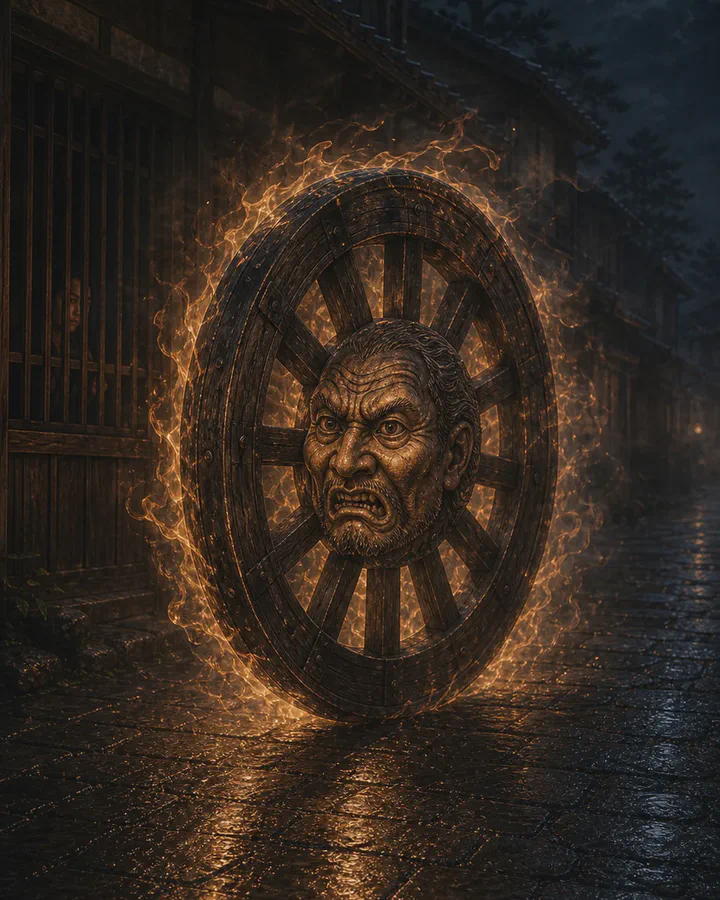
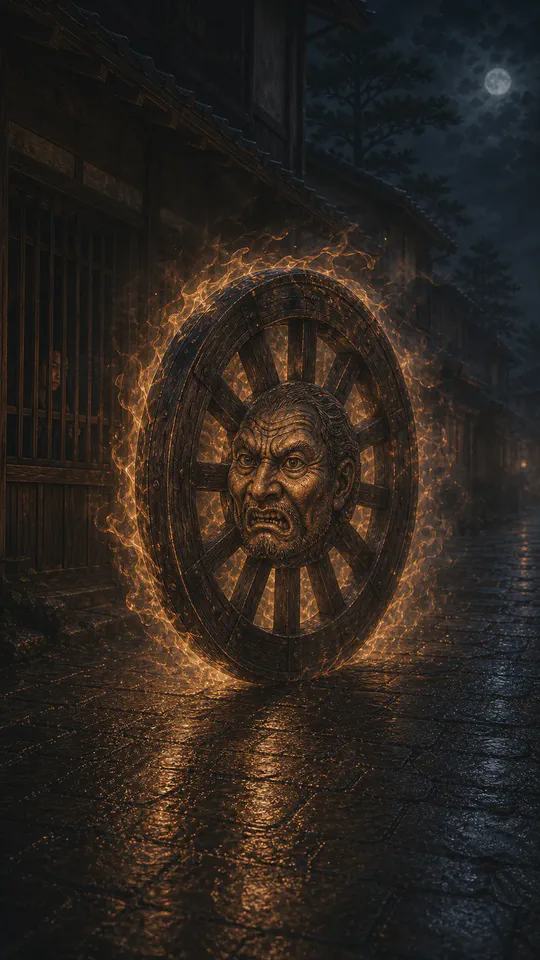
The Wanyūdō is one wooden wheel — not a burning cart, and not a wheeled monster with limbs. At the hub sits the face of a grown man: heavy brows, deep creases, mustache and beard, and a glare fixed on whoever is unlucky enough to be looking back. Flame and smoke wrap the rim like a moving halo.
Our illustration keeps Sekien’s economy: charred wood, iron fittings, real rolling weight, and fire that clings to the wheel rather than filling the street. Popular retellings often make the face a shaven-headed monk, but we follow the bearded face of the 1779 print and avoid fixing details the source leaves open.
Behavior and abilities
Sekien’s caption gives the Wanyūdō a small and terrible repertoire:
- It patrols alone. The single wheel moves by itself through the night streets, needing no cart and no bearer.
- Seeing it costs the soul. The caption warns that a person who looks at the wheel loses their soul — the danger is the sight itself.
That is all the source claims. The Wanyūdō of the print does not speak, does not chase, and does not burn houses; later fiction has added such powers, but they are not in the caption.
Folklore accounts and regional variations
Sekien’s caption names no province and no town. The association with Kyoto — often repeated in modern summaries — comes from a later interpretation that sees a 1677 wheel-apparition story in the tale collection Shokoku Hyakumonogatari as the inspiration behind Sekien’s design. That connection is a reading of the material, not a location stated in the 1779 caption, and this article keeps the two apart.
The Wanyūdō is also routinely conflated with the Katawa-guruma, another Edo-period wheel apparition associated with a woman on a single wheel. They are related images in the same print culture, but the sources treat them as distinct, and so do we.
Weaknesses and countermeasures
Uniquely among the yokai in this series so far, the primary source itself records a defense. Sekien’s caption says the wheel keeps away from any doorway where a paper sign reads “此所勝母の里” — “This place is Shōbo Village.”
The phrase is usually explained through an old Chinese story about a man of exemplary filial piety who refused to enter a place whose name meant “Conquer Mother.” A being that respects that scruple will not pass the sign. The explanation is an interpretation layered on the charm, but the charm itself — paper, ink, and a strange sentence — is right there in the 1779 caption.
Traditional folklore and later imagery
Documented tradition. A single self-rolling wheel with a bearded man’s face at its hub, wrapped in flame, drawn and captioned by Toriyama Sekien in 1779; seeing it costs the soul, and a written paper sign keeps it from the door. No location is named.
Later imagery. Modern anime, games, and collectible art have made the Wanyūdō a fire monster — hurling flame, dragging souls from bodies on sight lines like a weapon, and usually parked in a definite Kyoto. The fixed Kyoto setting, the fusion with Katawa-guruma, and the expanded fire powers are all later developments. The print’s horror is smaller and stranger: a piece of everyday transport, burning, alone, and looking at you.
Sources and further reading
- Primary text Wanyūdō, from Konjaku Gazu Zoku Hyakki (1779) (external link) Toriyama Sekien; Wikimedia Commons scan Sekien's print and caption; the caption names no location, warns that seeing the wheel costs the soul, and records the Shōbo-Village paper sign.
- Library Konjaku Gazu Zoku Hyakki bibliographic record (今昔畫圖續百鬼) (external link) National Diet Library Search Bibliographic record for Sekien's 1779 picture book.
- Library Konjaku zoku hyakki digitized copy (external link) Smithsonian Libraries Digitized copy of the picture book containing the Wanyūdō print.
- Library The World of Yokai through Toriyama Sekien's Yokai Encyclopedias (external link) National Diet Library Image Bank Surveys rokurokubi images by multiple artists, including female and male examples.
Related yokai
Nurikabe
塗り壁(ぬりかべ)
A night-road obstruction that stops travelers like a wall, though the early record does not describe a visible body.