Uwan (うわん): The Open Mouth With No Story
A black-bodied monster with yellow eyes, a gaping mouth and three claws on each hand, painted on an undated scroll, and the shout that was written for it two centuries later
うわん Uwan ASCII: Uwan
Also known as: Uhan
Pronunciation: oo-wahn
Uwan (うわん) is a monster that exists only in pictures. On a scroll of twenty-two monsters kept in Kyoto it has a black body, yellow eyes, a wide-open mouth with the tongue thrust out, and three sharp claws on each hand. It appears earlier in the Hyakkai Zukan of 1737 and in Sekien’s printed collection of 1776, with blackened teeth and both hands raised as if to shout. None of the paintings says what it does. The scream in the night, the old house and the rule about shouting back were all written in the twentieth century.
Quick Facts
- Habitat
- House
- Region
- Japan
- Recorded period
- Edo yokai scrolls and prints (1737, 1776, undated), twentieth-century yokai books (1972, 1974)
- Nature
- Unknown
- Danger rating
The danger rating is an editorial summary made for readability. It is not an objective measure found in folklore sources.
Watch the Short
What is Uwan?
A painted scroll in Kyoto shows twenty-two monsters in a row, with names beside them and the painter’s signature, Hokusai Suechika, and no other writing. One of them is labelled uhan, in the older spelling of uwan. It has a black body and yellow eyes. Its mouth is open as wide as it will go, and its tongue sticks out of it. Each hand ends in three fingers, and each finger ends in a sharp claw. That is the entire record. The scroll’s date is unknown; the catalogue that holds it has no year to give.
The uwan was already old when that scroll was painted. In the Hyakkai Zukan, the painted roll of thirty yokai that Sawaki Sūshi finished in 1737, an uwan appears with blackened teeth, both hands thrown up, in the pose of someone bellowing at you. Sekien put the same figure in his printed collection of 1776 with no caption, standing behind what looks like the crumbling wall of an abandoned house. Three pictures, three names, no sentence of explanation anywhere.
What does uwan mean?
The name is written only in kana, うわん, and has no characters behind it. It sounds like a shout, and that is the most that can be said. The blackened teeth of the 1737 and 1776 figures were the ohaguro that court nobles and warriors wore in the medieval centuries as well as married women later, which has prompted the guess that the uwan was the ghost of a house of that rank. Another guess starts from the sound: at Komine in the Aso district of Kumamoto, now part of Yamato town, ghosts were called wan-wan, and at Taniyama in Kagoshima a monster was a wan, so the uwan may belong to that family of words. The three fingers on each hand are the fingers of an oni, which is the one feature the pictures share with a named tradition.
The scream that was written for it
In 1974 a collection of ghost stories from the north-east gave the uwan a tale. At the end of the Edo period a man named Kasuke, in Aomori, saved his money, bought an old mansion and moved in with his wife; that night a great voice shouted “Uwan!” through the house, and neither of them slept. In the morning the neighbours had heard nothing, and said the pair had other reasons to be awake. An old man who heard the story said that in old mansions there lives a monster called the uwan. No earlier telling of this has ever been found, and the yokai dictionaries treat it as the author’s own composition.
Two years earlier, in 1972, a children’s encyclopaedia of yokai had already given it a method. The uwan appears near an old temple; when someone passes it shouts “Uwan!”; if they lose their nerve it takes their life, but if they shout “Uwan!” straight back it runs away. That has no source either, and the same dictionaries list it as invented. It has been copied since, and the bronze uwan on the yokai street in Sakaiminato carries the whole package: a quiet night road, an old house, a sudden loud voice, and a monster that is a voice without a body. The painters gave it a body and no voice. The twentieth century gave it a voice and took the body away.
Appearance
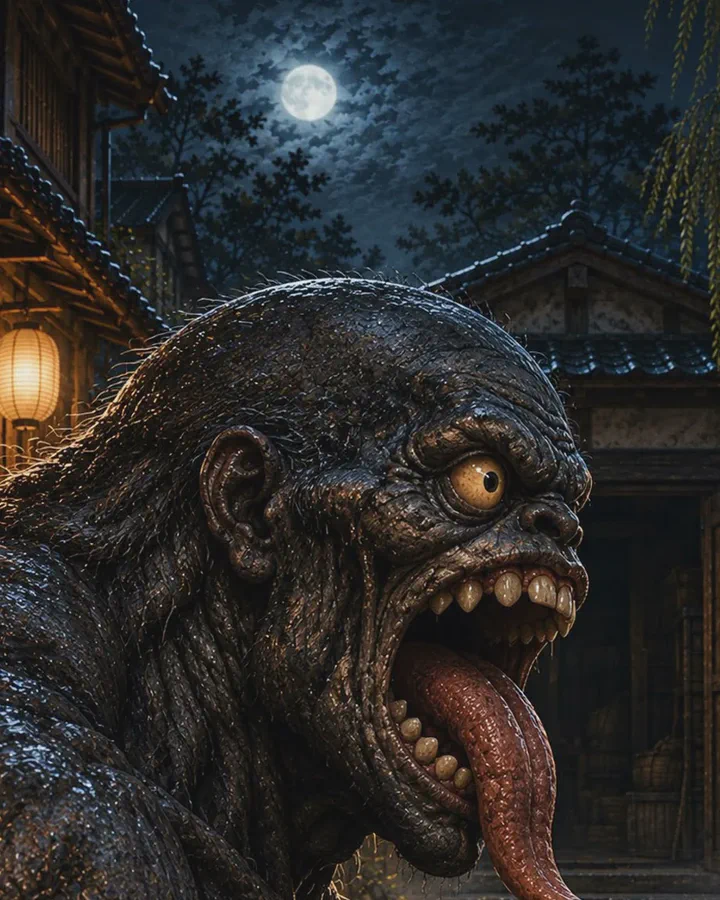
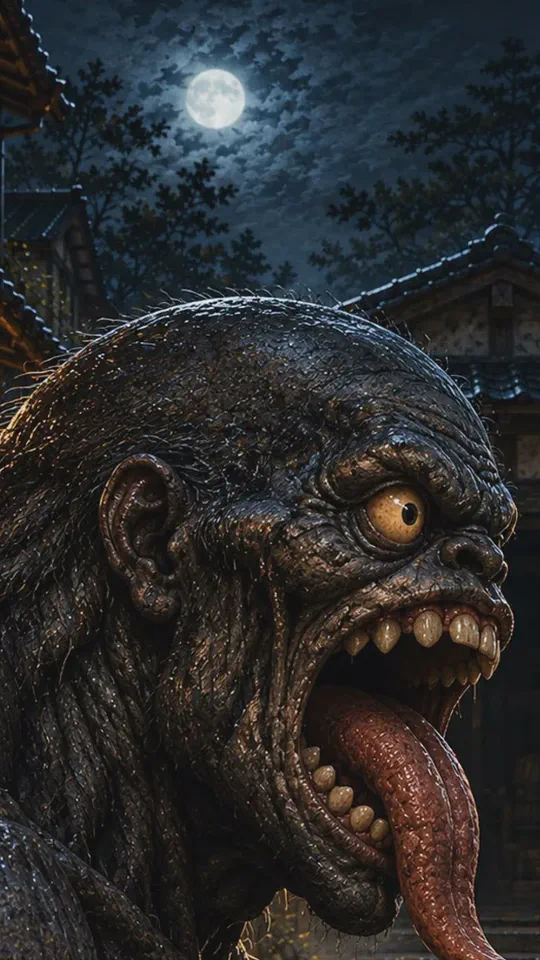
From the Kyoto scroll: black skin, yellow eyes, the mouth open, the tongue out, three clawed fingers on each hand. From the 1737 scroll and the 1776 print: blackened teeth and both hands raised. Our illustration follows the Kyoto scroll, a squat black figure with round yellow eyes and a gaping mouth, in a doorway at night, with the claws catching the light. The courtyard around it is a setting of our own; no painting puts the uwan anywhere in particular, apart from the broken wall behind Sekien’s.
Behavior and abilities
The honest list is short.
- It opens its mouth. In every picture.
- It raises its hands. In the 1737 scroll and the 1776 print.
- It has claws. Three to a hand, on the Kyoto scroll.
Everything else, the shout, the old house, the stolen life, the shout that drives it off, dates from 1972 and 1974.
Weaknesses and countermeasures
None in any painting. The rule that shouting “Uwan!” back makes it flee is from the 1972 children’s book, and the only thing it reliably does is tell you how old the story you are reading is.
Documented tradition and later imagery
Documented tradition. Pictures and nothing else: the uwan of the Hyakkai Zukan of 1737, with blackened teeth and raised hands; Sekien’s captionless print of 1776; the black, yellow-eyed, three-clawed uhan on the undated scroll by Hokusai Suechika in Kyoto; and a later uwan by Kawanabe Kyōsai in his illustrated discourse on painting.
Later imagery. The Aomori mansion and the man who could not sleep, from 1974; the shout near the old temple and the shout-back rule, from 1972; and the bronze on the Sakaiminato street that fixes them as the tradition. The pictures are stranger than the stories made from them. Three painters, over more than a century, each drew a monster with its mouth open and nothing to say, and wrote down only its name.
Sources and further reading
- Database Uhan (uwan) in the Bakemono-zukushi emaki by Hokusai Suechika, U426_nichibunken_0052_0014_0000 (external link) International Research Center for Japanese Studies, Yokai Image Database The painting and its catalogue description: a black-bodied monster with yellow eyes, its mouth open wide and its tongue out, with sharp claws on its three fingers. Consulted for research only; the illustration is an original drawing.
- Database Bakemono-zukushi emaki (化物尽絵巻) by Hokusai Suechika, U426_nichibunken_0052 (external link) International Research Center for Japanese Studies, Yokai Image Database The scroll record: twenty-two monsters, from the inugami to the nekomata, with no date given.
- Database IIIF manifest BB10004978, Bakemonozukushi emaki (external link) International Research Center for Japanese Studies Names Hokusai Suechika as the painter, gives the date as unknown, and marks the scroll public domain.
- Museum Sawaki Sūshi, Hyakkai Zukan (百怪図巻), 1737 (external link) Fukuoka City Museum A 1737 scroll of thirty named yokai, each with only its name written in; the colophon says it copies an original by Kano Motonobu. Includes Otoroshi.
- Museum Uwan from the Hyakkai Zukan (File:Suushi Uwan.jpg) (external link) Wikimedia Commons Sawaki Sūshi's 1737 painting of the uwan. Consulted for research only.
- Library Gazu Hyakki Yagyō bibliographic record (画図百鬼夜行) (external link) National Diet Library Search Bibliographic record for Sekien's 1776 picture book.
- Museum Uwan from Gazu Hyakki Yagyō (File:SekienUwan.jpg) (external link) Wikimedia Commons Sekien's 1776 print of the uwan, without caption. Consulted for research only.
- Database Uwan by Kawanabe Kyōsai, U426_nichibunken_0442_0030_0005 (external link) International Research Center for Japanese Studies, Yokai Image Database A later uwan from Kyōsai Gadan; consulted for the painter and the parent work only.
- Database Uwan (うわん) (external link) Wikipedia (Japanese) The 1737 and 1776 pictures with their blackened teeth and raised hands, the readings of the name from ohaguro and the Kyushu words wan and wan-wan, the three fingers as an oni trait, and the 1972 and 1974 stories that the yokai dictionaries list as inventions.
- Reliable secondary Yokai that lurk close to home: the bronze statues of Mizuki Shigeru Road (external link) Mizuki Shigeru Museum, Sakaiminato Statue 120, uwan, placed in Aomori as a loud voice in front of an old house with no visible body; statue 131, abura-sumashi, placed in Amakusa with the grandmother's story and a rustling in the bushes. Consulted for the later image only.
Records behind this article
Related yokai
Otoroshi
おとろし
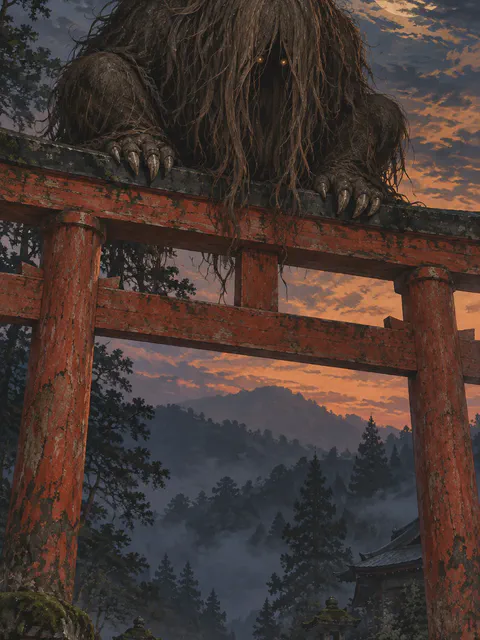
Otoroshi appears in a 1737 scroll and in Sekien's 1776 book as a hunched, hairy creature — on top of a torii in Sekien's version. Neither says what it does. The story about it dropping on the impious was read out of the picture later.
Ōkubi
大首(おおくび)
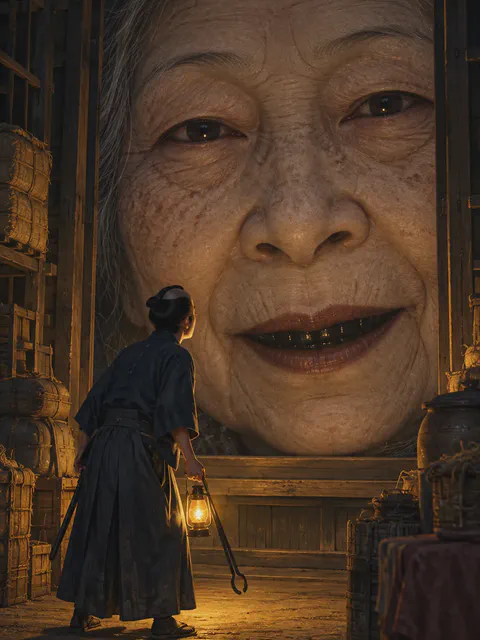
In the Inō Mononoke-roku, set in Miyoshi in 1749, sixteen-year-old Heitarō faces a month of nightly visitations. One night an old woman's face, teeth blackened, fills his doorway. He takes the fire tongs to it.


Shōkera
しょうけら
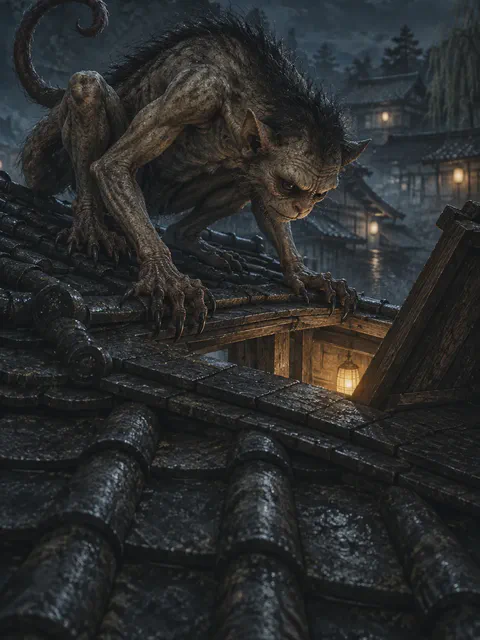
Sekien drew Shōkera in 1776 as a clawed, long-limbed figure clinging to a roof and peering in through the skylight. The plate gives a name and nothing else: no purpose, no victim, no reason it is looking.