
Ushi-oni: The Horned Face Among the Rocks
牛鬼(うしおに) Ushi-oni ASCII: Ushi-oni
Also known as: Gyūki
Pronunciation: oo-shee oh-nee
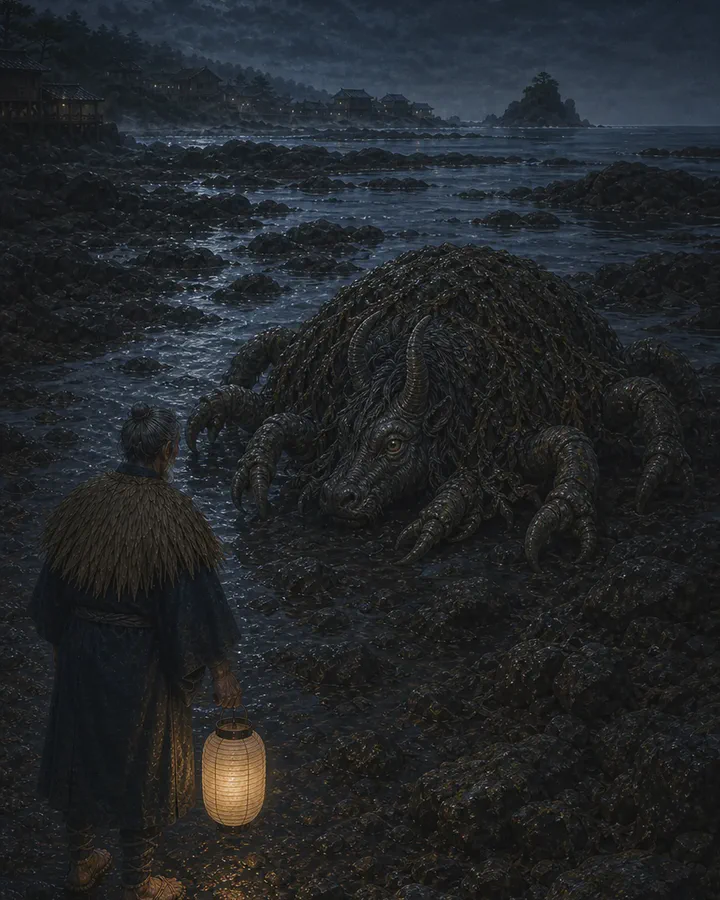
Toriyama Sekien's 1776 print shows a bull-like head on a squat clawed body at the water's edge — and tells us nothing else about it.
Quick Facts
- Habitat
- Coast, Sea
- Region
- Japan, Nanyo (southern Ehime)
- Recorded period
- Gazu Hyakki Yagyō (1776), Edo-period festival record (1784)
- Nature
- Unknown
- Danger rating
The danger rating is an editorial summary made for readability. It is not an objective measure found in folklore sources.
Watch the Short
What is Ushi-oni?
Ushi-oni — “ox demon,” also read gyūki — is one of the most striking images in Japanese yokai art and one of the least explained. The version featured here comes from Toriyama Sekien’s Gazu Hyakki Yagyō (“The Illustrated Night Parade of a Hundred Demons”) of 1776, where it appears among rocks at the water’s edge: a horned, bull-like head on a squat body ringed with thick clawed limbs.
What makes this yokai unusual is how little the source claims. Sekien’s print carries the name and nothing more. There is no encounter, no victim, no warning, and no method of escape — only a shape that could be mistaken for the rocks until it moves.
Appearance
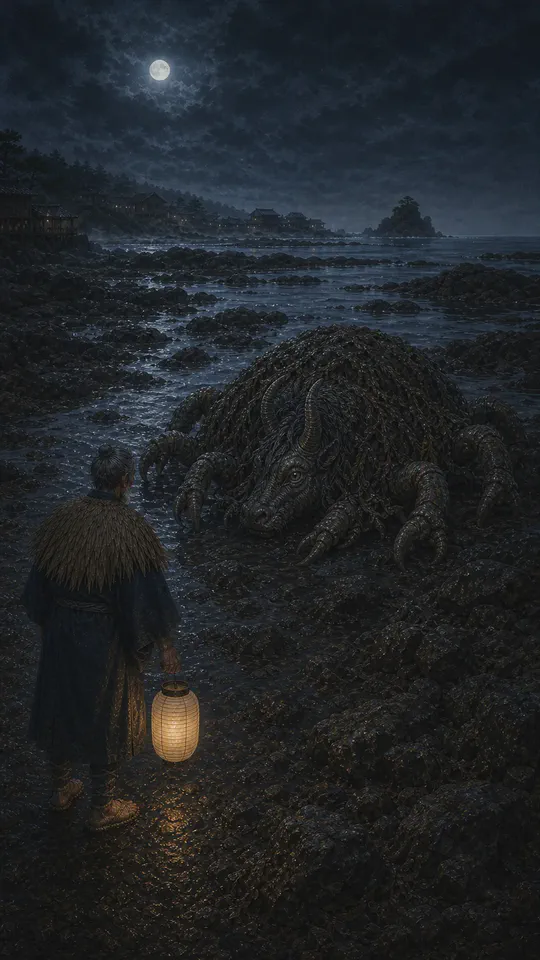
The print gives a careful, restrained anatomy: two curved horns above a bovine muzzle, round eyes, and long unkempt hair; a body that is not a bull’s at all, but low and rounded, pressed against the rock; and heavy jointed limbs ending in hooks that extend around it.
Our illustration keeps those proportions rather than inflating them. This is not a towering kaiju, a dragon, a minotaur, or a bull-headed man — the 1776 image is a compact shoreline creature, and its power comes from being almost readable as terrain.
Behavior and abilities
Honestly stated: the source shows a posture, not a behavior. What can be said from the print is that the creature is positioned among rocks at the waterline, partly concealed.
Everything beyond that — raising its head, taking a step — is our adaptation for a moving image. The powers usually attached to the name elsewhere (reversing waves, spitting poison, devouring travelers, causing sickness with a look) come from other traditions and other creatures that happen to share it.
Folklore accounts and regional variations
The word ushi-oni does not point to one creature. It is a label that several unrelated traditions carry, and conflating them is the most common error in popular accounts:
- Sekien’s shoreline creature (1776). The horned, clawed form pictured above, without narrative.
- The Nanyo festival Ushi-oni. In southern Ehime, ushi-oni names a huge festival float carried through the streets in procession, clearing and purifying the route ahead of a shrine’s portable shrine. Uwajima City dates its first documentary attestation to 1784. It is a working piece of civic ritual with a crew, a route, and a schedule — a different animal entirely from the thing on the rocks.
- The Rashōmon scroll tradition. An eighteenth-century illustrated scroll features an ushi-oni implicated in the illness of Minamoto no Yorimitsu and destroyed by his retainers — a hero narrative unrelated to the shoreline image.
One word, three traditions: a picture with no story, a festival with a job to do, and a warrior tale. Collapsing them into a single creature is how most modern accounts of the ushi-oni go wrong.
Weaknesses and countermeasures
None are recorded. Sekien’s print supplies no weakness, charm, weapon, or ritual — nothing to reach for, and nothing to say. In our short the fisherman does not fight. He registers that what he took for rock has moved, and puts distance between them, which is all the 1776 image gives anyone to work with.
Traditional folklore and later imagery
Documented tradition. A named image from 1776 — horned head, squat clawed body, shoreline rocks — with no accompanying account; plus separate regional traditions, including a documented Ehime festival float, that share the name.
Later imagery. Modern games, anime, and illustrated encyclopedias tend to merge everything into a single giant sea monster with spider legs, often paired with the Nure-onna as a hunting team and equipped with poison, tidal waves, and a body count. Those are appealing inventions built on a picture that stayed silent. The 1776 print is more unsettling for what it withholds: a face in the rocks, and no instructions.
Sources and further reading
- Primary text Ushi-oni, from Gazu Hyakki Yagyō (1776) (external link) Toriyama Sekien; Wikimedia Commons scan Sekien's print of a horned head on a squat clawed body among shoreline rocks. It carries no caption beyond the name, so it records no attack, victim, weakness or location.
- Library Gazu Hyakki Yagyō bibliographic record (画図百鬼夜行) (external link) National Diet Library Search Bibliographic record for Sekien's 1776 picture book.
- Library Hyakki Yagyō holding record (external link) Tokyo University of the Arts Library Library catalogue record for a copy of the picture book.
- Reliable secondary Autumn festival of Uwatsuhiko Shrine (external link) Uwajima City, Ehime Describes the Ushi-oni festival float that clears the way ahead of a shrine procession, first attested in 1784. A separate tradition from Sekien's shoreline creature.
- Museum Rashōmon Emaki cultural property record (external link) Agency for Cultural Affairs heritage database An eighteenth-century scroll with a different Ushi-oni narrative involving Minamoto no Yorimitsu.
Related yokai
Umi-bōzu
海坊主(うみぼうず)
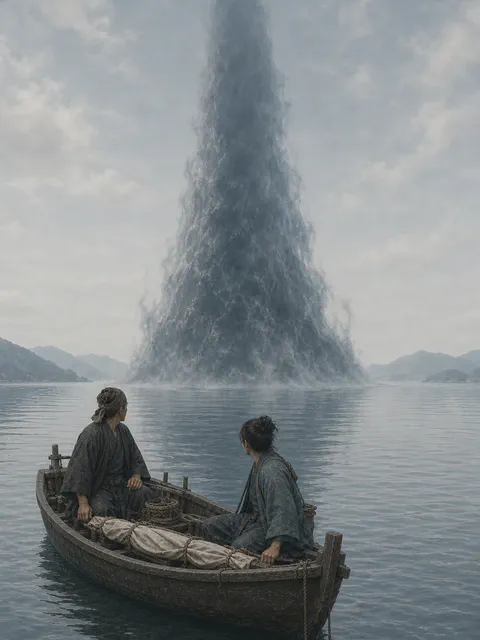
One account describes a vast Buddha-like shape crossing ahead of a boat on a clear, windless day, then slowly thinning until it vanished.

Nue
鵺(ぬえ)
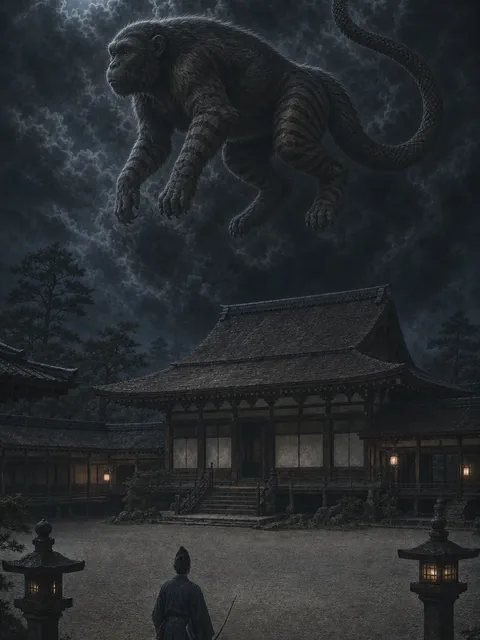
In The Tale of the Heike, a black cloud and a bird's cry sicken the emperor until an archer shoots the creature down — and the versions disagree on what fell.