
Umi-bōzu: The Thirty-Meter Shadow on a Calm Sea
海坊主(うみぼうず) Umi-bōzu ASCII: Umi-bozu
Pronunciation: oo-mee BOH-zoo
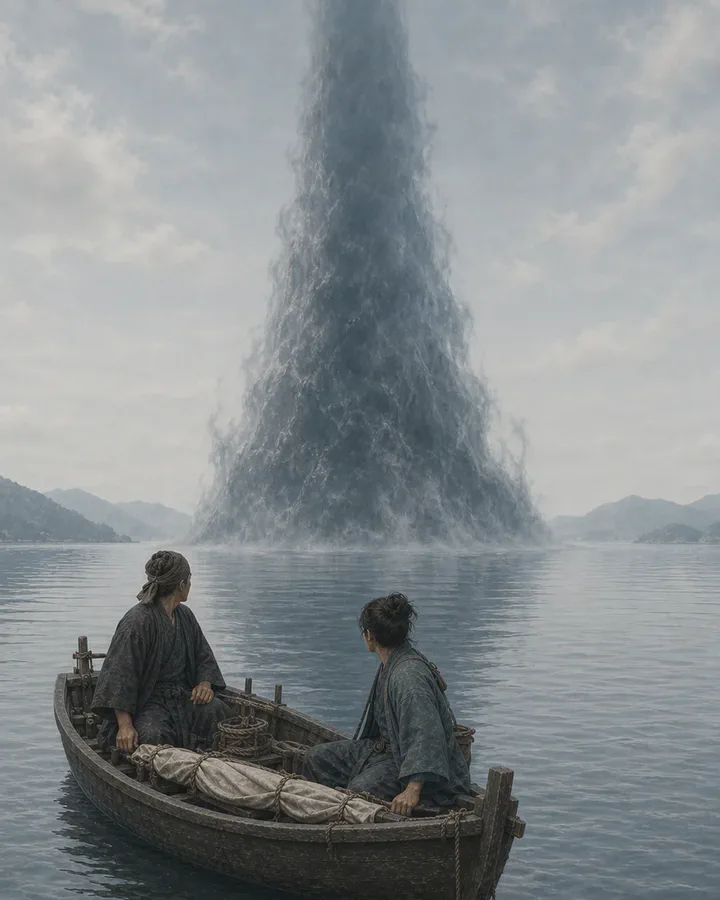
One account describes a vast Buddha-like shape crossing ahead of a boat on a clear, windless day, then slowly thinning until it vanished.
Quick Facts
- Habitat
- Sea, Ship, Coast
- Region
- Awa-Tosa waters, Suō-Ōshima, Tsushima
- Recorded period
- early modern textual account, 1930 folklore record, 20th-century folklore collection
- Nature
- Mixed
- Danger rating
The danger rating is an editorial summary made for readability. It is not an objective measure found in folklore sources.
Watch the Short
What is Umi-bōzu?
Umi-bōzu literally combines the sea with a word for a Buddhist priest. The name is applied to strange beings and apparitions encountered on the water, but the surviving accounts do not describe one species with one body, one behavior and one reliable defense.
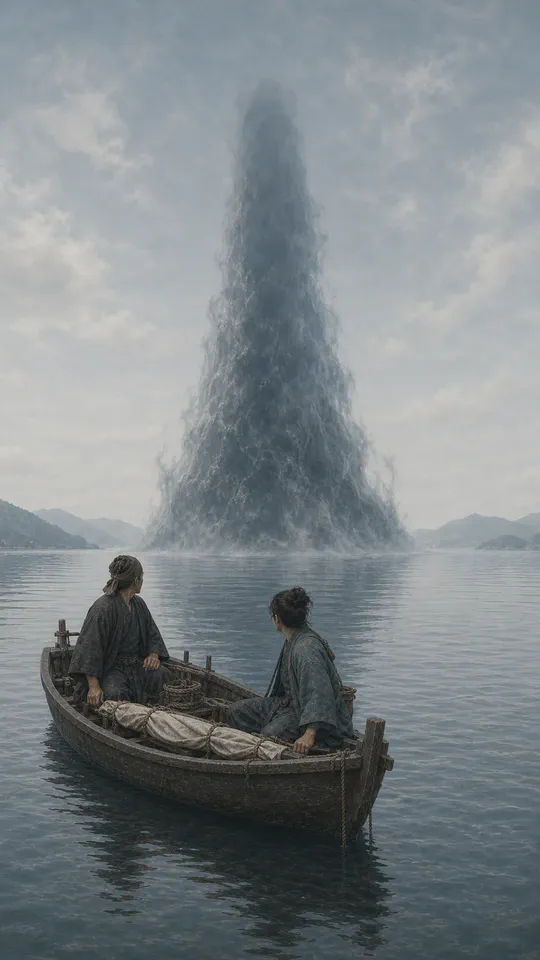
The episode featured here comes from waters near the boundary of Awa and Tosa, on the Pacific side of Shikoku. A vast shape appeared several hundred meters ahead of a boat. It was said to be about ten jō high—roughly thirty meters—and compared to a great Buddha, narrow above and widening below. Its head was not clearly visible.
Most strikingly, the sea was not in a violent storm. The boatman associated the rare apparition with clear, windless conditions. The form crossed ahead, gradually became thinner and disappeared. The contradiction between enormous scale and perfect calm is the source of the encounter’s unease.
Appearance
The Awa-Tosa account gives a silhouette rather than detailed anatomy. The form is very large, narrow toward the top, broad below and reminiscent of a Buddhist statue. It does not provide eyes, a mouth, arms, skin, clothing or even a clearly defined head.
That description differs from the smooth black head that dominates many modern depictions. Historical illustration also contributed distinct images to the name, while local oral accounts could describe something more humanlike. The single-eyed man of one record is a different encounter altogether, not the hidden face of the shapeless Awa-Tosa form.
Our visual interpretation uses dark seawater, mist and reflected sky to suggest the recorded outline without inventing fixed anatomy. This is an editorial choice, not a claim that the source explains the figure as a column made of water.
Behavior and abilities
In the calm-sea sighting, the Umi-bōzu passes across the boat’s route at a distance and fades. No attack, demand, storm or shipwreck is described. The boatman recognizes it and explains that it appears only rarely under those quiet conditions.
Other records preserve very different behavior. In a story from Suō-Ōshima, a single-eyed man attempts to board a boat and asks the boatman what he fears most. Material from Tsushima describes an Umi-bōzu asking for an akatori, a tool used to remove water from a boat, and using it to put seawater into the vessel.
These stories share a maritime setting and a name, and little else. Run them together and you get a sequence no source describes: a thirty-meter water figure that becomes a one-eyed passenger, requests a bucket and attacks. Keeping the accounts apart shows how maritime communities gave different forms to danger, uncertainty and unexplained sights at sea.
Folklore accounts and regional variation
The Awa-Tosa description appears in an early modern textual chain preserved through later quotation. It records what the sailors saw and the boatman’s identification, while leaving the physical nature of the apparition unresolved.
The Suō-Ōshima and Tsushima entries come from separate twentieth-century folklore records. They demonstrate variation rather than supplying missing chapters of the same story. One is organized around a disturbing question from a strange man; the other around a familiar piece of equipment being turned against the boat.
Maritime folklore often travels with sailors, trade and fishing, so similar names may gather multiple hazards and experiences. Distance, haze, reflected light, sudden weather and fear of taking on water can all shape such accounts, but identifying a possible natural influence does not erase the cultural meaning of the stories.
Weaknesses and countermeasures
The calm-sea Awa-Tosa account gives no countermeasure. The figure is not defeated; it simply becomes faint and disappears. The crew’s response is observation and recognition rather than combat.
Advice involving a bottomless ladle is often repeated in discussions of Japanese sea spirits and ship ghosts, but it answers a request that the Awa-Tosa apparition never makes. Even the Tsushima story involving an akatori has its own wording and context. A defense documented for one maritime tradition does not become a universal biological weakness.
Traditional folklore and later imagery
Documented variation. One account describes a roughly thirty-meter, Buddha-like form crossing the calm sea and fading. Separate records describe a single-eyed man or an apparition that requests a water-removal tool. The sources do not establish one appearance or behavior shared by all three.
Later imagery. Modern art commonly gives Umi-bōzu an enormous round black head, glowing eyes, arms, tentacles and the power to summon storms or crush ships. These features create an effective sea monster but can hide the strangeness of a source in which the day is clear, the water is still and an indistinct form simply passes. Our short focuses on that quiet sighting and treats its unresolved outline as the essential image.
Sources and further reading
- Historical text Giant Umi-bōzu sighting between Awa and Tosa, record 3360009 (external link) International Research Center for Japanese Studies Describes an enormous Buddha-like form crossing ahead of a boat in clear, windless conditions and gradually disappearing.
- Fieldwork collection Umi-bōzu account from Suō-Ōshima, record 1230086 (external link) International Research Center for Japanese Studies A separate regional account involving a single-eyed man attempting to board a boat.
- Fieldwork collection Umi-bōzu and the akatori in Tsushima, record 2390020 (external link) International Research Center for Japanese Studies A Tsushima account involving a water-removal tool; keep distinct from the calm-sea Awa-Tosa sighting.
- Museum Historical image catalogued as Umi-bōzu (external link) International Research Center for Japanese Studies Catalogue record illustrating one historical visual treatment of Umi-bōzu.
- Library The World of Yokai through Toriyama Sekien's Yokai Encyclopedias (external link) National Diet Library Image Bank Surveys rokurokubi images by multiple artists, including female and male examples.
Related yokai
Kappa
河童(かっぱ)
A child-sized water yokai whose strength lives in the water held by the dish on its head.
Ittan-momen
一反木綿(いったんもめん)
A white bolt of cloth that flutters across a rural night road, dazzles a traveler and attacks.