
Tsuchigumo: One Word, Two Very Different Histories
土蜘蛛(つちぐも) Tsuchigumo ASCII: Tsuchigumo
Pronunciation: tsoo-chee-GOO-moh
A monk appears at a sick warlord's bedside and throws spider silk at him. That is the tale. But the same word, centuries earlier, was what the court called people it wanted to treat as outsiders.
Quick Facts
- Habitat
- House, Mountain
- Region
- the capital, in the Yorimitsu tales
- Recorded period
- ancient chronicles for the older meaning, medieval tales and nō for the spider
- Nature
- Harmful
- Danger rating
The danger rating is an editorial summary made for readability. It is not an objective measure found in folklore sources.
Watch the Short
What is Tsuchigumo?
There are two answers and they have almost nothing to do with each other. Take the famous one first.
Minamoto no Yorimitsu is ill and confined to his bed. A monk comes to see him — a monk nobody quite recognises, arriving at a strange hour. At some point the visitor stops being a visitor and throws threads of spider silk at the man in the bed.
Yorimitsu drives him off. In the morning his retainers follow what was left behind: the trail, the silk, the damage. It leads them out of the city and to the thing itself, and they kill it.
The story appears in the Tsuchigumo Zōshi, in the Sword Chapter, and in nō, and the three differ on names, places and details. What they share is the shape: sickbed, monk, silk, pursuit.
Appearance
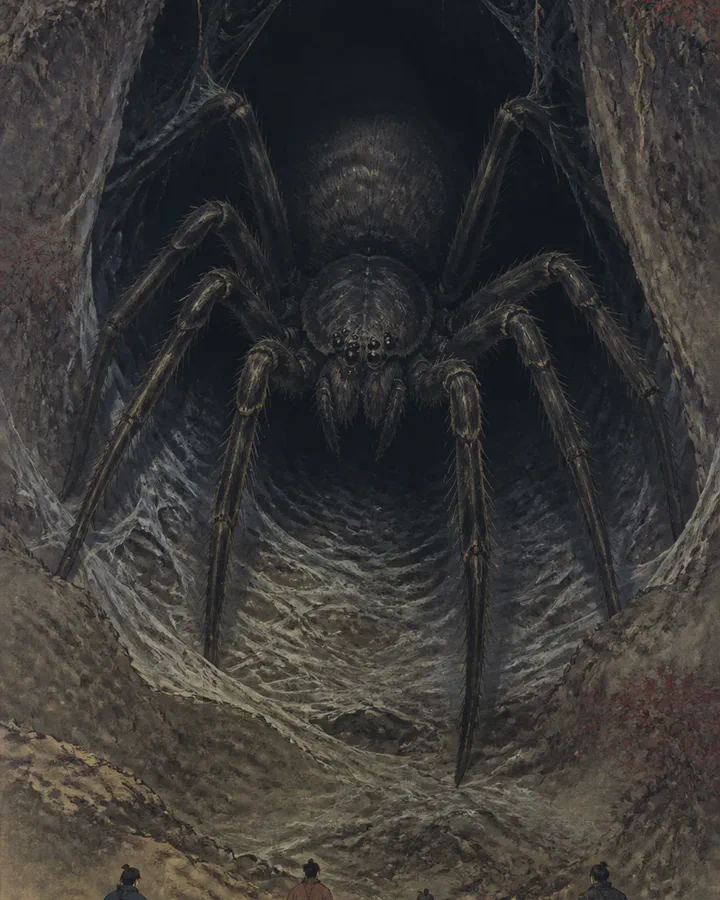
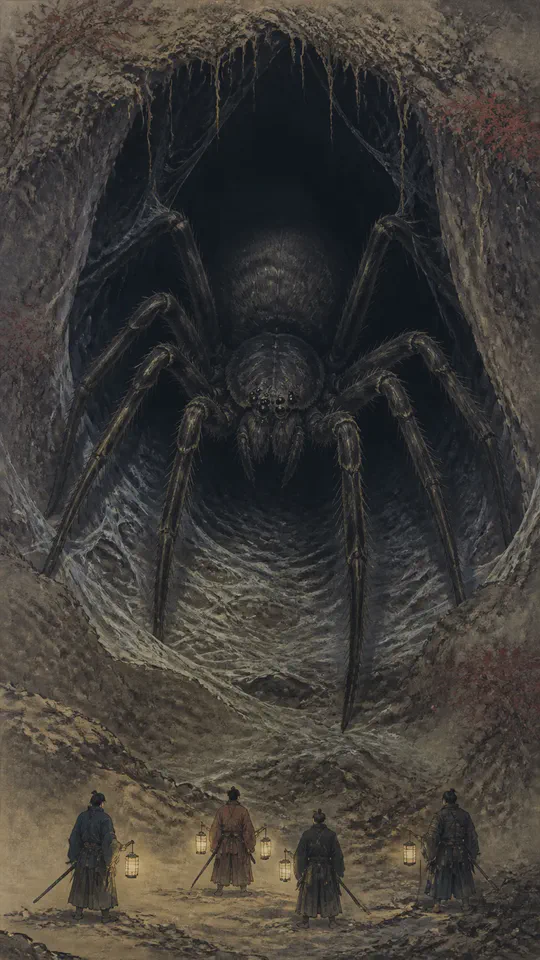
Our illustration takes the moment before the disguise fails: the room, the man on the bed, and something very large behind him that the room is not big enough for.
The spider is an original design rather than a copy of a particular old painting. The tale is medieval and the images of it are many, and none of them is the authoritative one.
Behavior and abilities
- It disguises itself. The monk is the whole first act, and the disguise is good enough to get through the door.
- It attacks the weak. Yorimitsu is chosen while ill in bed, not met in the field.
- It throws silk. The weapon is entanglement rather than force.
- It leaves a trail. Which is what ends it.
The older word
Now the other answer, and it is the reason this entry needs care.
In the ancient chronicles and the provincial gazetteers, tsuchigumo is not a spider at all. It is a label the Yamato court applied to regional groups it treated as outsiders — people who did not submit, described from the outside by the side that was writing.
That is a political vocabulary, not a bestiary. Reading those passages as records of monsters gets the history exactly backwards, and reproducing the court’s framing as though it described what those people were like would be repeating the original move rather than reporting it.
The two meanings are related only by inheritance. A word used to mark people as other was available centuries later when a story needed a name for a monster, and it got reused. Nothing in the older material describes a giant spider, and nothing in the medieval tale is about the groups the chronicles named.
Weaknesses and countermeasures
The disguise is the creature’s only real advantage, and it is spent in the first scene.
After that the tale is a manhunt. The retainers do not need a charm, a blessed weapon, or special knowledge — they need to follow the trail, and there is one to follow. Nothing about the creature is elusive once it stops pretending to be a monk.
For something that gets to a sleeping man’s bedside undetected, it turns out to be remarkably easy to find afterwards.
Documented tales and later imagery
Documented tales. The medieval material — the Tsuchigumo Zōshi, the Sword Chapter, the nō play — in which a monk visits the bedridden Minamoto no Yorimitsu, throws spider silk, is driven off, and is tracked to its lair by his retainers, with names, places and details varying between versions. Separately and much earlier, tsuchigumo as a term in the chronicles for regional groups the court cast as outsiders.
Later imagery. The Edo print-makers had a great deal of fun with the sickroom, and the giant spider looming over Yorimitsu’s bed is now the fixed image of the story. It is a good image. What tends to go missing beside it is that the same word carries a second history, in which nobody was a spider and the monsters were a matter of who was holding the brush.
Sources and further reading
- Museum Nishiki-e: Minamoto no Yorimitsu's mansion and the earth spider National Museum of Japanese History Later imagery of the sickbed, the spider disguised as a monk, and the cords of silk.
- Museum Fukutomi Zōshi and otogi-zōshi picture scrolls Kyoto National Museum Exhibition context for Tsuchigumo Zōshi as a tale of Yorimitsu and his four retainers.
- Database What does 'Tsuchigumo' refer to? Collaborative Reference Database, National Diet Library Establishes that in the ancient sources the word names regional groups the Yamato court treated as outsiders, not a giant spider.
Related yokai
Jorōgumo
絡新婦(じょろうぐも)
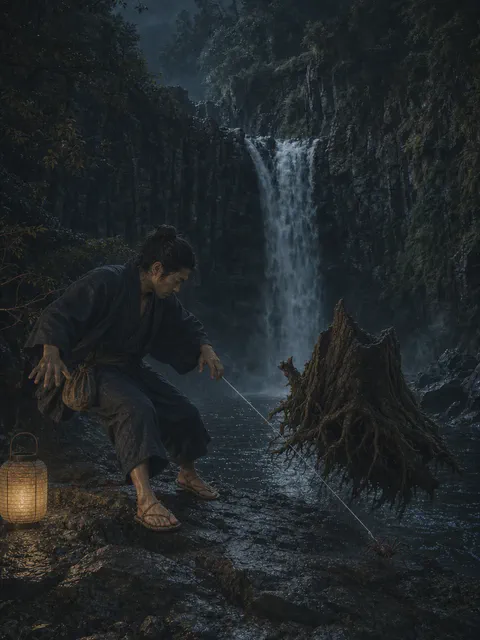
At a waterfall in Shizuoka, a spider winds one fine thread around a man's foot—and reveals enough strength to tear a mulberry stump from the earth.
Ōmukade
大百足(おおむかで)
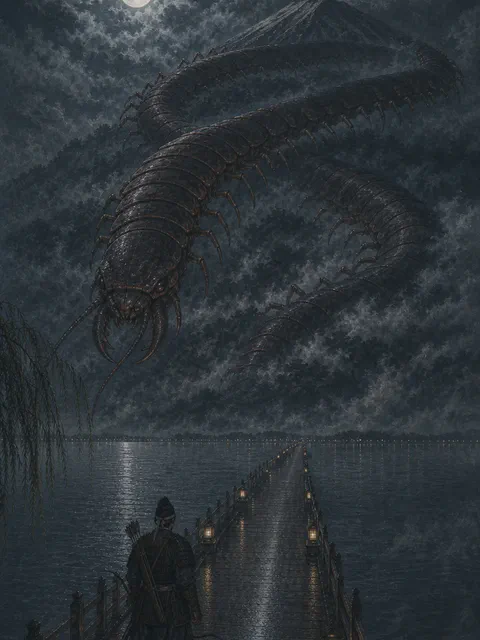
A warrior who walked over a serpent lying across the Long Bridge of Seta was asked by the dragon clan for help — because a centipede large enough to wrap a mountain was killing them, and they could not stop it themselves.