
Tōfu-kozō (豆腐小僧): The Shy Little Yokai Who Carries Tofu
Edo's timid tofu boy, from the comic picture books of the 1780s
豆腐小僧(とうふこぞう) Tofu-kozō ASCII: Tofu-kozo
Also known as: Tōfu-kozō, Tofu boy
Pronunciation: TOH-foo KOH-zoh
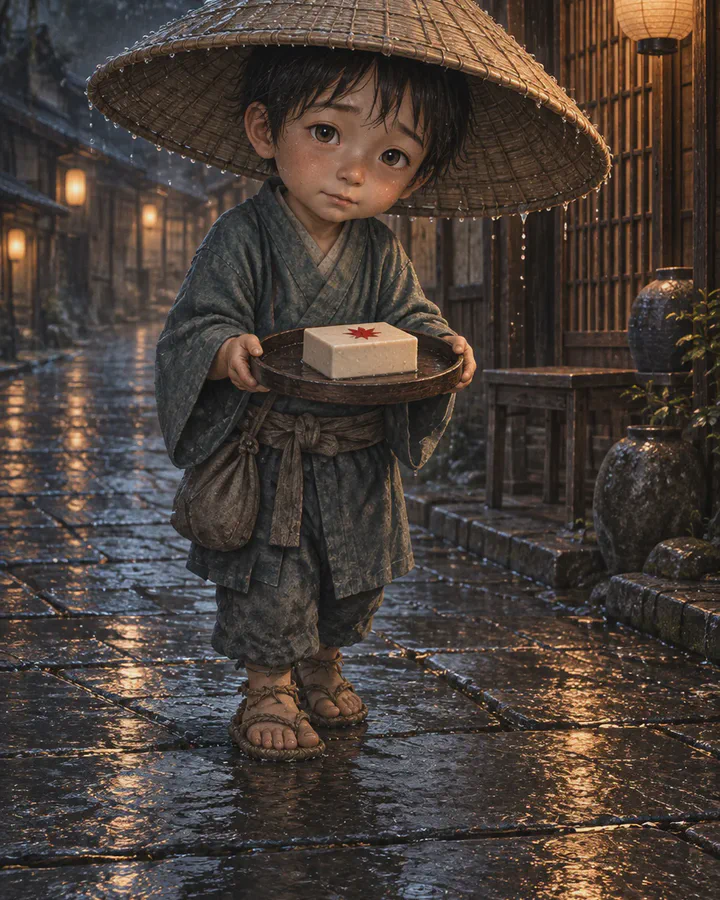
Tōfu-kozō (豆腐小僧, “tofu boy”) is a small child under a large hat, with an oversized head, carrying a tray with a block of tofu stamped with a maple leaf. He comes not from village legend but from the kibyōshi, the comic picture books of Edo, where he appears from 1779. He follows people along the road at dusk and does nothing worse; in one of Santō Kyōden’s books he runs away from a human and drops his tofu. He may be the least dangerous yokai in Japan.
Quick Facts
- Habitat
- Street
- Region
- Edo
- Recorded period
- kibyōshi from 1779
- Nature
- Neutral
- Danger rating
The danger rating is an editorial summary made for readability. It is not an objective measure found in folklore sources.
Watch the Short
What is Tōfu-kozō?
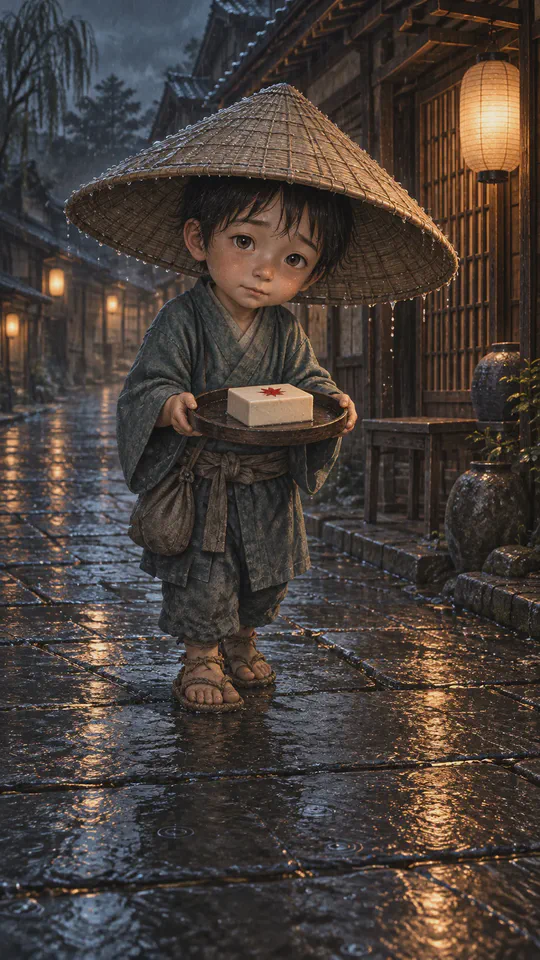
It is dusk, and raining, on a street in Edo, and a small boy is standing in the wet under a hat far too big for him. His head is too big as well. In both hands he holds a round tray, and on the tray is a block of fresh tofu with a red maple leaf pressed into the top of it. He follows you a little way down the street. He does nothing else.
That is the tōfu-kozō, and he comes out of books rather than out of the dark. His earliest known appearance is the Bakemono Shinai Hyōbanki of 1779, a comic kibyōshi — one of the cheap illustrated satirical booklets that Edo read for fun — and he turns up again and again in the kibyōshi of the following decades, usually as the butt of the joke.
What does tōfu-kozō mean?
The name is written 豆腐小僧: tōfu, bean curd, and kozō, a young boy — an apprentice, an errand boy, a temple novice. The tofu boy. It is pronounced TOH-foo KOH-zoh. In Kitao Masayoshi’s Bakemono Chakutōchō of 1788 a very similar figure is labelled simply “big-headed boy,” and he was sometimes confused with the one-eyed boy, the hitotsume-kozō. The name settled with the tofu.
Appearance
A child of about five, a very large head under a very large hat, a tray, and tofu with a maple-leaf stamp. He stands in the rain at dusk, holding his tofu and doing little else. Our illustration follows that scene and gives him two eyes, to keep him apart from the one-eyed boy. The big head is a drawing convention of the comic books, and nothing more.
Behavior and abilities
- He follows you. At a distance, on the road, at dusk.
- He carries tofu. Carefully.
- He is easily scared. In at least one book, by you.
A timid yokai
The tōfu-kozō’s defining quality is that he is not frightening. He is weak and comic: bullied by the other yokai in one book; in Santō Kyōden’s Bakemono Tsurezuregusa, running away from a human and dropping his precious tofu in the road; and in a picture book about yokai who give up haunting and take honest jobs, settling down as a tofu seller. He belongs with the karakasa-kozō and the chōchin-obake among the small comic monsters that Edo drew to be laughed at.
Weaknesses and countermeasures
None are needed. If anything, the human is the danger in his stories.
Documented figure and later imagery
Documented figure. Comic picture books from 1779 on: a big-headed child in a large hat carrying maple-stamped tofu, who follows people, does no harm, and in one Kyōden book drops his tofu fleeing a human.
Later imagery. Some modern books give the tōfu-kozō a darker side — tofu that grows mould on anyone who eats it, or a sinister errand on behalf of greater monsters. Those are not in the Edo descriptions. He may be the gentlest yokai on the shelf: a small boy in the rain, trying not to drop his tofu, more frightened of you than you could ever be of him.
Sources and further reading
- Library "Soybeans" exhibition, chapter 2: Tofu-kozō (external link) National Diet Library Earliest appearance in a 1779 kibyōshi; big hat, big head, maple-marked tofu on a tray; timid and comic; drops the tofu fleeing humans in a Kyōden book.
- Museum "Tofu-kozō appears!" (2011) (external link) Edo-Tokyo Museum A boy standing in the rainy evening holding tofu, and his spread through kibyōshi.
Where it was recorded
- 1779
Edo, Tokyo
Print or picture
Tofu boy of the kibyōshi comic books
Places named in the records behind this article. Coordinates are approximate. View on the map
On the timeline
In the glossary
In manga
- GeGeGe no Kitarō ゲゲゲの鬼太郎 Keeps the traditional forms, invents the stories
Related yokai
Karakasa-kozō
唐傘小僧(からかさこぞう)
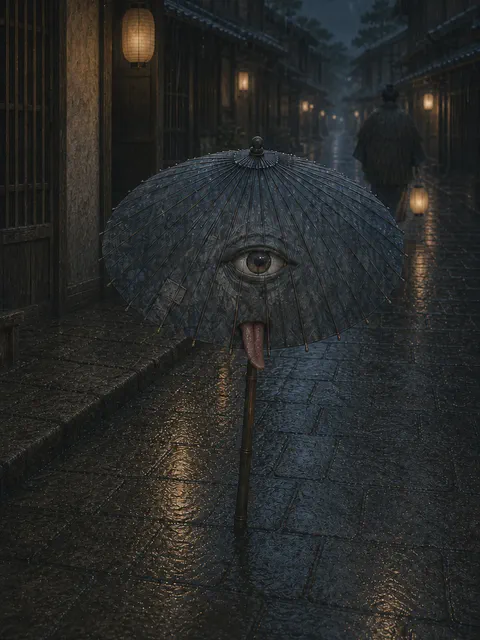
An 1857 Osaka print shows a kabuki actor playing a one-legged umbrella monster — the clearest history of a yokai known through pictures rather than encounters.
Chōchin-obake
提灯お化け(ちょうちんおばけ)
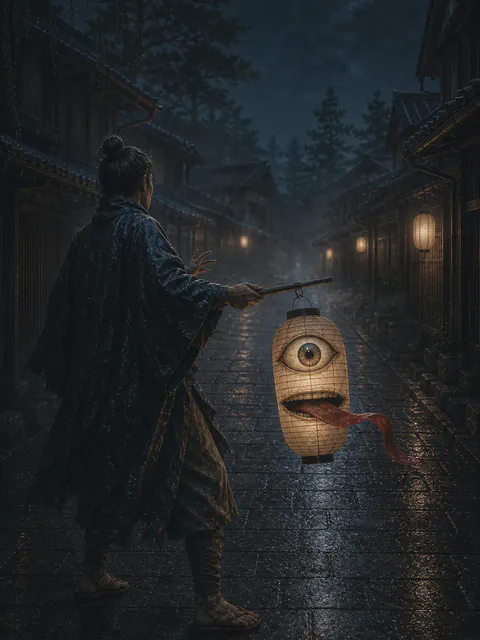
One of forty-eight monsters on Yoshimori's print Shinban Bakemono-zukushi is a paper lantern with an eye, a mouth, and something coming out of the mouth. That picture is the record — there is no story attached to it.
Azuki-arai
小豆洗い(あずきあらい)
A bean-washing sound repeats beside a dark stream, but the person making it cannot be found.