
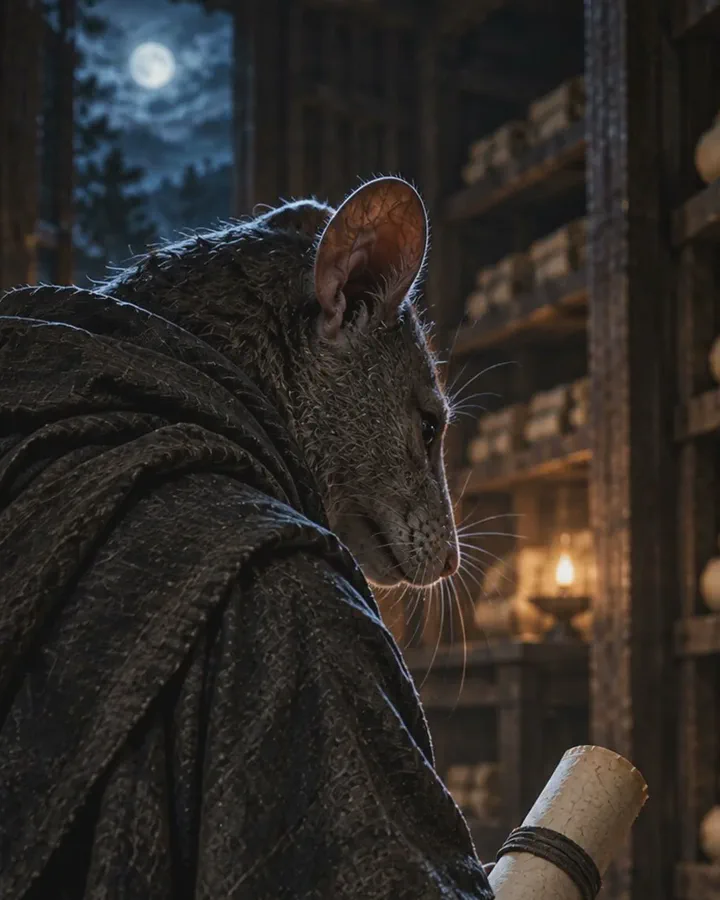
Tesso (鉄鼠, Raigō-nezumi): The Monk Whose Grudge Became Rats
The Mii-dera monk Raigō, the ordination platform he was refused, and the rats that climbed Mount Hiei to gnaw the sutras: one legend told two ways, and a name it was given in 1776
鉄鼠(てっそ) Tesso ASCII: Tesso
Also known as: Raigō-nezumi, Mii-dera-nezumi
Pronunciation: tes-soh
Tesso (鉄鼠), the “iron rat”, is the form taken after death by Raigō, a monk of Mii-dera in Ōtsu, in a legend of the two great Tendai temples above Lake Biwa. Raigō prays an heir into being for Emperor Shirakawa and asks in return for an ordination platform for his temple; Enryaku-ji on Mount Hiei objects, and the platform is refused. In the Taiheiki his ghost becomes eighty-four thousand rats with iron teeth and bodies of stone that climb the mountain and gnaw its images and sutras. The name Tesso is younger than the story: it comes from Toriyama Sekien’s picture book of 1776.
Quick Facts
- Habitat
- Temple or shrine, Mountain
- Region
- Japan, Shiga (Mii-dera and Mount Hiei in Ōtsu), Tochigi (Oyama)
- Recorded period
- Heike monogatari, Taiheiki, Gazu Hyakki Yagyō (1776), Edo-period novels and Meiji prints
- Nature
- Harmful
- Danger rating
- If you meet one
- Honour the dead monk as the god of a small shrine, the nezumi no hokura, and his grudge is quieted. In the article
The danger rating is an editorial summary made for readability. It is not an objective measure found in folklore sources.
Watch the Short
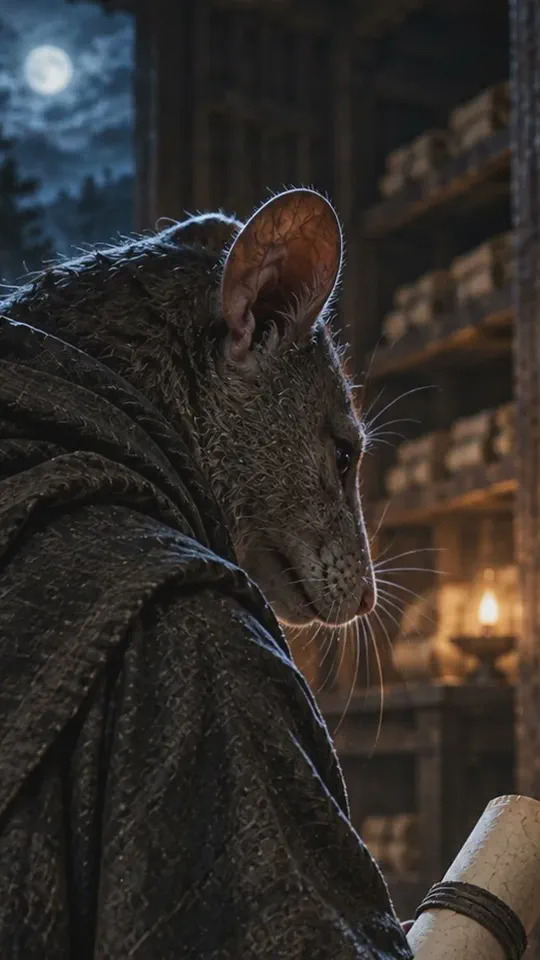
Who is Tesso?
Emperor Shirakawa has no son. He sends for Raigō, a monk of Mii-dera known for prayers that work, and Raigō prays, and a prince is born. Asked to name his reward, the monk sets rank and stipend aside and asks for one thing: leave for his temple to build an ordination platform, the place where monks formally receive the precepts. Mii-dera had none. The platform stood at Enryaku-ji on Mount Hiei, the other great house of the same Tendai school, further north above the same shore of Lake Biwa.
The request was for the temple and not for Raigō, and it was the one thing Mount Hiei would not let pass. What follows depends on who tells it. In both of the great medieval tellings the platform is lost, Raigō dies, and the young prince dies soon after. In one of them, that is the end. In the other, the dead monk comes back as rats.
What does tesso mean?
The characters are 鉄, iron, and 鼠, rat. The name appears in 1776, in Toriyama Sekien’s picture book of the night parade of a hundred demons, over a caption that says only that Raigō’s spirit turned into a rat, as all the world knows. Sekien was naming something already famous. Longer versions of the Heike monogatari say that a large rat came to be called a Raigō-nezumi, a Raigō rat, and a book of comic verse on a hundred ghost stories calls it the Mii-dera-nezumi after the temple. The iron in Sekien’s title has an older home as well: the rats of the Taiheiki have teeth of iron.
The tale without rats, and the tale with them
The Heike monogatari tells the story in its third book, in a chapter that bears Raigō’s name. Here the emperor promises in advance that if the prayer is answered the reward will be whatever Raigō asks. Raigō prays for a hundred days, and the prince is born in 1074. When the monk names the platform, the emperor answers that this he had not expected: to grant it would set the two temples at war and bring the Tendai teaching down. Raigō goes home to Mii-dera and stops eating. The emperor sends Ōe no Masafusa, who is bound to the monk as patron to teacher, to reason with him, but Raigō will not come out of his chapel; the prince he prayed into the world, he says, he will take with him. He dies. The child sickens, a white-haired old monk with a staff is seen at his pillow in dreams, and in 1077 Prince Atsufumi dies, four years old. The emperor then turns to a monk of Mount Hiei, whose hundred days of prayer bring the prince who will reign as Emperor Horikawa. No rat appears anywhere in the chapter.
The Taiheiki tells it in its fifteenth book, in a passage that counts seven burnings of Mii-dera over the platform. There is no promise beforehand. The emperor grants the platform, Mount Hiei sends up a petition and halts the lectures in every valley of the mountain, and the grant is recalled. Raigō lets his hair and nails grow, sits in the smoke of his fire altar, and dies on it within twenty-one days; the prince dies while still on his mother’s knee. Then the ghost becomes “eighty-four thousand rats with teeth of iron and bodies of stone”, climbs Mount Hiei, and gnaws through the Buddhist images and the sutras. Nothing the mountain does stops them.
Between the two stand the longer versions of the Heike, in which the grudge takes the body of one great rat that eats the scriptures of Enryaku-ji. A single huge rat and a swarm of eighty-four thousand are different creatures, and the legend has never chosen between them.
The monk in the record
Raigō was a real person. He was born in 1002, or 1004 by another reckoning, a son of Fujiwara no Arie, governor of Iga; he trained at Mii-dera, later lived at the Jissō-bō, and was known for the effect of his rites. Mii-dera’s petition for a platform and Enryaku-ji’s resistance to it are also history, one episode in a long quarrel between the two houses of the Tendai school.
The dates will not carry the rest. Prince Atsufumi died in 1077, in a year when smallpox was going round. Raigō died in 1084, seven years after the child whose death the tale lays at his door. The legend took two true things, a refused platform and a prince who died young, and tied them together with a ghost.
Appearance
The Taiheiki gives iron teeth, stone bodies and a number. The longer Heike versions give one rat of great size. Sekien’s page of 1776 gives the name. A picture book of monsters shows Raigō’s spirit, as the tesso, stealing into a sutra repository to gnaw the scriptures, with several black rats around it, and Yoshitoshi’s print shows a giant rat in a priest’s robes among other rats, chewing at books and scrolls. The iron of the name is in the teeth.
Our illustration follows the picture-book reading: a rat-faced spirit in a monk’s robe among dark rats in a sutra repository, with rolled scrolls on the shelves. The temple is an imagined mountain temple, not Enryaku-ji or Mii-dera, and the figure is no portrait of the historical monk.
Behavior and abilities
- It returns. As one great rat in the longer Heike versions, as eighty-four thousand in the Taiheiki.
- It climbs Mount Hiei. The target is the temple that blocked the platform, and nothing else.
- It gnaws. Sutra scrolls in every version, and Buddhist images too in the Taiheiki.
- It cannot be driven off. The Taiheiki says plainly that the mountain had no means of stopping it.
Weaknesses and countermeasures
Force fails, so the mountain changes its answer. In the Taiheiki the monks of Mount Hiei make Raigō the god of a shrine and so quiet his grudge: “this is the nezumi no hokura”, the rat shrine. A small shrine called the Nezumi-sha is counted among the subsidiary shrines of Hiyoshi Taisha at Sakamoto, below the mountain on the lake side. One tradition says the rat was sealed there; an old shrine record explains it instead as the shrine of the Rat, first of the twelve zodiac animals. A further story at Sakamoto has a great cat destroy the rat, and a Neko no Miya, a cat shrine, set looking toward Mii-dera.
Mii-dera has its own. Beside the stone steps that climb to the Kannon hall stands the Jūhachi Myōjin, properly a guardian of the precinct, which people call Nezumi no Miya-san, the rat shrine. It is said to face north, toward Mount Hiei, because it keeps the spirits of the rats. And far to the east, at Oyama in Tochigi, the swarm is said to have been stopped by Shōgun Jizō and shut in a mound, the Atago-zuka; a stone taken from the mound and set in a field keeps rats off the crop.
Documented tradition and later imagery
Documented tradition. The refused platform, the fast and the prince’s death in the third book of the Heike monogatari, with no rat; the single great rat and the name Raigō-nezumi in the longer Heike texts; the eighty-four thousand rats with iron teeth and the shrine that quieted them in the fifteenth book of the Taiheiki; the Nezumi no Miya at Mii-dera, the Nezumi-sha at Sakamoto and the mound at Oyama; and Sekien’s page of 1776, which gave the whole a two-character name.
Later imagery. In 1808 Kyokutei Bakin made the legend the engine of an adventure novel illustrated by Hokusai, in which Raigō’s spirit appears in a dream to Yoshitaka, the son of Kiso no Yoshinaka, and teaches him the magic of rats; in the fourth volume Hokusai draws a giant rat rising in front of the hero’s enemy, and the book went onto the kabuki and puppet stages. Yoshitoshi put the robed rat into his last series of prints, published between 1889 and 1892, and a mystery novel of the Heisei era carried the name Tesso to readers who had never heard of Raigō. Mii-dera now holds yokai nights in its own grounds. The old chapter is plainer than any of these. An emperor gives his word, a temple asks for the one thing that cannot be given, and the answer comes back on small feet, through the paper.
Sources and further reading
- Reliable secondary Nezumi no Miya and Raigō Ajari (ねずみの宮と頼豪阿闍梨), temple legends (external link) Mii-dera (Onjō-ji) The temple's own telling: the Jūhachi Myōjin beside the steps to the Kannon hall is properly a guardian of the precinct and is popularly called Nezumi no Miya-san; Raigō's prayer, the platform granted and recalled, the twenty-one days at the fire altar, the eighty-four thousand rats as the Taiheiki tells it, and the shrine said to face north toward Mount Hiei because it keeps the spirits of the rats. The page's wording about Mount Hiei's protest is the temple's and is not carried into the article. The server's certificate fails verification over https; the page was read over http.
- Primary text Taiheiki, book 15, "The ordination platform of Onjō-ji" (太平記 巻第十五 園城寺戒壇事) (external link) Wikisource (Japanese) Text of the Taiheiki version: Raigō (called sōzu) asks only for the platform after the birth, setting rank and stipend aside; the grant is made, Mount Hiei petitions and halts its lectures, and the grant is recalled; he dies on the altar within twenty-one days; the prince (unnamed) dies on his mother's knee; the ghost becomes eighty-four thousand rats with iron teeth and stone bodies that gnaw images and sutras; the mountain makes him the god of a shrine, the nezumi no hokura; Mii-dera burned seven times over the platform. No promise in advance.
- Primary text Heike monogatari, book 3, "Raigō" (平家物語 巻第三 頼豪): text, modern translation and notes (external link) Sadaijin Project (roudokus.com) Text of the Heike chapter: the reward promised in advance, the hundred days of prayer, the birth dated to the first year of Jōhō (1074), the emperor's fear of war between the two temples, Raigō's fast in his chapel, Ōe no Masafusa sent to him, the white-haired monk with a staff at the prince's pillow, Prince Atsufumi's death in 1077 at four, and Ryōshin of Mount Hiei praying for the future Emperor Horikawa. The chapter has no rats. The site does not name its base edition.
- Database Raigō (頼豪), dictionary entries (external link) Kotobank The historical monk: born 1002 (1004 in some dictionaries), died 1084, son of Fujiwara no Arie, governor of Iga, Tendai monk of Onjō-ji who later lived at the Jissō-bō; the prayer, the refused platform and the rat legend as tradition.
- Database Tesso (鉄鼠) (external link) Wikipedia (Japanese) Auxiliary pointer: the single great rat and the name Raigō-nezumi in the Enkyō-bon, Nagato-bon and Genpei Jōsuiki; the name Tesso from Sekien and Mii-dera-nezumi from the Kyōka Hyaku Monogatari; Sekien's caption; the Nezumi-sha of Hiyoshi Taisha and the zodiac reading in a shrine record; the Neko no Miya at Sakamoto; the Atago-zuka mound at Oyama; the discrepancy of dates and the historical platform dispute; the Heisei novel that spread the name. The longer Heike texts themselves were not opened.
- Database Raigō (頼豪) (external link) Wikipedia (Japanese) Auxiliary pointer for the monk's dates (1002-1084), his father, the 1074 prayer and the 1808 novel by Bakin.
- Database Prince Atsufumi (敦文親王) (external link) Wikipedia (Japanese) The prince's death in 1077 at four, in a smallpox year, seven years before Raigō's own death. Gives the birth as the 26th of the 12th month, where both tales say the 16th; the article gives the year only.
- Database Hiyoshi Taisha (日吉大社) (external link) Wikipedia (Japanese) Lists the Nezumi-sha among the subsidiary shrines outside the main precinct and records the tradition that it sealed the rat enshrined at Mii-dera's Jūhachi Myōjin.
- Database "Raigofu" (Raigō) in the picture book Kaibutsu Ehon, image U426_nichibunken_0051_0034_0000 (external link) International Research Center for Japanese Studies Card description: the spirit of the Mii-dera monk Raigō, as the tesso, stealing into a sutra repository to gnaw the scriptures, with several black rats around. The card's date (2006) is the record's, not the book's; the parent card gives no date or artist.
- Library Gazu Hyakki Yagyō bibliographic record (画図百鬼夜行) (external link) National Diet Library Search Bibliographic record for Sekien's 1776 picture book.
- Museum Tesso from Gazu Hyakki Yagyō (File:SekienTesso.jpg) (external link) Wikimedia Commons Scan of Sekien's Tesso page. The file page dates it c. 1781; the article follows the library record of the book (1776). Consulted for research only.
- Reliable secondary Bakin and Hokusai's Raigō Ajari Kaisoden (頼豪阿闍梨恠鼠伝) (external link) Serai.jp (Shōgakukan) The 1808 novel: Yoshitaka, son of Kiso no Yoshinaka, given rat magic by Raigō's spirit in a dream; Nekoma Mitsuzane as his enemy; Hokusai's giant rat in volume 4; the kabuki and jōruri adaptations.
- Library Raigō Ajari Kaisoden, vol. 4 (頼豪阿闍梨怪鼠伝 巻之4) (external link) National Diet Library Search Bibliographic record: by Takizawa (Kyokutei) Bakin, illustrated by Katsushika Hokusai, ten volumes. The record carries no date.
- Museum Miidera Raigō Ajari akunen nezumi to henzuru zu, by Tsukioka Yoshitoshi (RP-P-1984-36) (external link) Rijksmuseum Catalogue record of the print from the series Shinkei Sanjūrokkaisen, published by Sasaki Toyokichi: a giant rat in priest's robes with other rats gnawing books and scrolls. Consulted for research only.
- Museum New Forms of the Thirty-six Ghosts (series page) (external link) The Fitzwilliam Museum, University of Cambridge The series of thirty-six prints was published by Sasaki Toyokichi in 1889-92 and was Yoshitoshi's last major series.
- Reliable secondary Mii-dera Yōkai Night 2026 (三井寺妖怪ナイト2026) (external link) Mii-dera (Onjō-ji) The temple's own evening yokai event in its grounds. The retelling of the Tesso story read here on 2026-10-28 for the short was no longer on the page on 2026-11-13, which now announces the autumn edition; used only for the fact of the event.
Where it was recorded
- undated
Mount Hiei (Enryaku-ji), Ōtsu, Shiga
Legend or tale
In the Taiheiki, Raigō's ghost becomes eighty-four thousand rats with iron teeth and stone bodies that climb the mountain and gnaw its images and sutras
- undated
Mii-dera (Onjō-ji), Ōtsu, Shiga
Site
The Jūhachi Myōjin beside the steps to the Kannon hall is called Nezumi no Miya and is said to face north toward Mount Hiei because it keeps the spirits of the rats
- undated
Sakamoto (Hiyoshi Taisha), Ōtsu, Shiga
Site
The Nezumi-sha, a subsidiary shrine, is linked to the rat shrine with which the monks of Mount Hiei quieted Raigō; a shrine record explains it as the shrine of the zodiac Rat
- undated
Oyama, Tochigi
Legend or tale
Shōgun Jizō stops the swarm of rats and shuts it in the Atago-zuka mound; a stone from the mound set in a field keeps rats off
Places named in the records behind this article. Coordinates are approximate. View on the map
Records behind this article
Related yokai
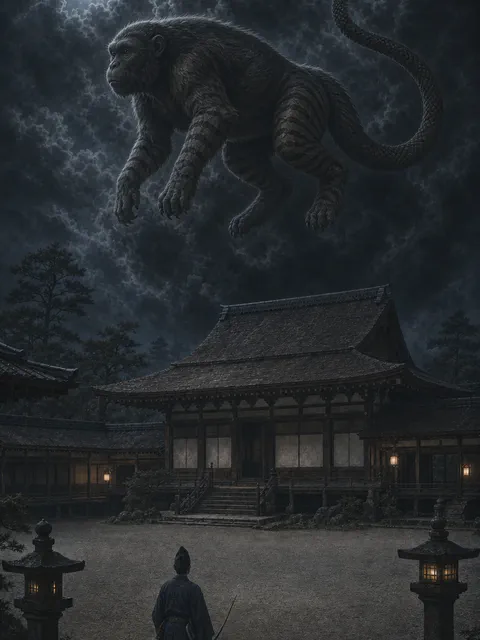
Nue
鵺(ぬえ)
In The Tale of the Heike, a black cloud and a bird's cry sicken the emperor until an archer shoots the creature down — and the versions disagree on what fell.
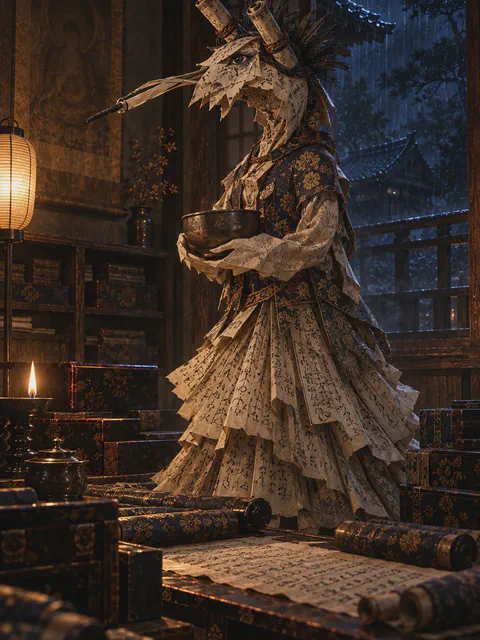
Kyōrinrin
経凛々(きょうりんりん)
Sekien's 1784 Kyōrinrin is a figure built from sutra scrolls and folded scripture. His caption wonders whether these are the scriptures thrown away by the monk Shubin, whose curse on Kūkai turned back on himself.

Tengu
天狗(てんぐ)
A mountain being associated with flight, impossible voices, disappearances, and more than one familiar face.