Tengu: The Changing Yokai of the Mountains
天狗(てんぐ) Tengu ASCII: Tengu
Also known as: Karasu-tengu, Daitengu
Pronunciation: ten-goo
A mountain being associated with flight, impossible voices, disappearances, and more than one familiar face.
Quick Facts
- Habitat
- Mountain, Forest, Temple shrine, Sky
- Region
- Japan
- Recorded period
- medieval Japan, Edo period, modern folklore collections
- Nature
- Mixed
- Danger rating
The danger rating is an editorial summary made for readability. It is not an objective measure found in folklore sources.
Watch the Short
What is Tengu?
Tengu are among the most recognizable beings in Japanese folklore, but the name does not describe one creature with a single appearance or personality. Across centuries, tengu have been imagined as birdlike beings, disruptive forces in Buddhist narratives, masters or challengers of warriors, and powerful presences attached to remote mountains and great trees.
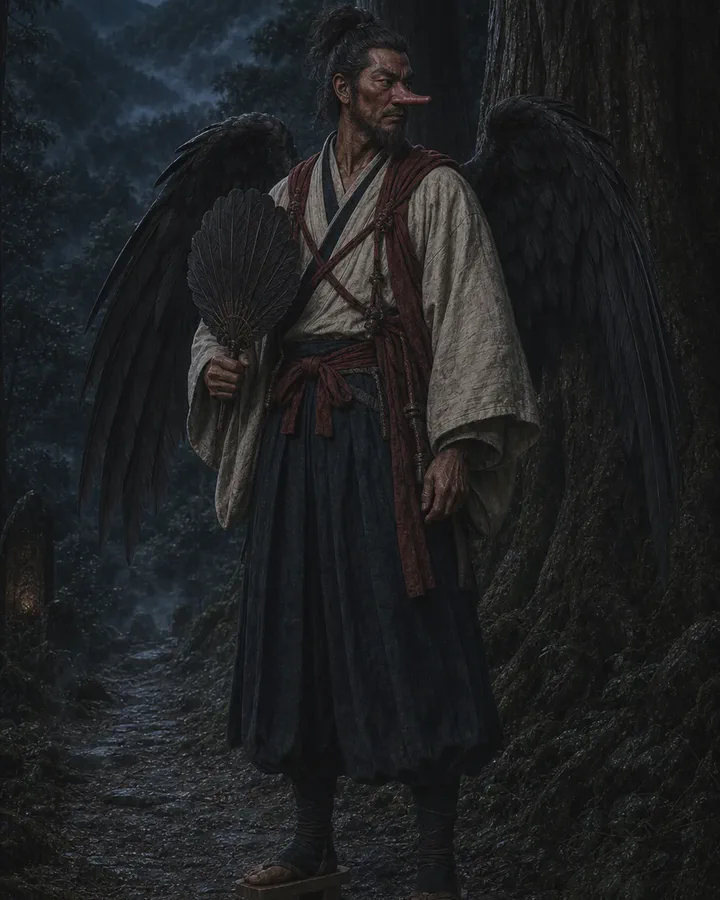
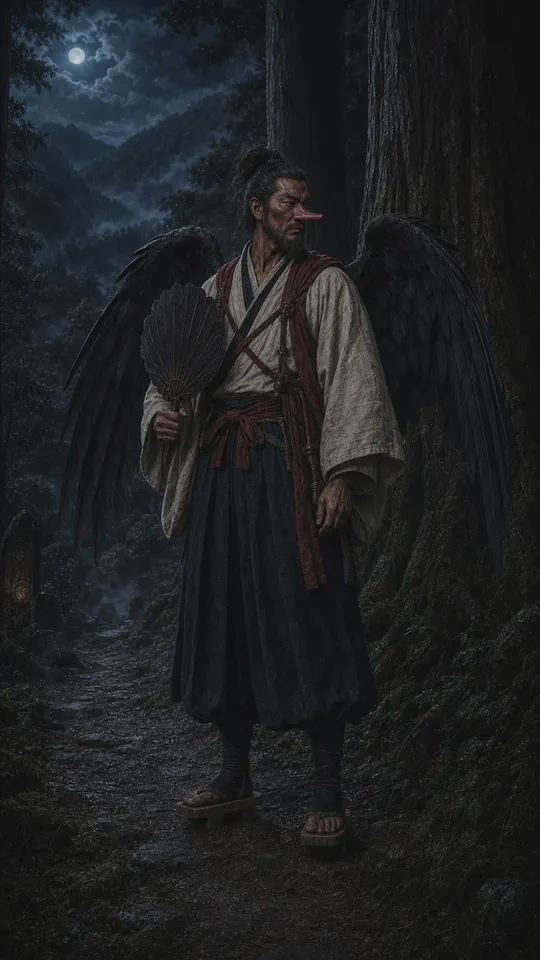
That long history matters. The red face, long nose, feather fan, and mountain-ascetic clothing familiar today are one influential form of tengu imagery, not a checklist shared by every account. Earlier and parallel forms may have a beak, wings, or a much more explicitly birdlike body.
Appearance
Two broad visual families are especially familiar.
The first is the birdlike tengu. Often called karasu-tengu in modern classification, it may have a beak, feathers, and obvious wings. Bird features have deep roots in tengu imagery and help express the being’s connection with flight and the inaccessible spaces above a mountain trail.
The second is the long-nosed form often associated with a powerful daitengu. It is commonly shown with a red or reddish-brown face, a human-shaped body, robes recalling those of mountain ascetics, high wooden footwear, and a fan made of feathers. The long nose became the defining popular image over time, but it arrived late. The earliest tengu wore a beak.
The clothing is also easy to misread. Tengu imagery borrowed signs associated with mountain religious practice because both belonged to the imaginative landscape of difficult peaks and spiritual power. That does not make actual mountain ascetics supernatural figures, and it is not a reason to present their religious practice itself as frightening.
Behavior and abilities
Flight is the most visually consistent tengu ability. Wings, sudden winds, movement through the sky, and appearances high in trees all place the being beyond ordinary human reach.
Collected stories also connect tengu with disruptions that are heard more clearly than they are seen. A person in the mountains may hear a voice, a flute, singing, crashing trees, or something like a storm — yet find no ordinary cause. Other accounts blame tengu when a person, especially a child, vanishes and later returns with a strange story about where they have been.
These motifs do not make every tengu uniformly hostile. Some narratives cast them as dangerous abductors or deceivers; others make them proud teachers, guardians of a place, or beings whose favor and anger depend on human conduct. It is more accurate to call their nature powerful and unstable than simply evil.
Folklore accounts and regional variations
The International Research Center for Japanese Studies’ folklore database collects individual tengu accounts from different places and periods. One record describes a child said to have been carried away by a tengu. Another describes voices, flute-like sounds, songs, and a violent mountain disturbance, followed by a morning in which the expected physical traces had disappeared.
Each record is evidence for one telling, not a national rule. The cause of a disappearance, the meaning of a voice, and the identity of the being behind a storm can change from village to village. Even the moral role of tengu shifts: in one context it is a warning about the dangers of the mountain; in another it is a religious or literary image of pride and disorder; elsewhere it is a local presence treated with caution or respect.
Research into the formation of tengu imagery shows that these changes were already happening in medieval sources. The modern viewer therefore meets a layered figure assembled through centuries of texts, pictures, religious ideas, and local storytelling.
Weaknesses and countermeasures
No single weakness or protective method is shared across tengu traditions. Unlike the familiar trick of making a kappa spill the water from its head dish, there is no comparably consistent action that defeats every tengu.
Avoiding an unexplained call on an empty mountain path works well as a ghost-story warning, but it is not a universal rule found in all tengu lore. The more defensible lesson in many accounts is simpler: the mountains are where human perception and control run out, and the sensible traveler treats what he cannot explain with care.
Traditional folklore and later imagery
Documented tradition. A changing family of mountain beings associated with flight, abductions, impossible sounds, sudden disturbances, religious ideas, and both birdlike and humanlike forms. Their moral character and appearance depend on period, genre, and region.
Later imagery. Popular media often standardizes tengu as a red-faced man with an extremely long nose, magical fan, martial skill, and a fixed position in a fantasy hierarchy. These elements draw from real strands of tradition, but the neat package is modern. It leaves out earlier bird forms, local variations, and the long historical process through which the familiar face was created.
Sources and further reading
- Database Database of Folklore and Yokai Phenomena (怪異・妖怪伝承データベース) (external link) International Research Center for Japanese Studies Use individual records; do not generalize one local account nationwide.
- Academic paper The Formation of Tengu Imagery through the Late Twelfth Century (天狗のイメージ生成について) (external link) Ito Nobuhiro; National Diet Library Digital Collections Academic study of how tengu imagery developed in medieval sources.
- Fieldwork collection Tengu child-abduction account, record 1080084 (external link) International Research Center for Japanese Studies One collected local account; do not generalize its details nationwide.
- Fieldwork collection Mountain voices and unexplained disturbance attributed to tengu, record 2363230 (external link) International Research Center for Japanese Studies Records sounds and a disturbance whose expected traces were absent the next morning.