
Teke Teke (テケテケ): The School Ghost With More Than One Body
Japan's crawling upper-body ghost, and the mirror version from Kobe
テケテケ Teke Teke ASCII: Teke-Teke
Also known as: Teke-teke-san, Teketeke
Pronunciation: TEH-keh TEH-keh
Teke Teke (テケテケ; also Teke-teke-san) is a modern Japanese school ghost story, named for the quick teke-teke tapping you hear before you see it. In the version everyone knows, a young woman cut in half by a train drags her upper body along on her elbows at terrible speed, and whatever you do you are never to turn round when you hear her behind you. In a version recorded at a Kobe high school in 2001, Teke-teke-san lives in a mirror and chases anyone whose eyes meet hers. The story has no traceable first telling, place or year.
Quick Facts
- Habitat
- Street, Other
- Region
- Japan, Kobe (Hyōgo)
- Recorded period
- late 20th-century school ghost stories, 2001 folklore record
- Nature
- Harmful
- Danger rating
The danger rating is an editorial summary made for readability. It is not an objective measure found in folklore sources.
Watch the Short
What is Teke Teke?
You are alone in the school corridor after dark and you hear it behind you: teke, teke, teke — a quick, light tapping on the hard floor, getting faster. Everyone knows what it is. A young woman was cut in half by a train, and her upper half still moves, on its elbows, faster than you can run, and the one rule is never to turn round.
That is the version in every anthology, and it is not an old yokai. Teke Teke belongs to the school ghost stories that spread among Japanese children in the late twentieth century — told in classrooms and corridors, collected in paperback series, and repeated endlessly online.
What does teke teke mean?
The name is written in katakana, テケテケ, and it is a sound: the rapid, light clatter of something hard hurrying over a floor. The ghost is named for the noise it makes before you see it — like the betobeto-san, another creature known first by its footsteps. With the polite suffix it is Teke-teke-san. It is pronounced TEH-keh TEH-keh.
The origin nobody can find
Online, the railway version is almost always said to have begun in Muroran, in Hokkaido. The claim circulates widely, but no one has traced where it began. There is no agreed first telling, first place or first year, which is typical of school ghost stories, and Teke Teke is a clear case of it.
The mirror in Kobe
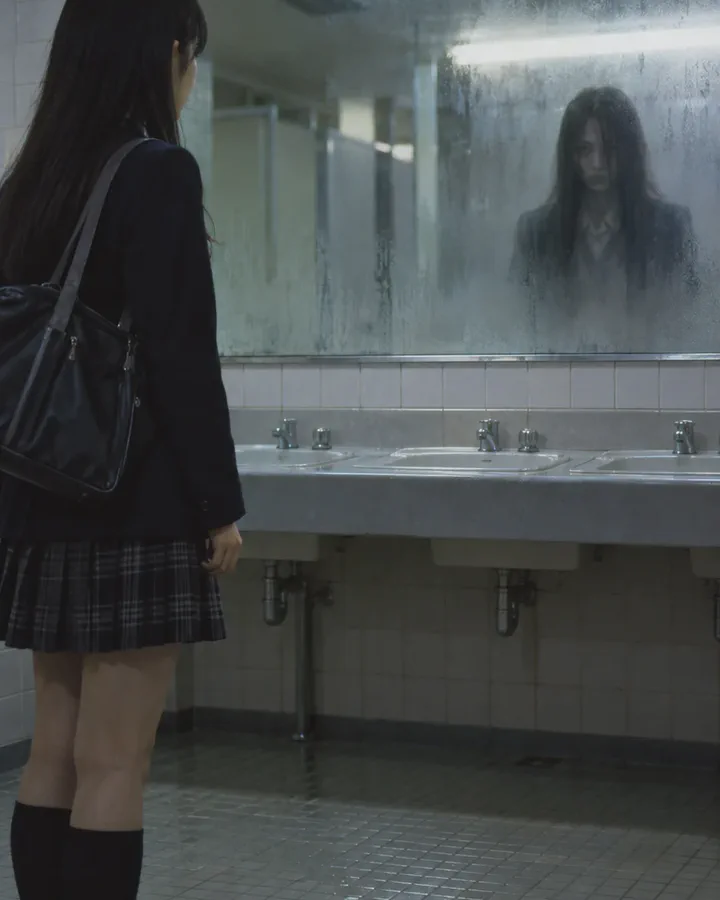
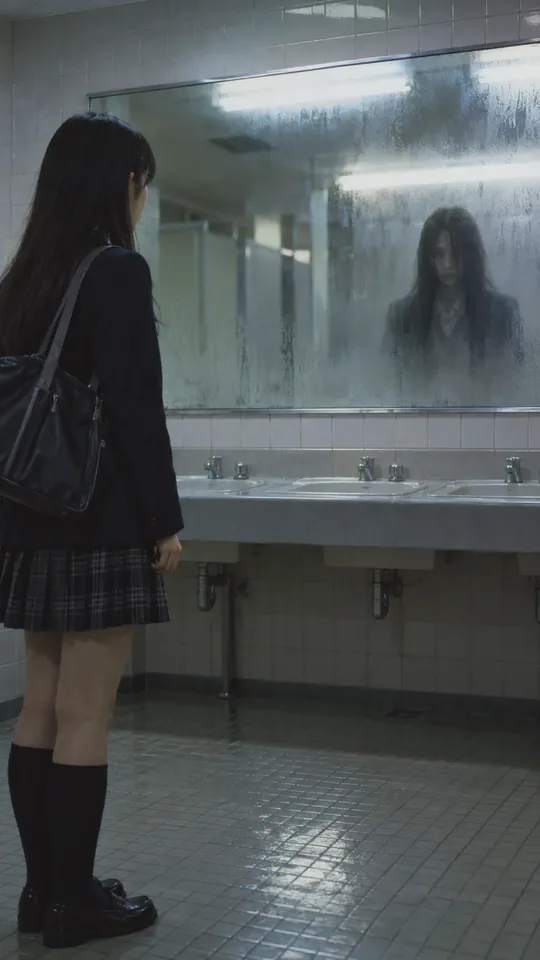
In a 2001 folklore journal, students at a high school in Kobe described a very different Teke-teke-san. She lives inside a mirror. If your eyes meet hers in the glass, she chases you. No railway, no accident, no elbows. The name is the same; almost nothing else is.
How the story moves
A 2022 study in the journal of Japan’s oral-literature society followed how Teke Teke was told in schools: tellers adjusted where it appeared, what was forbidden and how it ended to fit their school and their listeners, and former pupils remembered it differently years later. The Folklore Society of Japan’s survey of recent research lists it among the postwar stories that change shape fastest once they reach the internet.
Appearance
In the railway version, the upper half of a woman; in the mirror version, a face in the glass. Our short shows the corridor, the sound and the mirror, and keeps the railway version to a shadow.
Behavior and abilities
- It makes a sound first. The name is the warning.
- It chases. Both versions agree on that, and on little else.
Weaknesses and countermeasures
Every telling has its own rule — do not turn round, do not meet its eyes, answer a riddle correctly — and the rules disagree as much as the stories.
Documented versions and later imagery
Documented versions. A late twentieth-century school ghost story with no traceable origin; the widely repeated railway version; a 2001 record from a Kobe high school of a Teke-teke-san in a mirror; and studies showing how tellers reshape it.
Later imagery. Films and online horror have fixed the railway version as the definitive one and attached the Muroran origin to it. The record suggests something else: Teke Teke is less a single ghost than the name of a story that keeps being retold, and keeps changing in the telling.
Sources and further reading
- Fieldwork collection Teke-teke-san, record 2610026 (external link) International Research Center for Japanese Studies San'in Minzoku Kenkyū (2001), a high school in Kobe: meet the eyes of Teke-teke-san in the mirror and it chases you.
- Academic paper Memories of school ghost stories and their reality (external link) Satō Kikuichirō; Kōshō Bungei Kenkyū 45 (2022) How Teke-teke stories change with the school, the year, and the teller, and change again in memory.
- Library Reference case: sources for the Muroran origin of Teke-teke (external link) National Diet Library Search (Sapporo Central Library) A library reference question asking for any publication that states the Muroran origin found online.
- Academic paper Research trends in Japanese folklore studies, 2015–2017 (external link) The Folklore Society of Japan Cites Teke-teke among postwar ghost stories and urban legends that change shape as they spread online.
Where it was recorded
- 2001
Kobe (a high school), Hyōgo
Modern rumour
Teke-teke-san who lives in a mirror
- undated
Muroran, Hokkaidō
Modern rumour
Claimed origin of the railway version; no source found
Places named in the records behind this article. Coordinates are approximate. View on the map
Records behind this article
On the timeline
In the glossary
Related yokai

Kuchisake-onna
口裂け女(くちさけおんな)
Kuchisake-onna is not an old yokai. She is a rumour that swept through Japanese schoolchildren in 1978–79: a masked woman asking 'Am I pretty?' Almost every other detail changed from school to school.
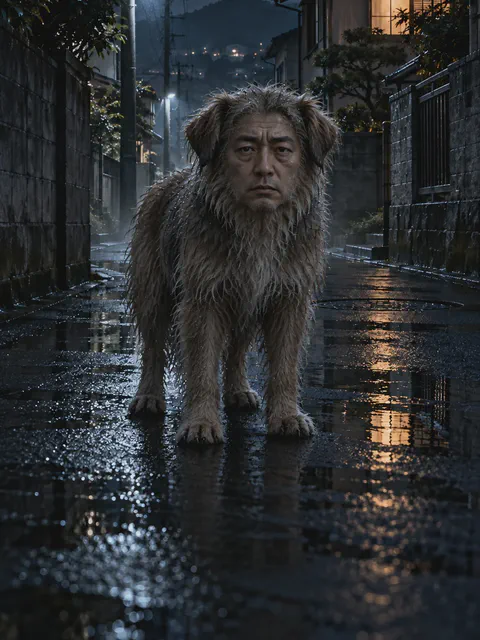
Jinmenken
人面犬(じんめんけん)
Jinmenken, the dog with a human face, swept through Japanese children's rumour around 1989–90. A first-grader in Yamagata had his own version: the dog had left Tokyo because people would not stop talking about it.