

Tamamo-no-Mae: The Perfect Court Lady Who Was a Fox
玉藻前(たまものまえ) Tamamo-no-Mae ASCII: Tamamo-no-Mae
Pronunciation: tah-MAH-moh noh MAH-eh
In the fifteenth-century tale, Tamamo-no-Mae is the most learned woman at the court of Retired Emperor Toba. He falls ill, divination names her as the cause, and she flees to Nasu as a fox. The killing stone came later.
Quick Facts
- Habitat
- Other, Field
- Region
- Kyoto (court), Nasu (Shimotsuke)
- Recorded period
- 15th-century Tamamo-no-Mae tales, Noh Sesshōseki
- Nature
- Harmful
- Danger rating
The danger rating is an editorial summary made for readability. It is not an objective measure found in folklore sources.
Watch the Short
Who is Tamamo-no-Mae?
Tamamo is “jewel weed,” a poetic word for seaweed. Mae is an honorific for a lady of the court. Tamamo-no-Mae is a name given at court, and the story is about what was underneath it.
Her tale was written down in the fifteenth century. A Tamamo-no-Mae Monogatari of 1470 is one of the earliest versions, and an entry in a monk’s diary of 1453 already records the story being told.
The tale
At the court of the Retired Emperor Toba, in the twelfth century, there is a woman without equal. She is beautiful, and she is learned — in Buddhist scripture, in Chinese and Japanese writing, in poetry and music. She can answer any question. She becomes the favourite.
Then Toba falls ill, and nothing helps. A diviner is consulted, and the answer is Tamamo-no-Mae. She is not human. Exposed, she takes her true shape, a fox, and flees east to the plain of Nasu, in Shimotsuke.
The court sends warriors after her. On the plain of Nasu, the archers Miura no Suke and Kazusa no Suke hunt her down, and the fox is shot.
One early telling, in the diary of 1453, adds that this hunt was the origin of inuoumono, the sport of mounted archers shooting at dogs. However much truth that holds, it shows how early and how widely the story had spread.
The stone that came later
The best-known part of the story is not in the 1470 tale. In the Noh play Sesshōseki, “The Killing Stone,” the fox’s spirit does not die with her body. It becomes a stone on the plain of Nasu that kills anything that comes near it with its poison — birds, beasts, travellers — until a Zen monk, Gennō, finally breaks its power.
The transformation into a stone is described as an addition made by the Noh. Our short says so: the stone comes “only later.”
The other famous layer is later too. Tamamo-no-Mae is now usually a fox with nine tails who had already ruined kingdoms in India and China before crossing to Japan. That long career across three countries is an elaboration built up over time, and it is not part of the core court tale.
Appearance
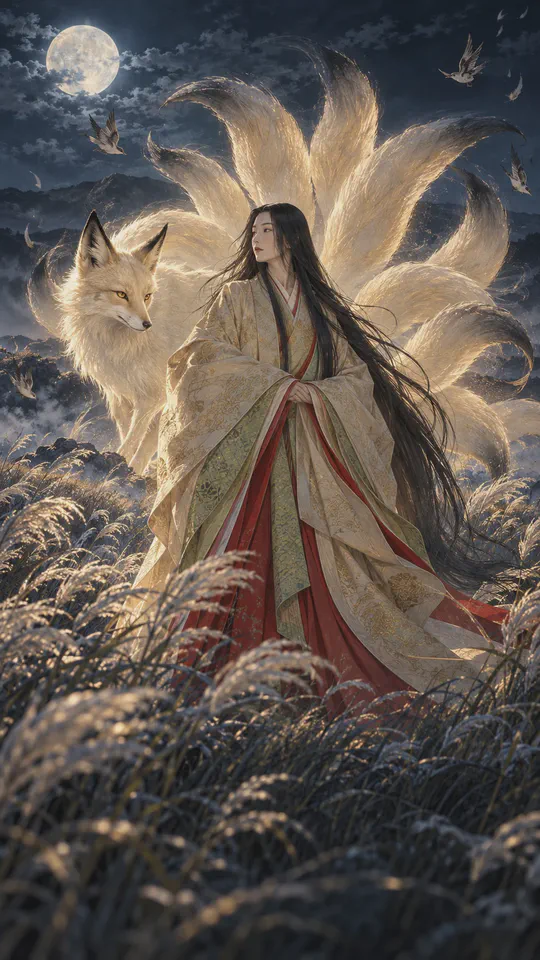
A court lady of extraordinary beauty and learning, and, beneath that, a fox. Our illustration shows the moment between: the lady in her robes on the plain, the fox beside her, and the tails already showing.
Behavior and abilities
- She is brilliant. Her learning is what makes her the favourite.
- The emperor sickens near her. The illness is the only harm the court tale ascribes to her, and it is enough.
- She runs. Exposed, she does not fight the court; she flees.
Weaknesses and countermeasures
Divination saw through her, and mounted archers ran her down. The tale’s answer is the ordinary machinery of the court: a diviner to name the cause and warriors to remove it.
Court tale and later imagery
Documented tale. Fifteenth-century versions, including the Tamamo-no-Mae Monogatari of 1470: an unmatched lady at the court of Retired Emperor Toba is identified by divination as the cause of his illness, flees to Nasu as a fox, and is shot down by Miura no Suke and Kazusa no Suke.
Later imagery. The Noh Sesshōseki turns her spirit into the poisonous killing stone of Nasu. Later retellings give her nine tails and a history across India, China, and Japan, and modern games and anime have made the nine-tailed fox one of the most familiar figures in Japanese folklore.
The court tale is smaller and colder. The cleverest person in the palace is the one making the emperor ill, and nobody can tell until a diviner says so.
Sources and further reading
- Academic paper The Sesshō-seki legend (external link) Art Research Center, Ritsumeikan University (ArtWiki) The fox's transformation into a stone is not yet in the Tamamo-no-Mae Monogatari of 1470 and is said to have been added in the Noh Sesshōseki.
- Reliable secondary Noh appreciation: Sesshōseki (external link) Art Research Center, Ritsumeikan University The Noh plot of Retired Emperor Toba, the exposure, the flight to Nasu, and the stone.
- Library The World of Yokai through Toriyama Sekien's Yokai Encyclopedias (external link) National Diet Library Image Bank Surveys rokurokubi images by multiple artists, including female and male examples.
Related yokai

Kitsune
狐(きつね)
A 1930 account from Toyooka describes blurred blue or red foxfire moving restlessly from beyond the mountain to somewhere close by.

Shuten-dōji
酒呑童子(しゅてんどうじ)
The tale of Shuten-dōji appeared in the fourteenth century: an oni lord on Mt. Ōe who carried off the daughters of the capital, and the warriors who got in disguised as monks and defeated him with sake.