
Sunekosuri: One Sentence, and Nothing Else
脛擦り(すねこすり) Sunekosuri ASCII: Sunekosuri
Also known as: 脛コスリ
Pronunciation: soo-neh-koh-SOO-ree
A naturalist writing a national dictionary of yokai in 1935 gave the Sunekosuri of Oda district about one line: dog shaped, on rainy nights, brushing between a traveller's legs as it passes. Everything else you have read about it came later.
Quick Facts
- Habitat
- Road
- Region
- Oda district, Okayama, in the old province of Bitchū
- Recorded period
- Satō Seimei's Genkō Zenkoku Yōkai Jiten (1935), Yanagita Kunio's Yōkai Meii
- Nature
- Neutral
- Danger rating
The danger rating is an editorial summary made for readability. It is not an objective measure found in folklore sources.
Watch the Short
What is Sunekosuri?
Here is the source, in full, near enough.
The naturalist Satō Seimei published Genkō Zenkoku Yōkai Jiten — a current national dictionary of yokai — in 1935. Under the Oda district of Okayama he recorded sunekosuri: dog shaped, appearing on rainy nights, brushing between the legs of people on the road as it passes.
That is it. That is the creature.
Yanagita Kunio’s Yōkai Meii gives the same thing for Bitchū Oda in almost the same words: a dog-shaped creature that on rainy nights brushes between the legs of people walking, and passes.
Behavior and abilities
- It is dog shaped. Not a dog. Shaped like one.
- It comes in the rain. Both records specify rainy nights.
- It brushes past. Between the legs, against the shins, and onward.
- It does not stay. The verb in both records is one of passing through.
That list is complete. There is no fifth item.
Appearance
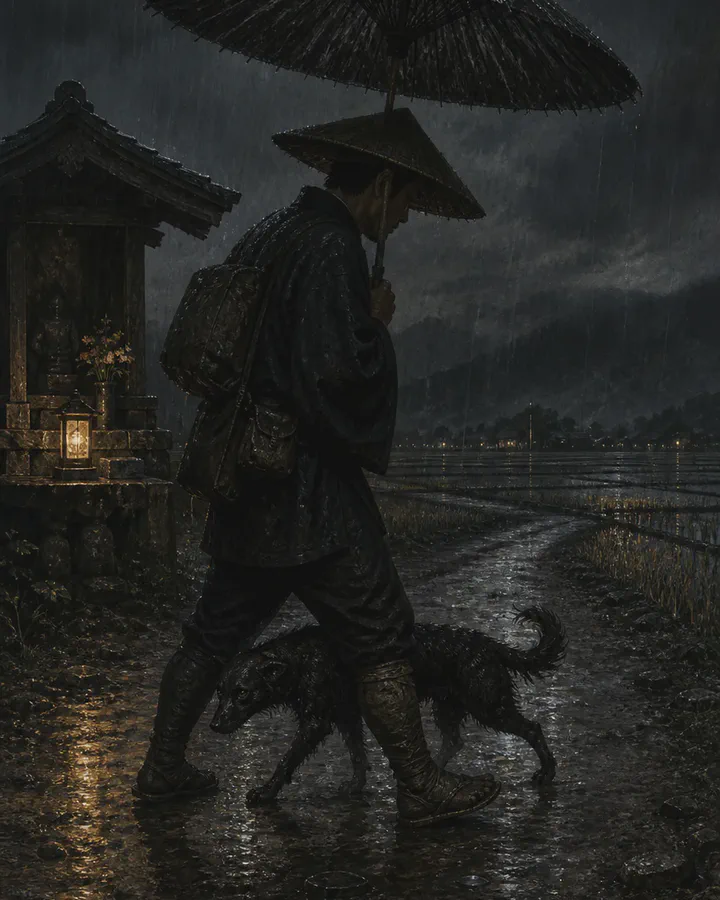
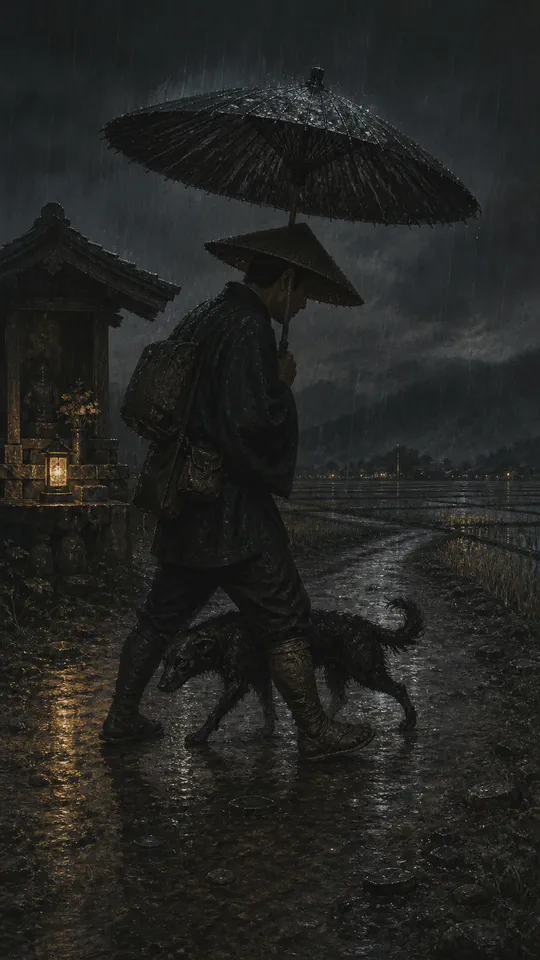
Our illustration reconstructs the 1930s Okayama countryside the record implies: a wet path between paddies, a wayside shrine, a man under an oiled umbrella, and something low and dark moving close against his legs.
The animal is deliberately dog-shaped and deliberately hard to see properly. Both records say dog and neither says anything more, so anything more would be ours rather than theirs.
What is not in the record
This section exists because the modern Sunekosuri has acquired a great deal.
It does not trip you. It does not cling to your legs and slow you down. It does not have a personality, a cry, a motive, a season, a preferred victim, or a way of being driven off. It is not lonely, it is not affectionate, and it is not asking for anything.
Some of that comes from similar traditions elsewhere, some from later explanation, and some from the sheer difficulty of leaving a one-line creature alone. The 1935 Oda entry supports none of it.
The modern picture is also a different animal. Sunekosuri is now usually drawn as a small round cat-like creature, appealing and merchandisable, and the older records say dog.
Weaknesses and countermeasures
There are none, and there is nothing for them to be against.
Nobody in the record is hurt, delayed, frightened into illness, or lost. A thing brushes past a person’s legs in the rain and continues on its way. Whatever the encounter was, it was over before anyone could have done anything about it.
This is the smallest yokai in these files by a wide margin, and the record’s refusal to make more of it is worth sitting with. Somebody in Oda district felt something pass between their legs on a wet night, and thought it was worth having a word for.
Who wrote it down
Satō Seimei is the reason this entry exists at all. He was a naturalist working in Okayama who compiled the 1935 dictionary, and he is remembered locally as the person who first introduced Sunekosuri nationally; the library in his home town of Satoshō maintains a site about him.
The Iryōdō area of Ibara is now presented as the creature’s home ground. That connection comes from regional promotion and is worth knowing; the one-sentence 1935 record does not name a spot.
Documented record and later imagery
Documented record. Satō Seimei, 1935, for Oda district in Okayama: dog shaped, on rainy nights, brushing between the legs of people on the road as it passes. Yanagita’s Yōkai Meii records the same creature for Bitchū Oda in near-identical terms.
Later imagery. Today’s Sunekosuri is a small round cat-like companion creature that winds around your ankles and trips you up, sometimes out of loneliness. It is likeable, and it is an expansion of a sentence.
The sentence is stranger. Something dog-shaped, in the rain, at night, on a road — close enough to touch you as it went by, and gone before you could turn.
Sources and further reading
- Reliable secondary Satō Seimei, Genkō Zenkoku Yōkai Jiten (現行全国妖怪辞典), 1935 Printed edition The Oda district, Okayama entry for Sunekosuri, in about one sentence: dog shaped, on rainy nights, brushing between a traveller's legs as it passes.
- Reliable secondary Yanagita Kunio, Yōkai Meii (妖怪名彙) Printed edition Gives the same creature for Bitchū Oda: dog shaped, on rainy nights, brushing between the legs of people on the road.
- Reliable secondary The home of the talked-about yokai Sunekosuri Okayama Prefecture Tourism Federation Satō Seimei's record, the Iryōdō area of Ibara, and the difference between the old dog-shaped figure and the modern cat-like one.
- Library Satō Seimei special site Satoshō Town Library Records Satō Seimei as the person who first introduced Sunekosuri nationally.
Related yokai
Okuri-inu
送り犬(おくりいぬ)
A 1936 Gifu account describes a mountain dog that follows a traveler all the way to his door — and leaves only after salt and a word of thanks.
Betobeto-san
べとべとさん(べとべとさん)
On a night road in Uda you hear a bita-bita footfall coming along behind you. There is nobody there. Step aside, say the words, and it stops — which is the entire record.