Suiko: The Creature You Only See the Knees Of
水虎(すいこ) Suiko ASCII: Suiko
Also known as: shuihu
Pronunciation: SOO-ee-koh
A Chinese pharmacological encyclopedia describes a river creature the size of a small child, armoured in scales that arrows cannot pierce, which keeps its body underwater and lets only its two tiger-pawed knees break the surface.
Quick Facts
- Habitat
- River
- Region
- the Zhonglu river country of what is now Hubei, and Japan by way of Sekien
- Recorded period
- Bencao Gangmu volume 42 (late 16th century, quoting the Xiangmian ji), Toriyama Sekien's Konjaku Gazu Zoku Hyakki (1779)
- Nature
- Harmful
- Danger rating
The danger rating is an editorial summary made for readability. It is not an objective measure found in folklore sources.
Watch the Short
What is Suiko?
Suiko is written 水虎 — water tiger — and it does not come from a village, a sighting, or a story anyone told by a fire. It comes from a reference book about medicine.
Li Shizhen’s Bencao Gangmu, completed in the late sixteenth century, is an enormous compendium of the natural world assembled for practical use: what things are, where they live, what they can be used for. Volume 42 carries an entry for the suiko, quoting an older text called the Xiangmian ji, and places it in the rivers of what is now Hubei.
The description is precise in the way a catalogue is precise. The creature is the size of a three or four year old child. Its body is covered in overlapping scales like a pangolin’s, and arrows will not go through them. In autumn it comes out onto the sand to dry its armour.
And when it is in the water, you do not see it. You see its knees.
Appearance
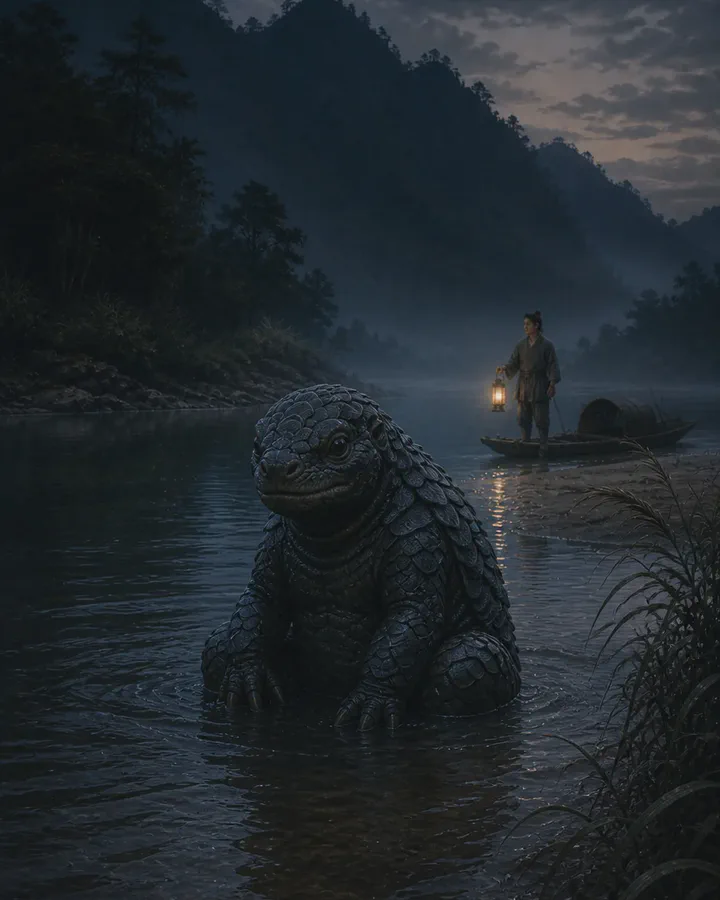
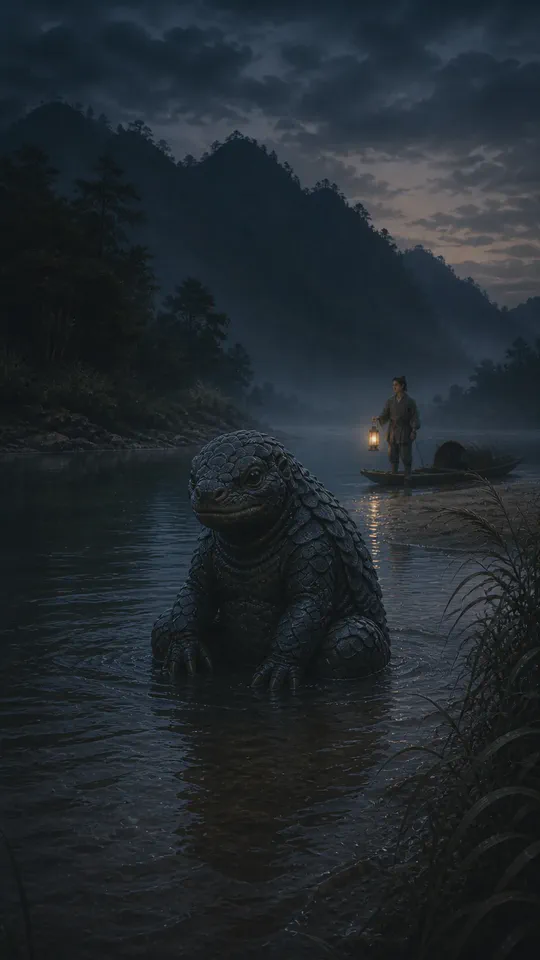
Our illustration follows the entry and refuses everything the name suggests. No stripes, no fur, no tiger. The body is squat and low, plated in grey-green overlapping scale from head to foot, with no visible skin or hair anywhere.
The knees are the identifying feature and the source says so: round, like a tiger’s paws, with short claws. In the water they are all that shows.
There is no dish on its head, no shell on its back, and no beak. Those belong to a different creature that this one later got confused with.
Behavior and abilities
- It hides its body. The whole shape stays under; the knees break the surface and nothing else does.
- It cannot be shot. The armour is described as arrow-proof, which is a specific claim rather than a general one about toughness.
- It sits out in autumn. The record has it on the sand, drying its scales, once a year.
- The knees are the trap. The text says a child who plays with those knees is harmed. That is the one thing it does to anyone, and it happens because the knees look like something worth reaching for.
From a Chinese pharmacopoeia to a Japanese demon catalogue
Two hundred years after Li Shizhen, Toriyama Sekien put the suiko into Konjaku Gazu Zoku Hyakki (1779), his illustrated catalogue of Japanese monsters. The creature had not migrated. The book had.
This is a route the Yokai Files has seen before. Hihi reached Japan through a 1712 encyclopedia quoting Chinese sources; Hakutaku arrived as an image people copied and carried. Educated readers in Edo Japan had access to Chinese reference works, and creatures came across in the same shipments as the medicine and the astronomy.
What happened afterwards is the interesting part. In Japanese usage 水虎 drifted into service as another name for the kappa — and the kappa is a genuinely Japanese river creature with a dish of water on its head, a shell, and an appetite for cucumbers and for something rather worse. The two have almost nothing in common. But both live in rivers, both are roughly child-sized, and one of them had a spare name available.
Weaknesses and countermeasures
The sources give none, and they close the obvious door on the way past. Arrows were the ordinary answer to a dangerous animal at a distance, and the entry states plainly that arrows do not work.
What is left is avoidance, and the text supplies the shape of it without ever phrasing it as advice: the thing that gets people is the knees, and the people it gets are children who did not know they were knees.
Documented entry and later imagery
Documented entry. The Bencao Gangmu, volume 42, quoting the Xiangmian ji: a river creature of the Zhonglu country the size of a three or four year old, scaled like a pangolin and proof against arrows, submerged except for its tiger-pawed knees, sunning its armour on the sand in autumn, and dangerous to children who handle those knees. Sekien’s 1779 plate brought the same creature into a Japanese collection.
Later imagery. The name won and the creature lost. Ask for a suiko today and you will usually be handed a kappa — green, beaked, dish on the head, shell on the back. The armoured thing in the Hubei rivers with two knees above the waterline is the one the book actually describes, and it is stranger than its replacement, because almost all of it is deliberately out of sight.
Sources and further reading
- Primary text Bencao Gangmu (本草綱目) by Li Shizhen (external link) Chinese Text Project Volume 42 carries the Suiko entry, quoting the Xiangmian ji: a river creature the size of a three or four year old, armoured in scales like a pangolin's, arrow-proof, showing only its tiger-pawed knees above the water.
- Museum Toriyama Sekien, Konjaku Gazu Zoku Hyakki (今昔画図続百鬼), 1779 (external link) Tokyo Museum Collection The 1779 sequel to Sekien's illustrated demon catalogue, containing both Kawa-akago and Suiko.
- Library Wakan Sansai Zue (倭漢三才図会) bibliographic record (external link) National Diet Library Search Catalogue record establishing the work, its compiler, and its dating.
Related yokai
Kappa
河童(かっぱ)
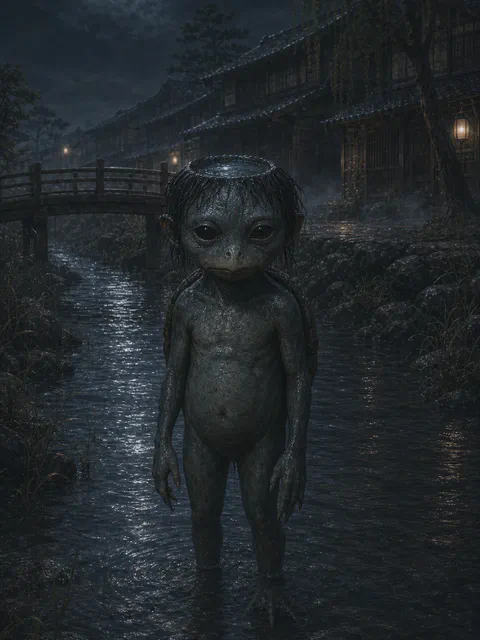
A child-sized water yokai whose strength lives in the water held by the dish on its head.
Kawa-akago
川赤子(かわあかご)
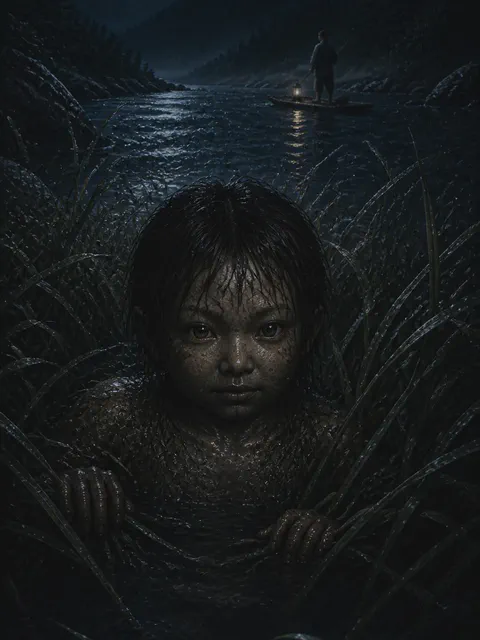
Toriyama Sekien drew an infant-shaped creature rising from the water plants of a mountain river in 1779, watching a man on a raft — and admitted in the caption that he was guessing about what it was.