Shin: The Clam That Breathed a Palace
蜃(しん) Shin ASCII: Shin
Also known as: 蜃気楼, shinkirō
Pronunciation: SHEEN
Old records describe a creature at the coast whose breath rises over the water and takes the shape of towers. The sources never agreed on what it was — and the Japanese word for a mirage is still its name.
Quick Facts
- Habitat
- Sea, Coast, Sky
- Region
- the Chinese coast in the earliest records, and Japan through the same texts
- Recorded period
- Shiji, Treatise on the Feng and Shan Sacrifices, Wakan Sansai Zue (c. 1712), Toriyama Sekien's Konjaku Hyakki Shūi (1781)
- Nature
- Neutral
- Danger rating
The danger rating is an editorial summary made for readability. It is not an objective measure found in folklore sources.
Watch the Short
What is Shin?
Start with a word you may already know. The Japanese for mirage is shinkirō, written 蜃気楼 — three characters meaning shin, vapour, tower.
The tower is the thing people saw. The vapour is what it was made of. And shin is the creature that breathed it out.
The phenomenon is ordinary and well understood: light bends through layers of air at different temperatures, and a coastline or a ship appears where it is not, stacked and floating. What is not ordinary is that the standard word for this in Japanese is still, structurally, an accusation against an animal.
The oldest records
The lineage runs back a long way. Sima Qian’s Shiji, in the treatise on the Feng and Shan sacrifices, is part of the chain of early Chinese material describing vapour at the coast that takes the appearance of towers and terraces.
Which is a careful way of putting it, and worth noticing. The records are not describing a monster attacking a port. They are describing something people on the shore could see, and reaching for what produced it.
What the sources cannot agree on
Here the tradition splits, and it never closes back up.
One line of explanation makes the shin a dragon-kind creature — a jiao, a water-dragon, something in that family. Another makes it a giant clam. Both readings travelled to Japan, both were taken seriously, and Edo-period essayists argued the question in print. Terajima Ryōan’s Wakan Sansai Zue deals with the material in its section on dragons and serpents.
This is a disagreement about the cause of an effect everyone accepted. Nobody was arguing about whether the towers appeared. They were arguing about what was underneath.
Sekien’s clam
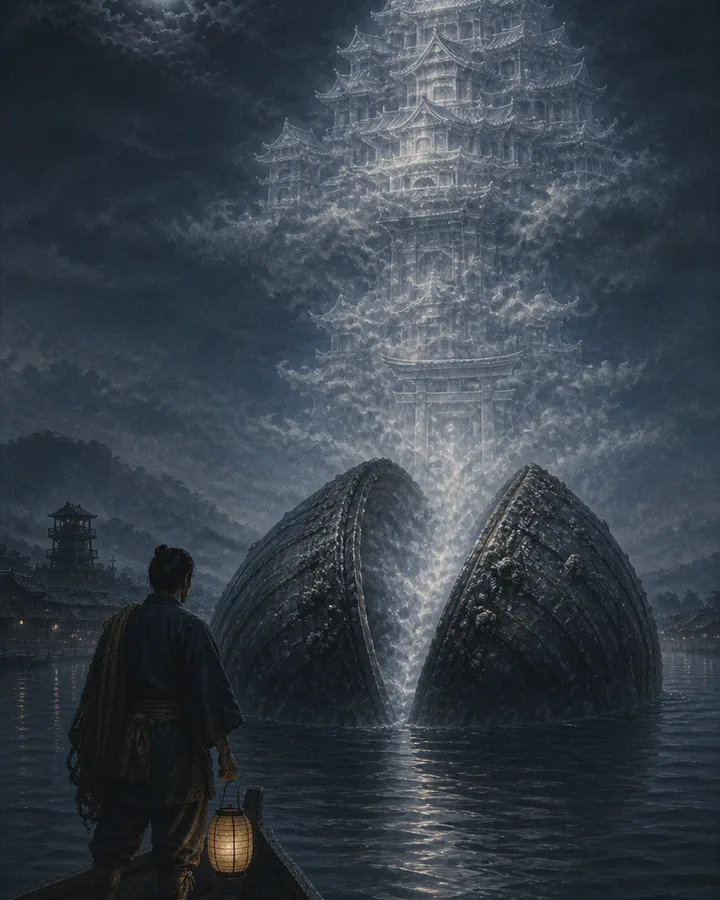
In 1781 Toriyama Sekien settled it visually, if not textually. His Konjaku Hyakki Shūi contains a plate titled Shinkirō, and what he drew was the clam.
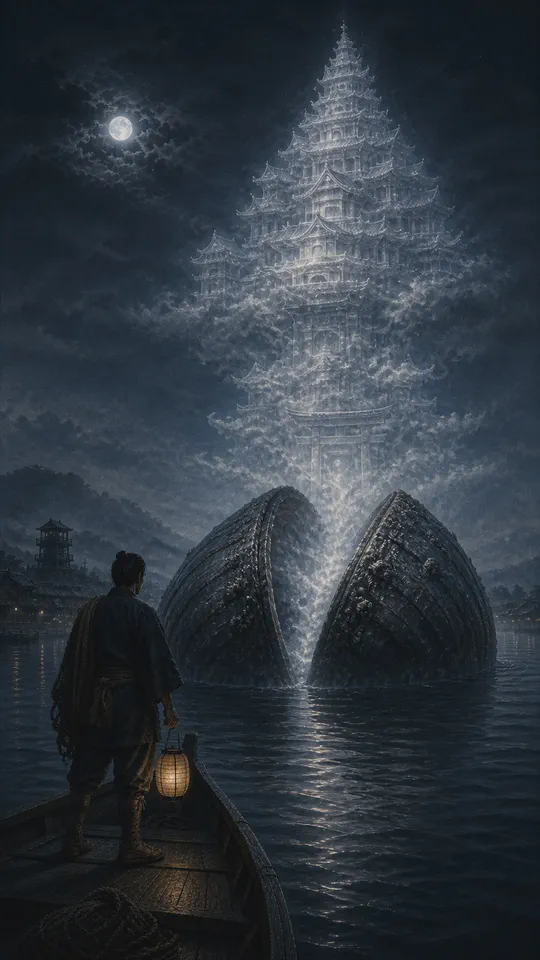
The shell stands open in the water. Vapour pours up out of it. Standing in the vapour, complete and detailed and impossible, is a many-tiered palace.
Our illustration follows Sekien’s version, with the harbour and the palace built as atmosphere rather than as any real place. It is one image out of a tradition that never resolved, and choosing it is a choice about which record to show, not a ruling on what a shin is.
Behavior and abilities
- It exhales. That is the entire ability, and everything else in the entry follows from it.
- The breath takes the form of architecture. Not smoke, not fog — towers, terraces, a palace.
- It does nothing to anyone. No attack, no lure, no drowning, no victim anywhere in the material.
- It stays where it is. Nothing approaches, and it approaches nothing.
Weaknesses and countermeasures
None are recorded, and there is no reason for any. This is one of the very few creatures in these files that never harms a person.
The shin’s job in the sources is explanatory. Something appeared over the water that clearly was not there, and the records offer a body that could account for it. That is a different kind of monster from the ones that follow people home — it is the answer to a question, and once the answer was optics, the creature had nothing left to do.
Except that it kept the word.
Documented tradition and later imagery
Documented tradition. Early Chinese records, in the lineage of the Shiji, of coastal vapour appearing as towers and terraces; a persistent disagreement across both Chinese and Japanese sources over whether the shin is a dragon-kind creature or a giant clam, argued in Edo-period essays and handled in the Wakan Sansai Zue among the dragons and serpents; and Sekien’s 1781 Shinkirō plate showing the opened clam with a palace standing in its breath.
Later imagery. The creature has largely dissolved into the vocabulary. Most people who say shinkirō today mean a mirage and nothing else, and the clam is a footnote in a book about monsters. But the older situation is worth keeping in view: a coastline where buildings appeared in the air, a disagreement in print about what was breathing them out, and nobody at any point suggesting that the thing responsible had ever hurt a single person.
Sources and further reading
- Primary text Shiji (史記), Treatise on the Feng and Shan Sacrifices (external link) Chinese Text Project Early record in the lineage describing vapour at the coast that takes the appearance of towers and terraces.
- Library Toriyama Sekien's Illustrated Night Parade of the Demon Horde (external link) National Diet Library Image Bank Overview of Sekien's four illustrated collections, including the 1781 Konjaku Hyakki Shūi that carries the Shinkirō plate.
- Library Wakan Sansai Zue (和漢三才図会), volume 45, dragons and serpents National Archives of Japan Consulted for the competing explanations of shin as a dragon-kind creature and as a giant clam. Consulted in the archive's own copy; no stable public URL recorded.
- Database Shin (蜃) entry (external link) International Research Center for Japanese Studies Records of the Edo-period essayists arguing over whether shin was a dragon or a clam.
Related yokai
Hakutaku
白澤(はくたく)
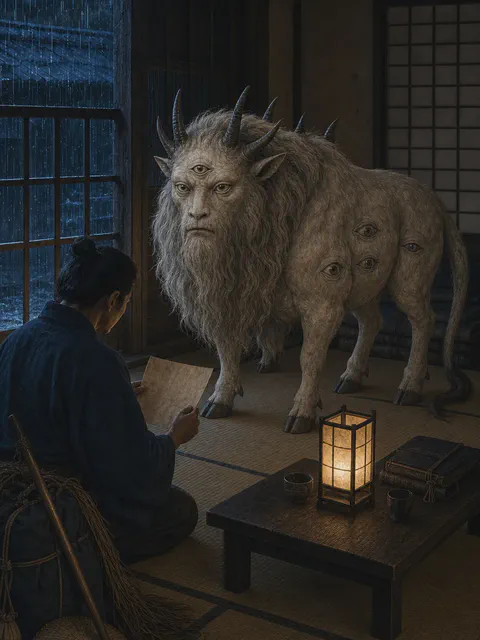
A beast from Chinese legend that named every harmful thing in the world for the Yellow Emperor, and whose image — nine eyes, six horns, a human face — was carried by Edo travelers and set beside pillows during the cholera epidemic of 1858.
Suiko
水虎(すいこ)
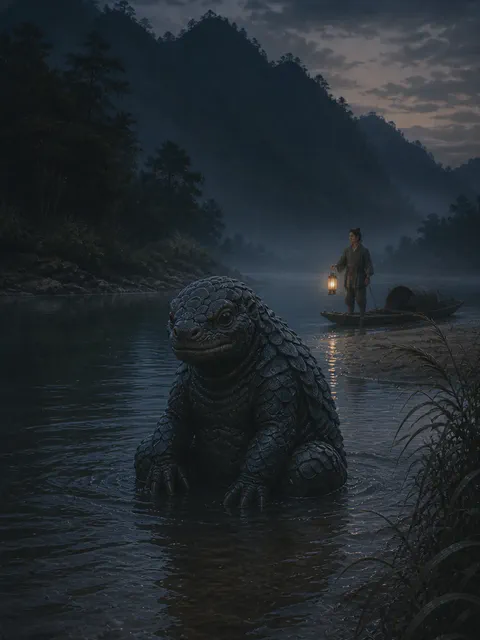
A Chinese pharmacological encyclopedia describes a river creature the size of a small child, armoured in scales that arrows cannot pierce, which keeps its body underwater and lets only its two tiger-pawed knees break the surface.