
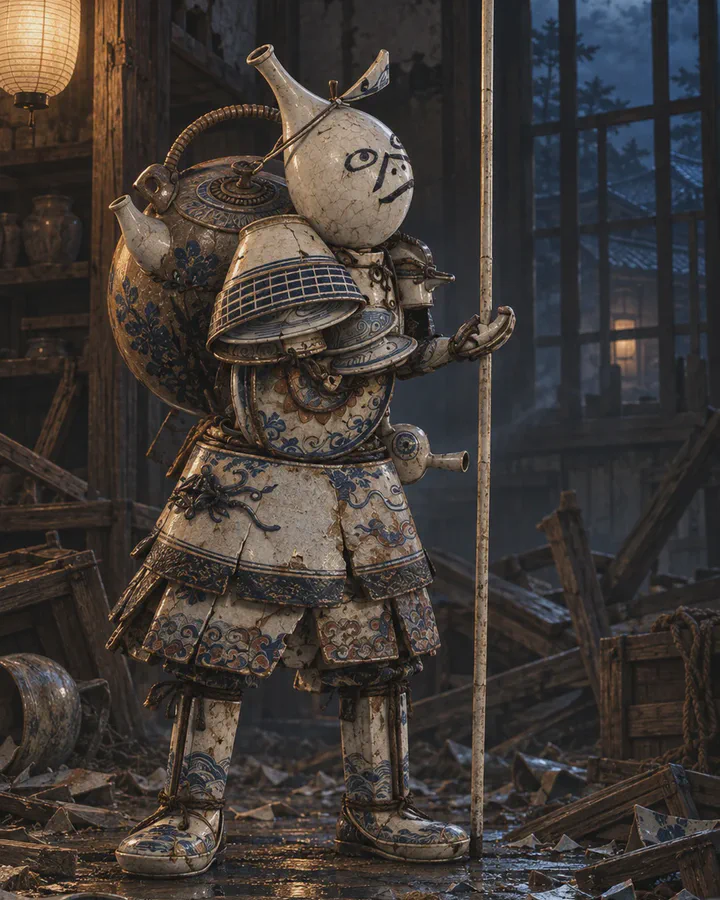
Seto-taishō: The General Built From a Crockery Cabinet
瀬戸大将(せとたいしょう) Seto-taishō ASCII: Seto-taisho
Pronunciation: SEH-toh tie-SHOH
Sekien's 1784 Seto-taishō is a warrior assembled from sake flasks, plates, bowls, a teapot, and a kettle, carrying a spear tipped with a vase. Its caption is a chain of puns on Cao Cao, Guan Yu, and the names of Japanese pottery.
Quick Facts
- Habitat
- House
- Region
- unspecified
- Recorded period
- Toriyama Sekien's Hyakki Tsurezure Bukuro (1784)
- Nature
- Unknown
- Danger rating
The danger rating is an editorial summary made for readability. It is not an objective measure found in folklore sources.
Watch the Short
What is Seto-taishō?
Seto is a town near Nagoya whose kilns were so productive that setomono, “Seto things,” became the everyday word for ceramics. Taishō is a general. Seto-taishō is the general of the crockery.
It appears in the last volume of Hyakki Tsurezure Bukuro, Toriyama Sekien’s 1784 collection of household objects turned into yokai, on a spread facing Choko-boro, a creature made of sake cups. The two are built from the same cupboard.
The plate
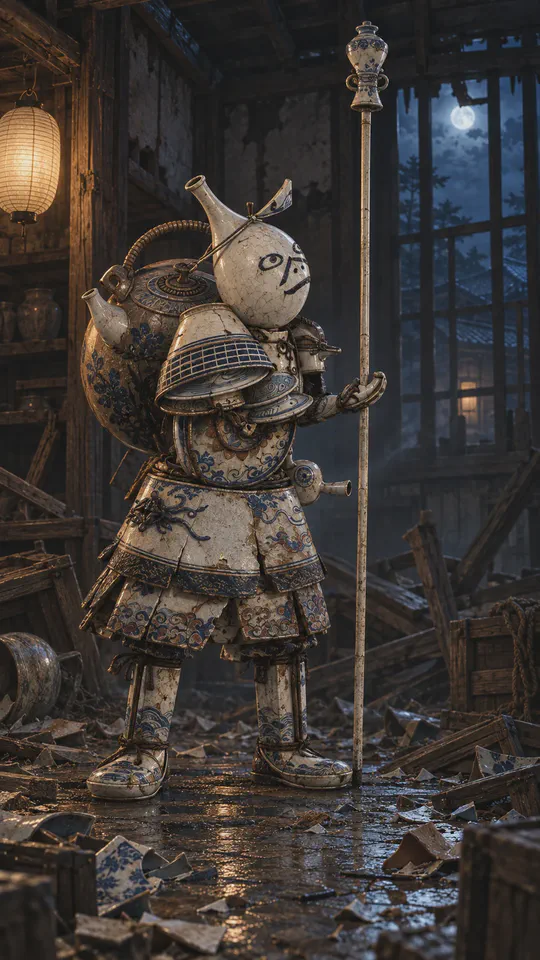
Every part of the warrior is a vessel. A sake flask makes the head. Plates and bowls are the armour of the body and shoulders; one shoulder bowl, in early printings, carries the eight trigrams of divination. A teapot hangs at the hip. A large kettle for warming sake is slung across the back. The legs are ceramic too. In one hand is a long spear with a flower vase at its tip.
At its feet lie broken pieces of pottery and smashed wooden boxes, the nails still sticking out.
The caption
The caption is a run of puns, each one joining a scene from Chinese history to a word from the kitchen.
Cao Cao’s spear. Sekien opens with “Cao Mengde, who laid his spear across and composed a poem” — the warlord Cao Cao, who famously wrote verse on the river with his spear across his lap. The poem he wrote opens with sake, which is why he is here.
Karatsu ware. Then “the karatsu-yaki that made him taste karaki me.” Karatsu is a rival pottery from Kyushu; karaki me is a bitter experience. The sound carries the sense from one to the other.
Guan Yu’s title. Next comes Guan Yu, Cao Cao’s famous adversary, by his title Marquis of Hanshou — read in Japanese as Kan no jutei-kō. The kan runs straight into kan-nabe, the sake-warming kettle on the warrior’s back.
Shu brocade. Last, the figure wears “Shu River brocade,” a famous fabric from Guan Yu’s kingdom of Shu, which is also nishiki-de, “brocade ware,” the richly coloured enamel decoration of Japanese porcelain.
Read together, Seto and Karatsu wares face each other across the page like two armies, and the generals of the Three Kingdoms lend them their names. But the battle exists only in the wordplay. No campaign is described.
Behavior and abilities
- It is armed. It carries a spear, even if the spear ends in a vase.
- It is a general. It has the title and the armour, if not the army.
The caption records no battle, no march, and no harm to anyone.
Weaknesses and countermeasures
None are recorded. The broken crockery at its feet suggests the obvious one.
Documented plate and later imagery
Documented plate. Toriyama Sekien, Hyakki Tsurezure Bukuro, 1784: a warrior assembled from a sake flask, plates, bowls, a teapot, and a large kettle, holding a vase-tipped spear among broken pottery. The caption puns its way through Cao Cao, Karatsu ware, Guan Yu’s title and the sake kettle, and Shu brocade and enamelled porcelain.
Later imagery. Modern yokai books often turn the wordplay into a story: Seto-taishō as the leader of an army of Seto ware, waging war on the potters of Karatsu, broken plates as the casualties. It is a fair dramatisation of the caption’s opposition, and it is not in the caption.
The plate is a cabinet full of dishes, standing to attention, wearing a joke for armour. If your own crockery ever chose a general, it would probably be the kettle.
Sources and further reading
- Museum Seto-taishō by Toriyama Sekien (external link) Wikimedia Commons The 1784 plate of a warrior assembled from flasks, plates, bowls, a teapot, and a large kettle.
- Library Hyakki Tsurezure Bukuro, volume 3 (NDL scan) (external link) Wikimedia Commons; National Diet Library Full scan of the 1805 printing's last volume, with the Choko-boro and Seto-taishō spread.
- Museum Hyakki Tsurezure Bukuro, last volume (external link) Kawasaki City Museum Archive The last volume of the 1805 printing, carrying Choko-boro and Seto-taishō.
- Library Hyakki tsurezurebukuro digitized copy, volume 3 (external link) Smithsonian Libraries Digitized last volume of Sekien's 1784 book of utensil yokai.
- Reliable secondary Seto-taishō: caption and plate notes (external link) Yōkaidō (Sekien Hyakusekinyū) Identifies the vessels in the plate and unpacks the caption's puns on Cao Cao, Karatsu ware, Guan Yu's title, and Shu brocade.
Related yokai
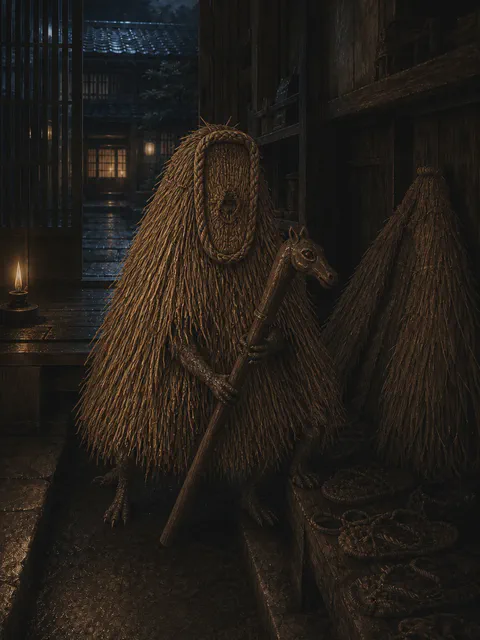
Bakezōri
化け草履(ばけぞうり)
A yokai scroll in the Nichibun collection shows a sandal monster covered in yellow straw, with a straw sandal for a face, riding a horse-head staff. It is stranger than the one-eyed singing sandal of modern books, and it comes with no story.
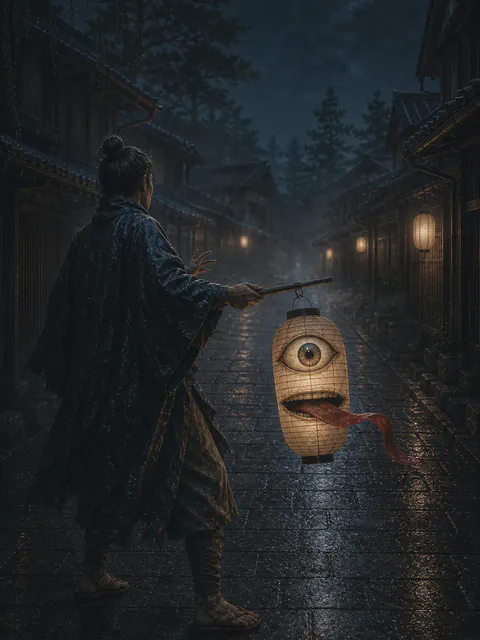
Chōchin-obake
提灯お化け(ちょうちんおばけ)
One of forty-eight monsters on Yoshimori's print Shinban Bakemono-zukushi is a paper lantern with an eye, a mouth, and something coming out of the mouth. That picture is the record — there is no story attached to it.

Karakasa-kozō
唐傘小僧(からかさこぞう)
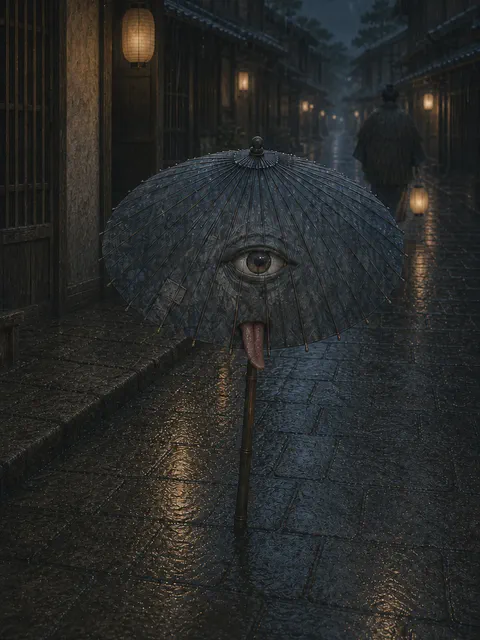
An 1857 Osaka print shows a kabuki actor playing a one-legged umbrella monster — the clearest history of a yokai known through pictures rather than encounters.