
Satori: The One That Hears You Decide
覚(さとり) Satori ASCII: Satori
Pronunciation: SAH-toh-ree
Sekien's 1779 entry describes a black, long-haired creature of the deep mountains that understands speech, reads what you are thinking, and leaves the moment you decide to kill it — and a later tale defeats it with something nobody thought at all.
Quick Facts
- Habitat
- Mountain, Forest
- Region
- the deep mountains of Hida and Mino, and Hinoemata in Fukushima for the later tale
- Recorded period
- Toriyama Sekien's Konjaku Gazu Zoku Hyakki (1779), a tale published in Ashinaka (1960)
- Nature
- Neutral
- Danger rating
The danger rating is an editorial summary made for readability. It is not an objective measure found in folklore sources.
Watch the Short
What is Satori?
Satori is a word for understanding — the kind that arrives complete, without being worked out. Attached to a creature, it means exactly what it sounds like.
Toriyama Sekien put one in Konjaku Gazu Zoku Hyakki in 1779. It lives in the deep mountains of Hida and Mino, it is black and long-haired, it understands human speech, and it perceives what is in a person’s mind.
And then Sekien adds the part that makes it interesting: it does not harm anyone. If a person decides to kill it, it knows before they move, and it leaves.
Behavior and abilities
- It reads you. Not your face, not your intentions from your posture — what you are thinking.
- It speaks your language. The mind-reading is not a substitute for understanding. It has both.
- It does no harm. Sekien’s entry contains no attack of any kind.
- It withdraws from violence. The only thing it is recorded as doing about a person is getting out of the way of one.
That last pair is unusual. Most creatures in these files are dangerous, or neutral, or unexplained. This one is specifically described as declining.
Appearance
Black, long-haired, in the deep mountains. That is the whole description, and our illustration keeps to it: a tall dark figure among trees, at a distance, already looking at the traveller who has just noticed it.
The distance is the point. Nothing in the account has it come closer.
The night in the mountain hut
There is a later tale, from somewhere else entirely, and it is the one everybody remembers.
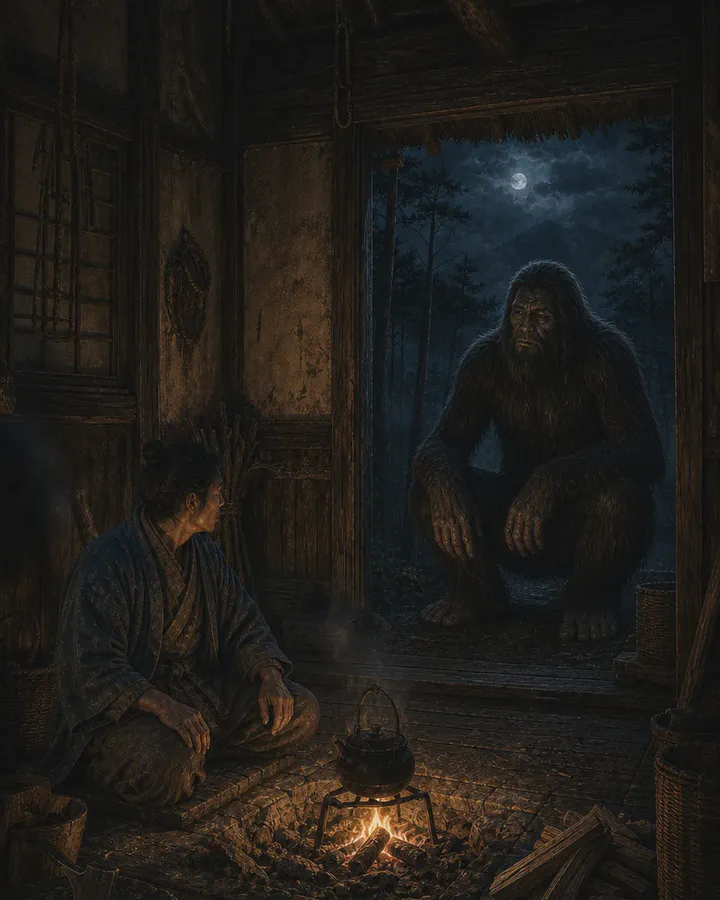
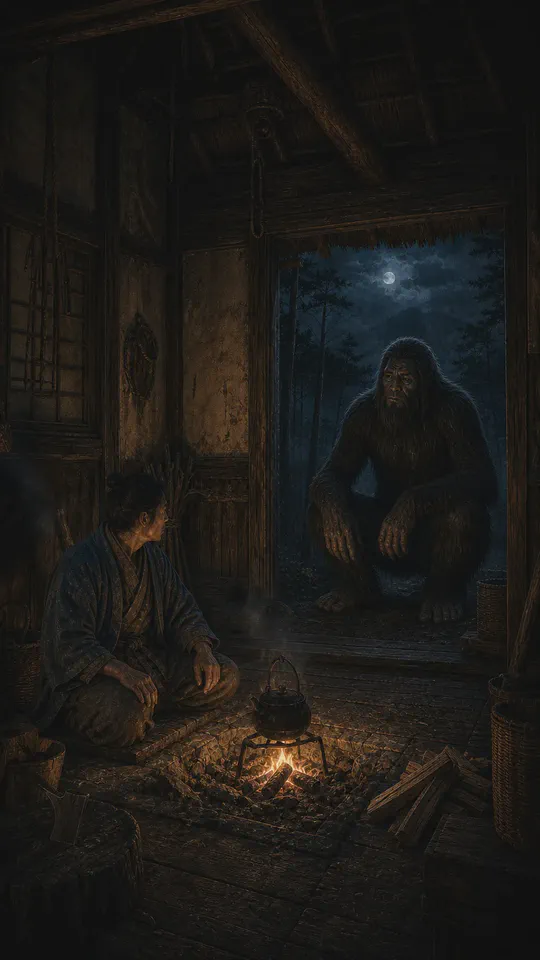
Ishikawa Jun’ichirō published material from Hinoemata in Fukushima in the journal Ashinaka in 1960. An old man is warming himself at a fire in a mountain hut. Something arrives and sits with him — and begins saying his thoughts out loud as he has them.
He thinks about the creature and it tells him he is thinking about it. He thinks about being frightened and it says so. Every move he could make is announced before he makes it, which means there is no move he can make.
Then a stick of firewood in the fire pops of its own accord and hits the creature.
It had not seen that coming. Nobody had thought it. The creature is startled, and it leaves.
Weaknesses and countermeasures
The Fukushima tale is the answer, and it is a very good one.
You cannot outthink a mind-reader by thinking harder, and you cannot surprise it by planning a surprise, because the plan is the thing it reads. The only category of event it cannot anticipate is one that no mind produced.
A log spitting a spark is not a strategy. It is not anyone’s intention. It is the world doing something on its own while two parties sit watching each other, and it is the one gap in an otherwise complete defence.
Note what this is not. It is not a weapon, a charm, or a technique. Nobody in the story defeats the satori. Something happens near it.
Two records, kept apart
Sekien’s entry and the Hinoemata tale are not the same event and this page does not merge them.
Sekien gives Hida and Mino, an appearance, an ability, and a disposition — no story, no encounter, no ending. The Fukushima material is a story with a hut, a fire, a man, and a resolution, collected in a different province and published nearly two centuries later.
What they share is the mechanism. Something that knows what you are about to do. Whether the creature of the tale is Sekien’s creature is not established, and there is a longer argument about how both relate to Chinese accounts of mountain beasts that this page does not attempt to settle.
Documented entry and later imagery
Documented entry. Sekien, 1779: a black, long-haired creature of the deep mountains of Hida and Mino that understands speech and perceives what is in the mind, does not harm people, and departs when someone decides to kill it. Separately, a tale from Hinoemata in Fukushima, published 1960, in which such a creature narrates a man’s thoughts in a mountain hut until a piece of firewood pops unexpectedly and startles it away.
Later imagery. Modern versions usually make the satori a threat — it reads your mind in order to catch you, and the firewood becomes a clever trick the man pulls off. Both changes are small and both matter. The 1779 entry describes something that reads minds and then leaves people alone, and the 1960 tale is about a man who was completely helpless and was saved by an accident.
Sources and further reading
- Museum Toriyama Sekien, Konjaku Gazu Zoku Hyakki (今昔画図続百鬼), 1779 (external link) Tokyo Museum Collection The 1779 sequel to Sekien's illustrated demon catalogue, containing both Kawa-akago and Suiko.
- Fieldwork collection Ishikawa Jun'ichirō, Hinoemata mukashibanashi-shū, in Ashinaka no. 70 (1960) Ashinaka A mountain hut in Hinoemata, Fukushima. A creature warms itself at the fire and names each thought the old man has, until a stick of firewood pops of its own accord and startles it. Consulted in the printed issue; no stable public URL recorded.
- Database Satori (さとり) entries (external link) International Research Center for Japanese Studies Summary, bibliography and regional information for the Hinoemata tale.
Related yokai
Yamabiko
山彦(やまびこ)
The echo in a Japanese valley was heard as an answer before anyone drew the thing answering — and when painters finally gave it a body, they produced a small animal that is neither quite a dog nor quite a monkey.
Yamauba
山姥(やまうば)
A man carries a woven object home from the hills, and that night a woman's voice demands the return of her ashinaka.