Samebito: The One Whose Tears Were Worth Something
鮫人(さめびと) Samebito ASCII: Samebito
Also known as: こうじん, Shark-Man, 鮫人 (jiaoren)
Pronunciation: sah-meh-BEE-toh
In a story Lafcadio Hearn published in English in 1900, a man on the Long Bridge of Seta shelters a creature banished from the Dragon Palace — and is repaid in tears that harden into jewels, which only come when the grief behind them is real.
Quick Facts
- Habitat
- Pond, River, Sea
- Region
- Ōmi — the Long Bridge of Seta and Lake Biwa
- Recorded period
- Lafcadio Hearn's Shadowings (1900), attributed by Hearn to a book he names Kibun-Anbaiyoshi
- Nature
- Helpful
- Danger rating
The danger rating is an editorial summary made for readability. It is not an objective measure found in folklore sources.
Watch the Short
What is Samebito?
Every other creature in these files had to be translated to reach you. This one did not. It arrived in English already, in 1900, in Shadowings by Lafcadio Hearn — a writer who had moved to Japan, taken Japanese citizenship, and spent the rest of his life explaining the country to readers who would never see it.
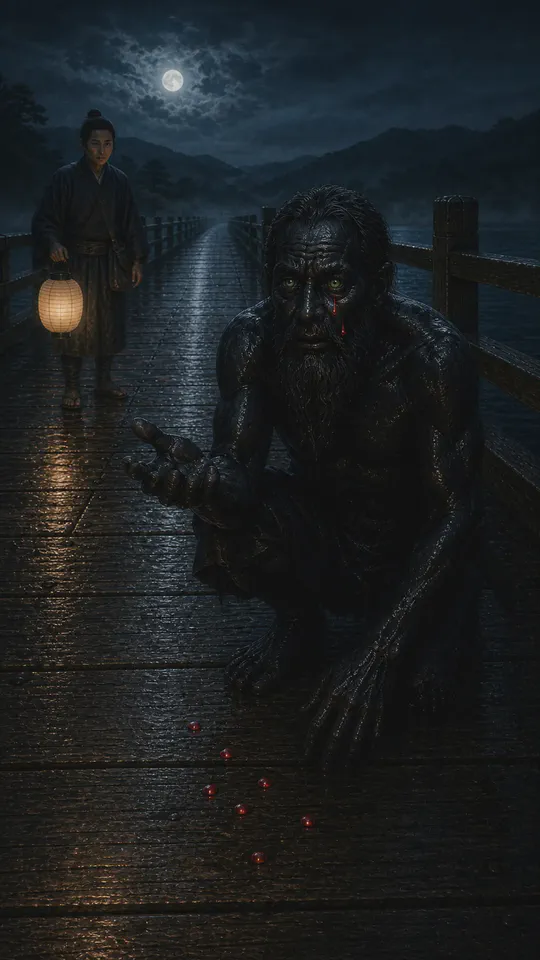
The story is called “The Gratitude of the Samébito.” Tawaraya Tōtarō is a man of modest means in Ōmi, near Lake Biwa, twenty-nine years old and unmarried. He is crossing the Long Bridge of Seta when he finds something crouched on it.
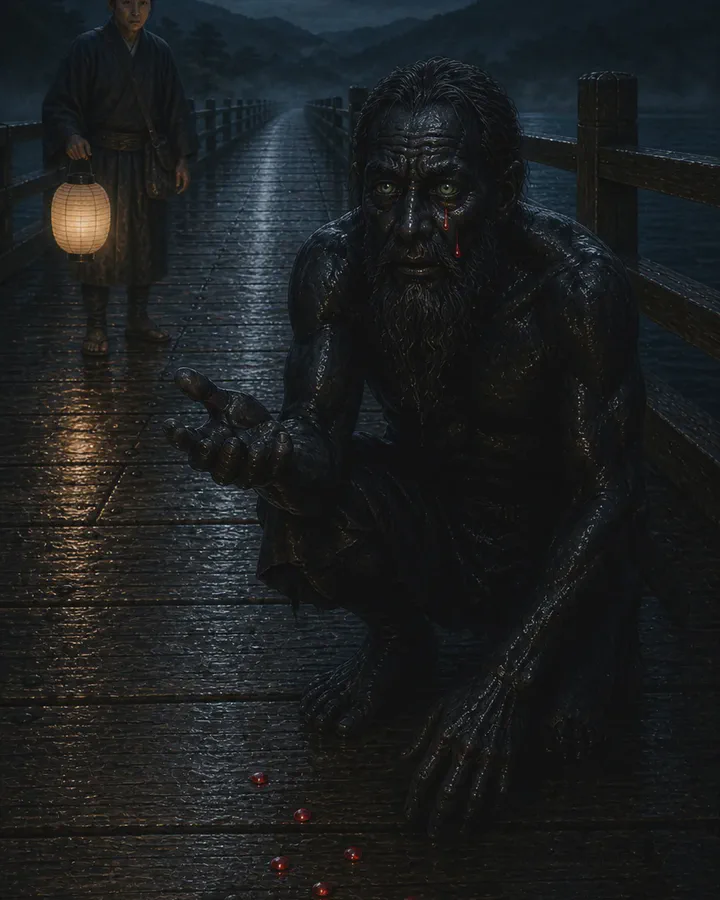
It has a body black as ink, a face like a demon’s, eyes green as emeralds, and a beard like a dragon’s. It is not attacking anyone. It has been thrown out of the Dragon Palace for a small offence, and it has nowhere to go.
Tōtarō takes it home and puts it in his garden pond.
Appearance
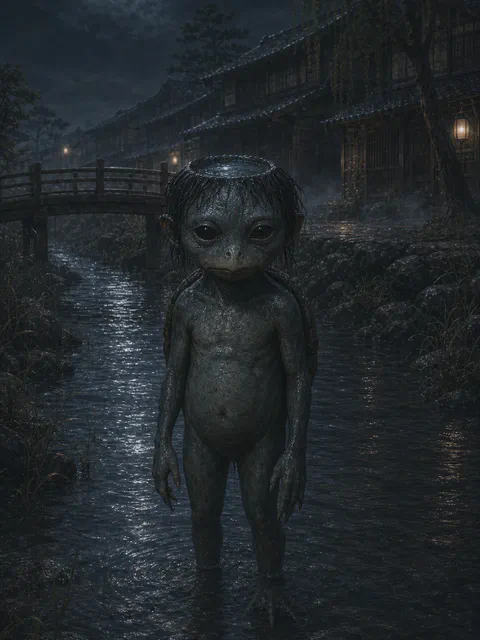
Hearn’s four clauses are the whole description, and our illustration follows them exactly: ink-black skin, a demon’s face, emerald eyes, a dragon’s beard.
Notice what is missing. No fins, no gills, no shark’s head, nothing fishlike at all. The word same means shark, but the creature Hearn describes is shaped like a man and reads as one — which is why the scene on the bridge works. Tōtarō is not looking at an animal. He is looking at someone in trouble.
The crimson on its face in our illustration is a tear.
Behavior and abilities
- It is in exile. It did something minor, it was dismissed, and it cannot go back until it is pardoned.
- It cannot feed itself on land. The shelter Tōtarō offers is not a courtesy. It is why the creature survives the story.
- It weeps jewels. Tears fall and harden into rubies.
- It asks for nothing. Nowhere does it bargain, propose terms, or offer its tears in trade.
What the story is actually about
At a temple festival Tōtarō sees a girl named Tamana and cannot stop thinking about her. Her family names their price for the betrothal: ten thousand jewels. It is meant to be impossible, and it works — Tōtarō stops eating, stops sleeping, and begins to die of it.
It is a transaction. A marriage is being sold, the sum is set high enough to refuse him without saying no, and the man is destroyed by a number.
The Samebito learns Tōtarō is dying and weeps for him. The tears fall and are rubies — but not ten thousand of them. Later Tōtarō takes his guest to the Long Bridge of Seta so he can look out toward the water, and there the Samebito weeps again, and the second weeping completes the count.
Then the pardon arrives. The Samebito is summoned back to the Dragon Realm, leaps from the bridge, and is gone. Tōtarō delivers ten thousand jewels and marries Tamana.
Weaknesses and countermeasures
The obvious question: why not make him cry on purpose?
The story answers by never letting anyone try. Both weepings happen because the Samebito is genuinely moved — first by a dying friend, then by the sight of the water he was exiled from. Tōtarō manufactures neither. He despairs in front of his guest, and his guest reacts.
That is the closest thing to a rule in the whole tale. The tears are worth something because they are not for sale. A creature that could be farmed would be a resource. This one is a houseguest, and the difference is the entire point.
The Chinese jiaoren and Hearn’s version
The characters 鮫人 are read jiaoren in Chinese, and they are much older than Hearn. The Bowuzhi, a Chinese work of natural curiosities, describes dwellers of the southern sea who live in the water as fish do, never stop weaving, and weep pearls.
That is a different creature. No Tōtarō, no bridge, no banishment, no debt — only beings in the sea whose eyes produce pearls. What survives the journey to Hearn’s story is a single image: weeping that yields something hard and valuable.
Hearn points further back still, naming a Japanese book, Kibun-Anbaiyoshi, as his source. So the chain runs: an old Chinese motif of sea-dwellers who weep pearls, a Japanese book that built a plot around one, an Irish-Greek writer in Japan who put it into English in 1900, and this page.
Documented tale and later imagery
Documented tale. Hearn’s Shadowings, 1900: a creature black as ink with a demon’s face, emerald eyes and a dragon’s beard, banished from the Dragon Palace and found on the Long Bridge of Seta; sheltered in a garden pond by Tawaraya Tōtarō; weeping rubies when Tōtarō is dying of a betrothal price of ten thousand jewels; weeping the remainder on the bridge; pardoned, and gone into the lake. Separately, the Bowuzhi’s southern-sea jiaoren, who weave underwater and weep pearls.
Later imagery. The name has drifted toward the literal. Modern collections give Samebito a shark’s head, a fish’s lower body, or the outline of a Western merman, and file it under sea monsters. Hearn’s creature has none of that, and would not work if it did. The story needs a man on a bridge to look at something frightening and decide it is a guest rather than a threat — and then to be right about it, at a scale he never asked for.
Sources and further reading
- Primary text Lafcadio Hearn, Shadowings (1900): The Gratitude of the Samébito (external link) Project Gutenberg Hearn's English retelling. Tawaraya Totaro meets a Shark-Man banished from the Dragon Palace on the Long Bridge of Seta, shelters him, and is repaid in tears that harden into jewels. Hearn attributes the story to a book he names Kibun-Anbaiyoshi.
- Reliable secondary Samebito no ongaeshi (鮫人の恩返し), Seta (external link) Otsu City Municipal account of the same story tied to its actual geography, naming Totaro, the Long Bridge of Seta, and the dragon king.
- Primary text Bowuzhi (博物志), volume 2 (external link) Chinese Text Project The older Chinese jiaoren: dwellers of the southern sea who live in water like fish, never stop weaving, and weep pearls. No Totaro, no bridge, no banishment — a separate and earlier motif.
Related yokai
Hakutaku
白澤(はくたく)
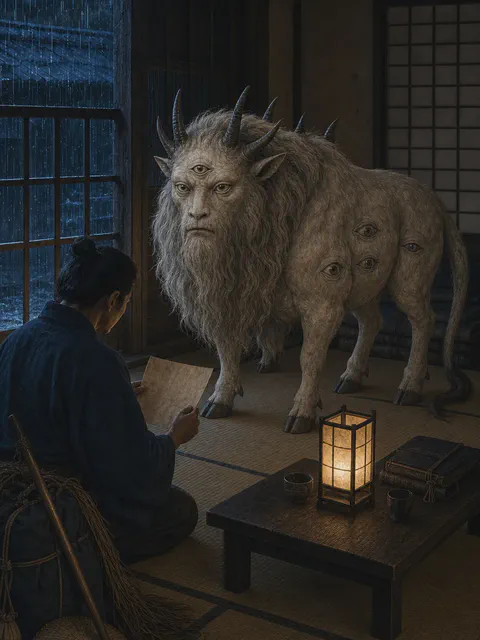
A beast from Chinese legend that named every harmful thing in the world for the Yellow Emperor, and whose image — nine eyes, six horns, a human face — was carried by Edo travelers and set beside pillows during the cholera epidemic of 1858.
Kappa
河童(かっぱ)
A child-sized water yokai whose strength lives in the water held by the dish on its head.