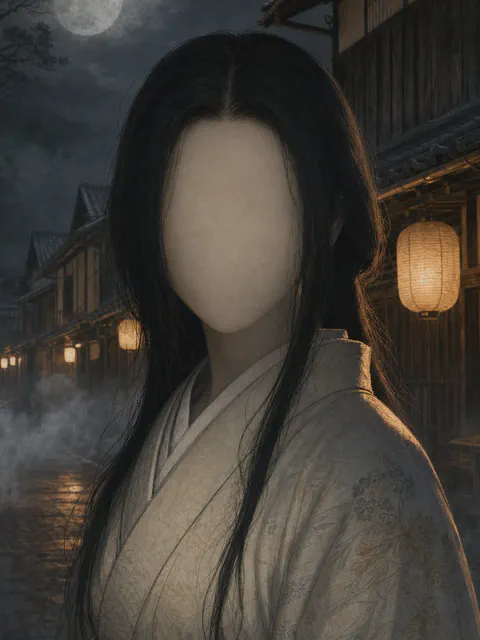
Rokurokubi: The Yokai with the Stretching Neck
轆轤首(ろくろくび) Rokurokubi ASCII: Rokurokubi
Also known as: Nukekubi
Pronunciation: roh-koo-roh-koo-bee
A seemingly human figure whose neck stretches at night—and one name that once covered more than one uncanny form.
Quick Facts
- Habitat
- House
- Region
- Japan
- Recorded period
- Edo period, modern folklore collections
- Nature
- Mixed
- Danger rating
The danger rating is an editorial summary made for readability. It is not an objective measure found in folklore sources.
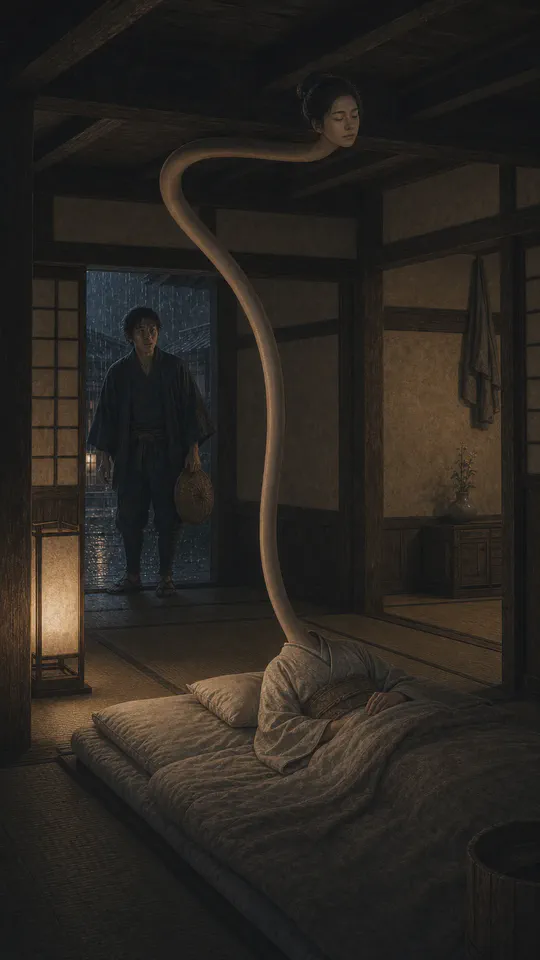
Watch the Short
What is Rokurokubi?
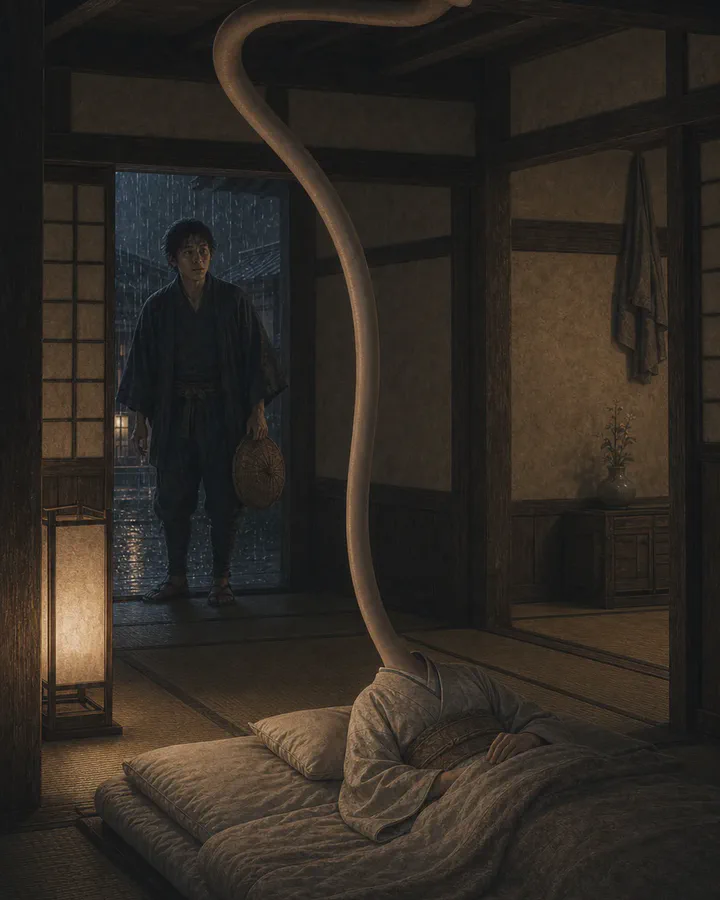
Rokurokubi is the name given to a strange humanlike being best known today for a neck that stretches to an impossible length. By day, a rokurokubi may appear to be an ordinary person. At night, often while the body rests, the neck extends and the head travels far beyond normal human reach.
That familiar image is only part of the history. Japanese sources and later scholarship distinguish a long-necked form from an older flying-head form in which the head separates from the body. The detached form is also called nukekubi. The two have long shared the name rokurokubi while describing two quite different things happening to a neck.
Appearance
The long-necked rokurokubi usually keeps a human face, hair, clothing, and body. Its defining transformation is the continuous neck connecting head and torso. Edo-period artists made this shape instantly readable by sending the neck around a screen, through a room, or high above a sleeping body.
Women appear frequently in famous images, including works discussed by the National Diet Library, but the visual tradition is not exclusively female. The same NDL overview points to a male example in a print by Tsukioka Yoshitoshi. A woman with a stretching neck is therefore an iconic design, not a rule that every rokurokubi must follow.
The flying-head type looks different. Its head leaves the torso instead of remaining attached by a long, ordinary-looking neck. Some historical images and stories blur the transition with a thin line or cord-like connection, which helps explain how several related forms came to be grouped under one name.
Behavior and abilities
Transformation commonly happens at night. In some stories the person lives and works among other people before the hidden nature is discovered. A folklore record collected in Makino, Shiga Prefecture, reduces the encounter to one striking contrast: a diligent daughter-in-law in a household was a rokurokubi.
Accounts do not agree on what happens after the transformation. A head or extended neck may wander, observe its surroundings, or create the shock of being discovered. More threatening behavior appears in some narratives, but there is no sound basis for making every rokurokubi a blood-drinker, a man-eater, or a deliberate hunter.
The person’s awareness also changes from story to story. Modern summaries sometimes state that a rokurokubi never knows what happens at night. That is an effective horror premise, but it is not a universal rule shared by all long-necked and flying-head traditions.
Folklore accounts and changing forms
Scholar Yokoyama Yasuko traces the flying-head image to Chinese accounts of the feitouman, beings whose heads could leave their bodies and fly. Such material circulated in Japan, and flying-head stories became widespread in the Edo period.
Yokoyama describes a visual transformation from the flying-head type, to a form connected by a cord or sinew, and finally to the long-necked type familiar today. She argues that illustrated books and popular print culture helped the continuous neck become dominant: it gave artists a clear and entertaining way to show the path of a moving head.
This history is a reminder that yokai are not always timeless species with unchanging bodies. Texts, imported ideas, pictures, jokes, and local stories can reshape what later audiences think a creature has always looked like.
The image tradition is varied even within the famous long-necked form. The National Diet Library notes female examples by Toriyama Sekien and Utagawa Toyokuni, while the International Research Center for Japanese Studies catalogues an Utagawa Kuniyoshi image of a long-necked female figure. Other artists used the stretching-neck motif for male figures and for beings identified differently.
Weaknesses and countermeasures
No single weakness or reliable protective method is documented across rokurokubi traditions. Leaving the room, waking the body, or following the wandering head may work inside a particular story, but none should be presented as a nationwide rule.
The same caution applies to the detached-head form. Rules sometimes attached to nukekubi cannot automatically be transferred to every long-necked rokurokubi. When a tale provides a method of escape, it belongs first to that telling and its specific kind of transformation.
Traditional folklore and later imagery
Documented tradition. The name rokurokubi has covered at least two major forms: a head that separates from the body and a head that remains attached by an enormously extended neck. Edo-period visual culture helped make the long-necked form especially prominent. Recorded examples include people who seem ordinary within a household, and famous artwork includes both women and men.
Later imagery. Modern horror and fantasy often standardize rokurokubi as a woman whose neck stretches like a snake and who hunts victims at night. Games and animation may add venom, blood-drinking, conscious control, or a fixed origin story. Those are usable fictional inventions, and they are also why the older accounts read as so much stranger and quieter. Our short video uses an adult woman at a rainy inn and a continuous stretching neck as a cinematic version of the famous Edo-period long-necked form.
Sources and further reading
- Database Database of Folklore and Yokai Phenomena (怪異・妖怪伝承データベース) (external link) International Research Center for Japanese Studies Use individual records; do not generalize one local account nationwide.
- Academic paper Yokai and Comparative Cultural Studies — Focusing on Rokurokubi (妖怪と比較文化研究――轆轤首を中心に) (external link) Yokoyama Yasuko; ICU Comparative Culture 36 (2004) Distinguishes the flying-head and long-necked forms and traces the visual transition from flying head to cord-neck to long neck.
- Library The World of Yokai through Toriyama Sekien's Yokai Encyclopedias (external link) National Diet Library Image Bank Surveys rokurokubi images by multiple artists, including female and male examples.
- Fieldwork collection Rokurokubi household account from Makino, Shiga, record 2360386 (external link) International Research Center for Japanese Studies A local account of a diligent daughter-in-law who was said to be a rokurokubi.
- Museum Rokurokubi image attributed to Utagawa Kuniyoshi (external link) International Research Center for Japanese Studies; Náprstek Museum collection Catalogue record describing a long-necked female figure in an Utagawa Kuniyoshi work.
Related yokai
Yuki-onna
雪女(ゆきおんな)
A pale woman seen on winter roads, sometimes deadly, sometimes harmless, and never described the same way everywhere.