
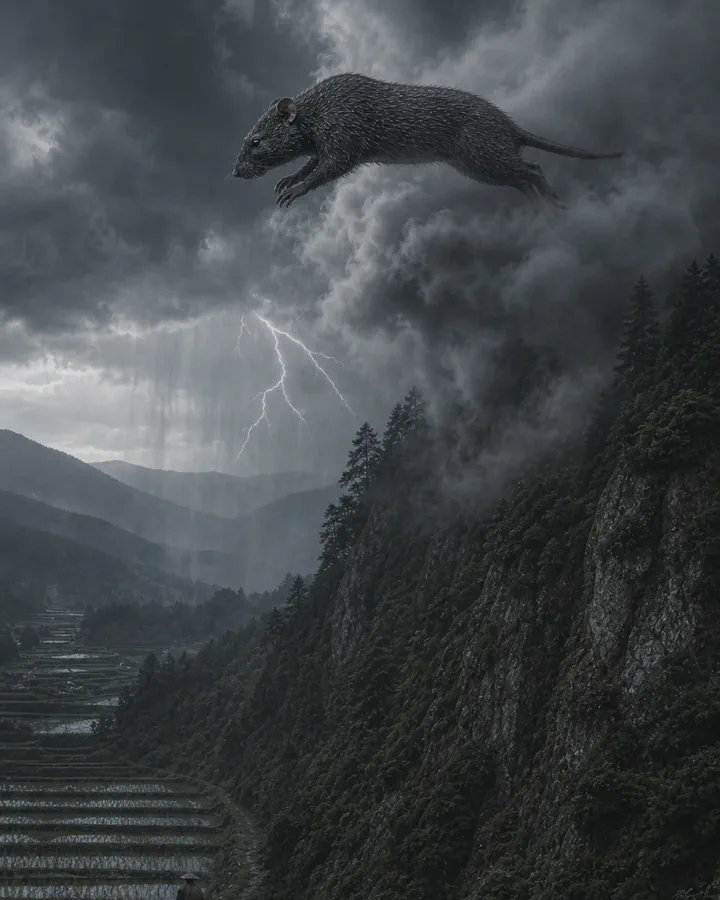
Raijū: The Beast That Rode the Storm
雷獣(らいじゅう) Raijū ASCII: Raiju
Pronunciation: rye-JOO
An Edo-period account from Shimotsuke describes a mouse-like animal that waited in a mountain hole each summer until its own thundercloud came to collect it.
Quick Facts
- Habitat
- Mountain, Sky, Field
- Region
- Karasuyama (Shimotsuke), Iwatsuki
- Recorded period
- Hokusō Sadan (1829 printing), Edo-period essays and images
- Nature
- Harmful
- Danger rating
The danger rating is an editorial summary made for readability. It is not an objective measure found in folklore sources.
Watch the Short
What is Raijū?
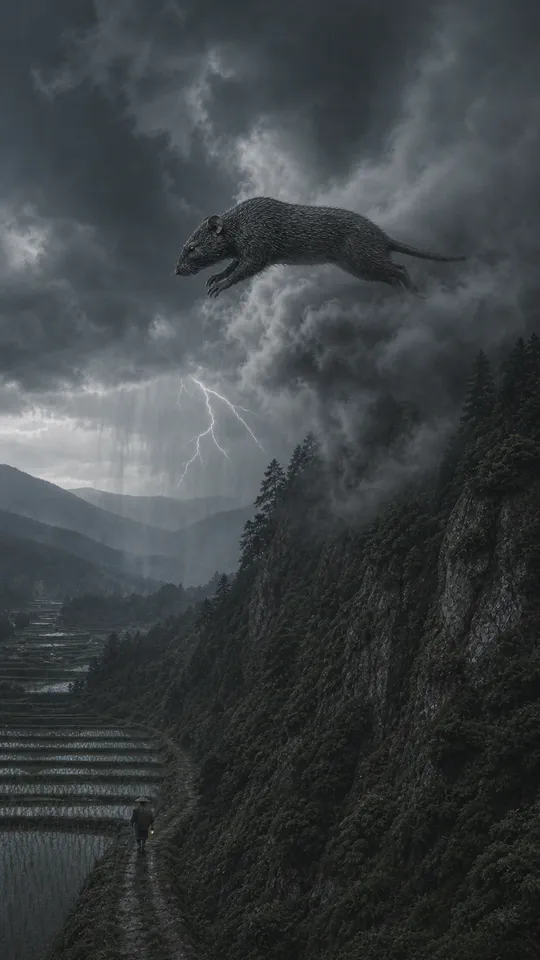
Raijū means “thunder beast,” and it is the answer Edo-period Japan gave to a reasonable question: if lightning strikes a hillside and leaves gouged wood and torn earth behind, what made those marks?
The account featured here comes from Hokusō Sadan, an essay collection by Tachibana Shunki; the printing held by Ibaraki University is dated 1829. It describes a creature living near Karasuyama in Shimotsuke Province, in what is now Tochigi. The animal resembled a mouse, though larger than a weasel. In summer it would appear at a hole in the mountain and watch — until the evening storm cloud that had come for it arrived, and it rode away into the sky.
That is the striking part. The raijū does not throw lightning. It commutes on it.
Appearance
Our illustration follows the Karasuyama record and nothing else: a single animal, mouse-like but larger than a weasel, with wet grey-black fur, round ears, a narrow muzzle, a low body, and clawed limbs. Lightning happens in the sky around it, never from its eyes, mouth, or coat.
We commit to one form because the sources do not. That is a deliberate choice about which record to visualize, not a claim that this is what a raijū looks like.
Behavior and abilities
- It waits. The creature watches from a hole in the mountainside, in summer, when storms are due.
- It rides. The cloud is described as coming for it, and it goes with the cloud.
- It leaves marks. Split trees and gouged bark were read as traces of its passage.
Notably absent: any account of the raijū attacking a person. It is a creature associated with a hazard rather than one that hunts.
Folklore accounts and regional variations
Almost every record gives the raijū a different body, and that disagreement is the most interesting thing about it.
Toryūkō Zuihitsu describes one captured at Iwatsuki that looked like a puppy, with claws as sharp as a bear’s and distinctive hind legs. An Edo-period printed sheet held by the National Museum of Japanese History shows a raijū with a single leg. Painted examples in museum collections vary again.
This is what happens when a name is attached to an event rather than to an animal. Everyone knew what thunder did. Nobody agreed on what it was, and the descriptions people offered depended on which unlucky creature was found near a strike, or which artist was working from which rumor.
Weaknesses and countermeasures
No charm, no ritual, no defense appears in these sources — but one record does something better. At Iwatsuki, a raijū was reportedly caught and kept alive. That is as close as the tradition comes to a weakness: not a way to drive the thunder beast off, but the claim that someone once had one in a box.
Traditional folklore and later imagery
Documented tradition. A mouse-like animal larger than a weasel, watching from a mountain hole near Karasuyama and departing on a summer thundercloud; elsewhere a puppy-like creature with bear’s claws, or a one-legged beast in a printed image. The storm is its transport, and the records do not settle on a single body.
Later imagery. Modern games and illustrated collections have converged on one design — a wolf or tiger wreathed in electricity, hurling lightning as a weapon, often serving the thunder god Raijin as a pet. It makes a good boss fight. It also throws away what the Edo accounts were actually doing, which was trying, in good faith and with no agreement whatsoever, to describe an animal that nobody managed to see clearly.
Sources and further reading
- Primary text Raijū entry from Hokusō Sadan (external link) Tachibana Shunki; International Research Center for Japanese Studies The adopted account from near Karasuyama in Shimotsuke: mouse-like but larger than a weasel, watching from a mountain hole in summer until its thundercloud arrives to carry it away.
- Library Hokusō Sadan (北窓瑣談), 1829 printing (external link) Ibaraki University Digital Collections Digitized copy of the Edo-period essay collection containing the account.
- Primary text Raijū entry from Toryūkō Zuihitsu (external link) International Research Center for Japanese Studies A captured raijū at Iwatsuki described as puppy-like, with claws as sharp as a bear's. A different body from the Karasuyama account.
- Museum Printed sheet, one-legged raijū (tentative title) (external link) National Museum of Japanese History An Edo-period image showing yet another raijū form, with a single leg.
- Museum Raijū-zu (雷獣図), Edo period (external link) Yumoto Koichi Memorial Japan Yokai Museum Museum exhibition record of an Edo-period painting of the creature.
Related yokai
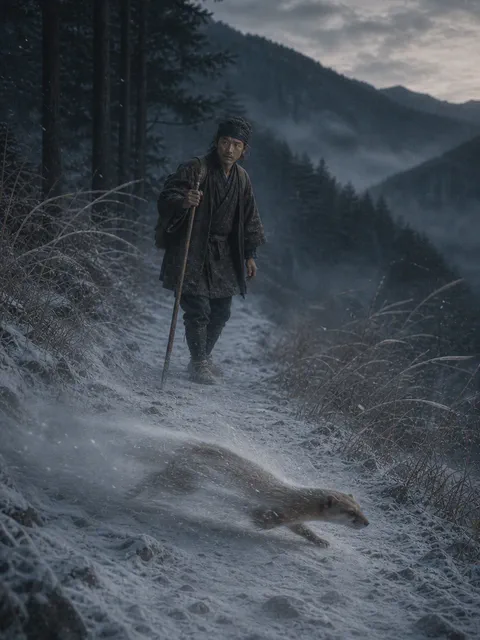
Kamaitachi
鎌鼬(かまいたち)
A 1955 Nagano record describes a weasel-like being so fast no one has seen it — known only by the clean cut it leaves on a stumbling traveler's shin.
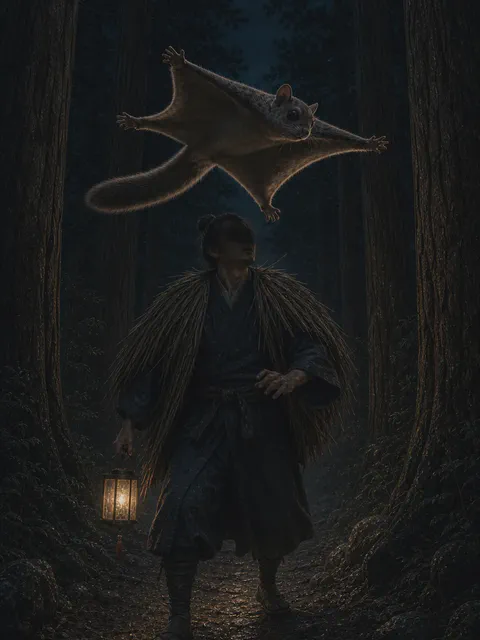
Nobusuma
野衾(のぶすま)
A 1938 Tokyo record describes something like a flying squirrel that drifts down onto a traveler and covers the eyes and mouth — and stops there.