
Ōtakemaru: The Demon of Mt. Suzuka and His Three Swords
大嶽丸(おおたけまる) Ōtakemaru ASCII: Otakemaru
Also known as: Ōtake-maru
Pronunciation: OH-tah-keh-mah-roo
In the Muromachi tale Tamura no Sōshi, the demon god Ōtakemaru of Mt. Suzuka cannot be found or beaten by force. The hero Tamura-maru wins only because Suzuka Gozen deceives the demon and takes his swords.
Quick Facts
- Habitat
- Mountain
- Region
- Mt. Suzuka (Ise–Ōmi border)
- Recorded period
- Muromachi otogi-zōshi (Tamura no Sōshi, Suzuka no Monogatari)
- Nature
- Harmful
- Danger rating
The danger rating is an editorial summary made for readability. It is not an objective measure found in folklore sources.
Watch the Short
Who is Ōtakemaru?
Ō is great. Take is a high mountain peak. Maru is a common ending for names of men, swords, and ships. Ōtakemaru is the great one of the peaks — the demon god of Mt. Suzuka, the pass between Ise and Ōmi on the road east from the capital.
He appears in a Muromachi-period story usually called Tamura no Sōshi, or Suzuka no Monogatari, written in the fifteenth or sixteenth century. It is a long tale of a hero and three demon campaigns, and Ōtakemaru is the first and most formidable of the demons.
The tale
Mt. Suzuka had long been a dangerous crossing, and stories of bandits and demons gathered there. In this one, the emperor orders the general Tamura-maru to destroy the demon god of the mountain.
Tamura-maru is a legendary figure modelled on Sakanoue no Tamuramaro, the real general of the late eighth century. The story makes him far more than that: in the tale he is an incarnation of Kannon.
He cannot win. Ōtakemaru flies, hides, and cannot be found; and he holds three swords that make him unbeatable.
The one who can reach him is Suzuka Gozen, a heavenly woman living on the mountain, whom the tale makes an incarnation of the goddess Benzaiten. She binds herself to Tamura-maru. Then she wins Ōtakemaru’s trust, draws him in, and takes the three swords from him.
Disarmed, the demon god can finally be struck down, and Tamura-maru kills him.
Versions
Tamura no Sōshi survives in many manuscripts, and its details vary from one line to another — the demon’s name is sometimes written Ōtake-maru, the sequence of campaigns differs, and later northern storytellers retold it again. This article keeps to the core the versions share: the demon who cannot be found, the three swords, Suzuka Gozen’s deception, and the final stroke.
Appearance
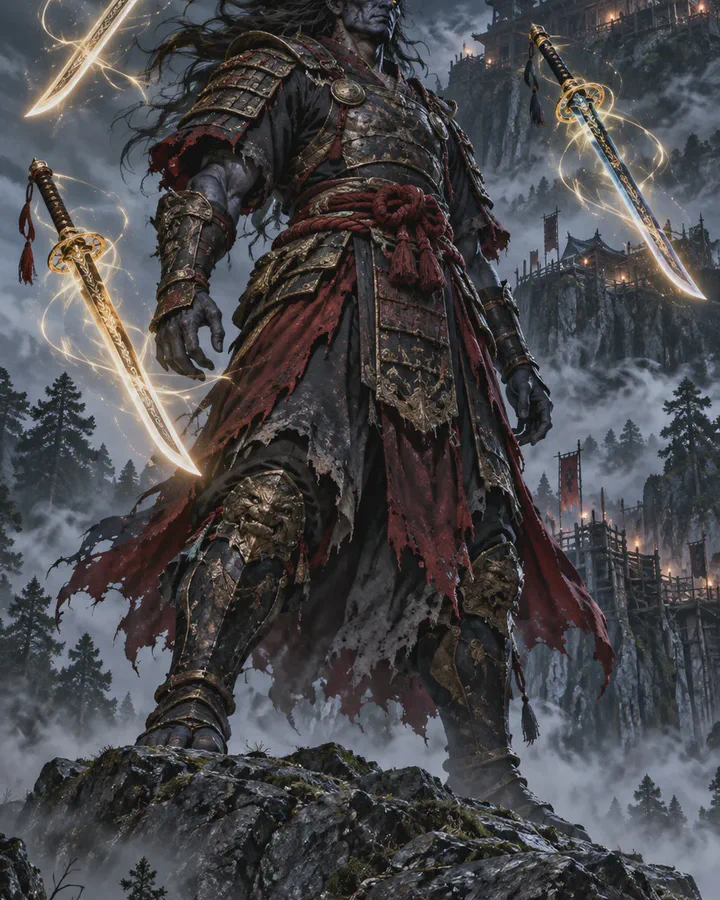
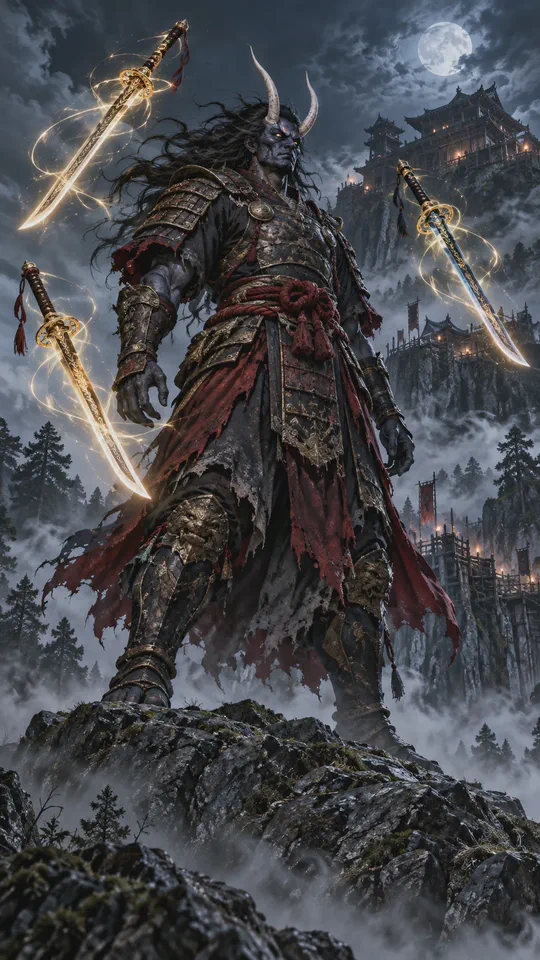
The tale gives him a demon’s body and a mountain fortress, and above all the swords. Our illustration shows him in armour on a crag of Mt. Suzuka, the three swords circling him in the air — the thing that has to be taken away before anyone can touch him.
Behavior and abilities
- He cannot be found. The hero’s first problem is simply reaching him.
- He cannot be beaten by force. The three swords protect him.
- He can be deceived. The one weakness the tale gives him.
Weaknesses and countermeasures
The swords. As long as Ōtakemaru holds them he is invincible; once Suzuka Gozen has them, he is not. The victory in the tale belongs as much to her as to the general with the famous name.
Tale and later imagery
Documented tale. Tamura no Sōshi / Suzuka no Monogatari, Muromachi period: the emperor orders Tamura-maru to destroy the demon god of Mt. Suzuka; the demon cannot be found or defeated; Suzuka Gozen deceives him and takes his three swords; Tamura-maru then kills him.
Later imagery. Modern yokai books often rank Ōtakemaru with Shuten-dōji and Tamamo-no-Mae as one of the three great yokai of Japan, a pairing that is a modern grouping rather than an old one. He is also sometimes presented as a real event in the career of Sakanoue no Tamuramaro.
The tale is clearer than either. A hero is sent to kill a demon, and cannot. A woman the demon trusts takes away what makes him strong.
Sources and further reading
- Academic paper 005-0384: Tamura and Suzuka print notes (external link) Art Research Center, Ritsumeikan University (ArtWiki) Dates Tamura no Sōshi to the mid-to-late Muromachi period and describes Suzuka Gozen deceiving Ōtakemaru and taking his three swords.
- Library Researching the many legends of Suzuka Gozen (external link) Collaborative Reference Database, National Diet Library Reference record pointing to Tamura no Sōshi, where Tamuramaro defeats the demon Ōtakemaru with Suzuka Gozen's help.
- Academic paper Suzuka Pass and Sakanoue no Tamuramaro (external link) Yamada Yūji; Mie University repository The Suzuka mountain legend in medieval otogi-zōshi and Noh, and Suzuka Gozen's help in Tamura no Sōshi.
- Academic book Suzuka no Monogatari: kenkyū to chūshaku (external link) Andō Hideyuki; Seibundō Publisher's page for a study of the Muromachi tale, its manuscript lines, and the Ōtake episode.
Related yokai
Shuten-dōji
酒呑童子(しゅてんどうじ)
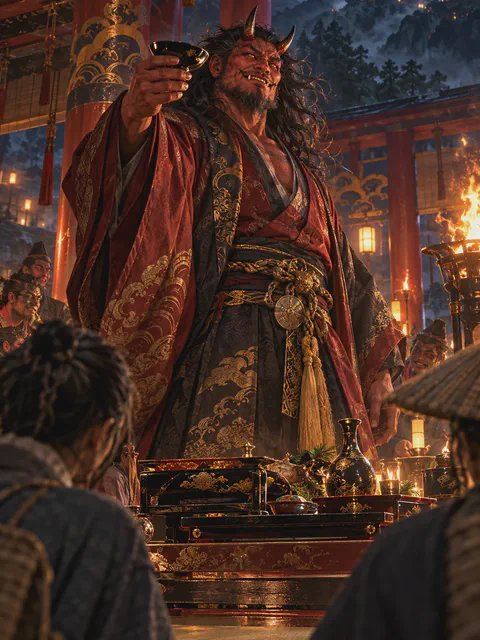
The tale of Shuten-dōji appeared in the fourteenth century: an oni lord on Mt. Ōe who carried off the daughters of the capital, and the warriors who got in disguised as monks and defeated him with sake.

Tamamo-no-Mae
玉藻前(たまものまえ)
In the fifteenth-century tale, Tamamo-no-Mae is the most learned woman at the court of Retired Emperor Toba. He falls ill, divination names her as the cause, and she flees to Nasu as a fox. The killing stone came later.