Ōmukade: The Thing the Dragons Could Not Kill
大百足(おおむかで) Ōmukade ASCII: Omukade
Pronunciation: oh-moo-KAH-deh
A warrior who walked over a serpent lying across the Long Bridge of Seta was asked by the dragon clan for help — because a centipede large enough to wrap a mountain was killing them, and they could not stop it themselves.
Quick Facts
- Habitat
- Mountain, River
- Region
- Mount Mikami and the Long Bridge of Seta, in Ōmi
- Recorded period
- the Taiheiki, and the otogizōshi that developed from it
- Nature
- Harmful
- Danger rating
The danger rating is an editorial summary made for readability. It is not an objective measure found in folklore sources.
Watch the Short
What is Ōmukade?
The story starts with a test that the hero does not know he is taking.
A serpent lies across the Long Bridge of Seta, and nobody will cross. Fujiwara no Hidesato — remembered in this tale as Tawara Tōda — walks up to it and steps over. He does not fight it, negotiate with it, or go around. He simply declines to be impressed.
The serpent is a member of the dragon clan, and the point of lying on the bridge was to find someone who would do that. They have a problem, and their own kind cannot solve it.
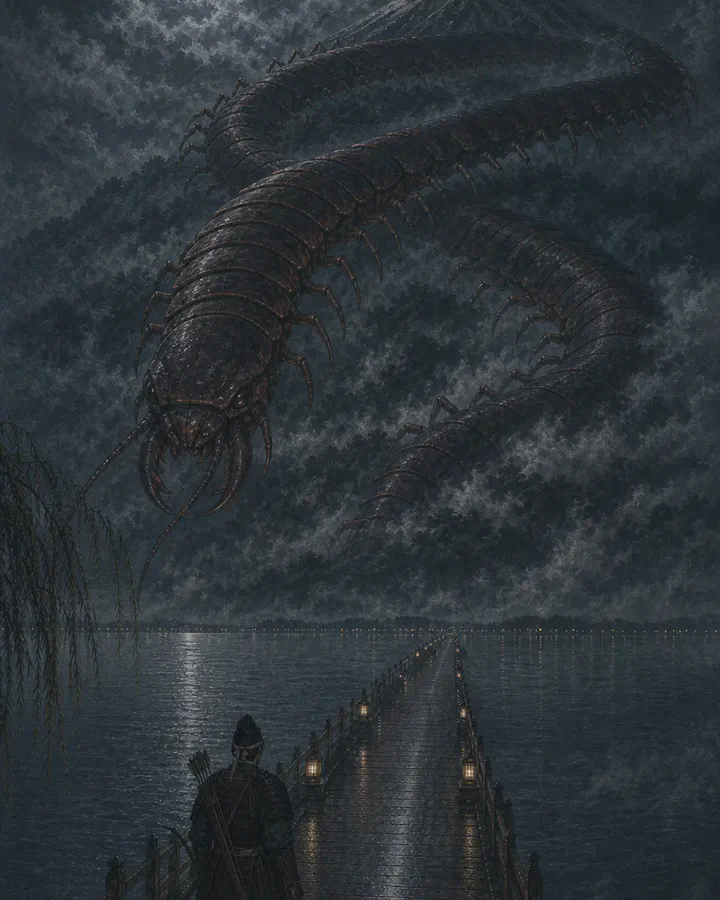
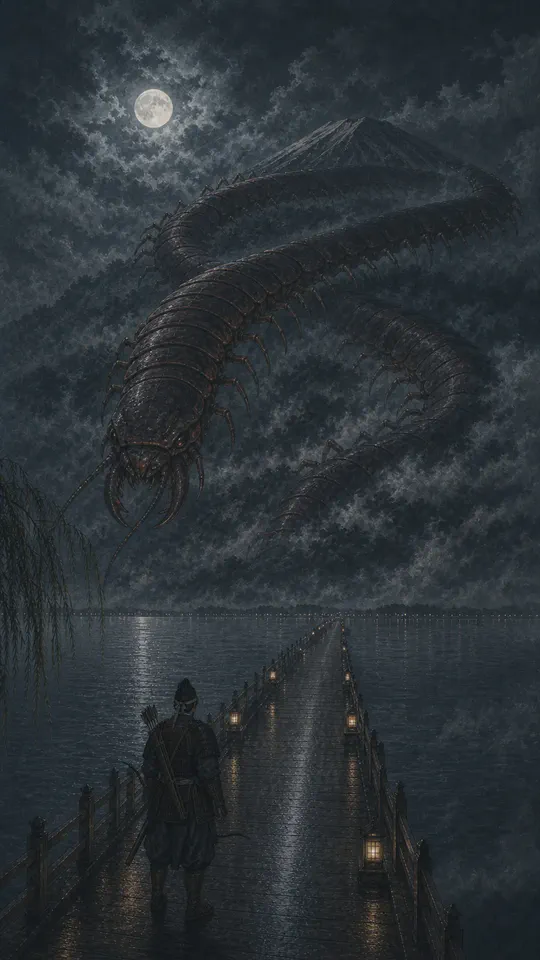
Around Mount Mikami there is a centipede. It is large enough to wrap the mountain.
Appearance
Our illustration follows the scale the story demands: a segmented body winding around an entire forested slope, legs braced along its length, seen from the far side of the water.
There is no old painting being copied here. The tale is much older than any particular image of it, and what it specifies is size — a creature measured against a mountain rather than against a person. Everything else in the picture is built to make that size legible.
Behavior and abilities
- It is enormous. The mountain is the unit of measurement.
- It is beyond the dragons. They are a supernatural clan with their own palace, and they outsource this.
- It shrugs off arrows. Hidesato is an archer, and archery is not enough.
- It has no stated motive. Nothing in the tale explains what it wants.
The third arrow
Hidesato shoots. The arrow does not go in. He shoots again, with the same result.
Then he wets the point of the third arrow with his own saliva, and that one kills it.
This is the hinge of the whole story and it is worth being precise about what it does. The problem was never the archer’s aim or his strength — both were already adequate, and both already failed. What changed was that something of the man himself went into the shot.
Whatever else that is, it is not a technique anyone else could copy from a distance.
Weaknesses and countermeasures
Saliva on the arrowhead, and it is the only recorded answer.
The tale gives no charm, no ritual, no weapon of special make, and no advice about where to strike. Two conventional arrows fail against the creature. The third differs only in having been touched by the person shooting it.
For a creature that the dragon clan themselves could not defeat, the solution turns out to be startlingly small and completely unrepeatable at scale.
What comes after
The reward comes from the dragon palace, and the versions differ on what exactly it was — a bag of rice that never empties is the item people usually remember, and different tellings supply different lists alongside it. This page keeps it general because the sources do not agree.
The tale appears in the Taiheiki and was developed further in later otogizōshi, which is the pattern for this kind of material: a medieval military chronicle carries the story, and the picture books afterwards expand the parts that are fun to illustrate.
Fujiwara no Hidesato was a real person. The centipede is a legend. The tale carries both in the same sentence, and only one of them left records anywhere else.
Documented tale and later imagery
Documented tale. From the Taiheiki and its later developments: a serpent lying across the Long Bridge of Seta, crossed without fear by Tawara Tōda; a request from the dragon clan; a centipede large enough to encircle Mount Mikami; two arrows that fail and a third, wetted with saliva, that does not; and treasures from the dragon palace afterwards.
Later imagery. The centipede has been drawn many times since and tends to grow teeth, malice, and a grudge. The tale supplies none of those. What it supplies is a creature so far beyond its opponents that a supernatural clan went looking for a human being — and a man who beat it by spitting on an arrowhead.
Sources and further reading
- Museum Fujiwara no Hidesato and the giant centipede Art Research Center, Ritsumeikan University The sequence of the tale: the serpent lying across Seta bridge, the giant centipede of Mount Mikami, and the treasures from the dragon palace.
- Database On the tale of Tawara Tōda and the centipede Collaborative Reference Database, National Diet Library Traces the story from the Taiheiki into later otogizōshi, including the arrow wetted with saliva and the variation in what the rewards were.
Related yokai
Samebito
鮫人(さめびと)
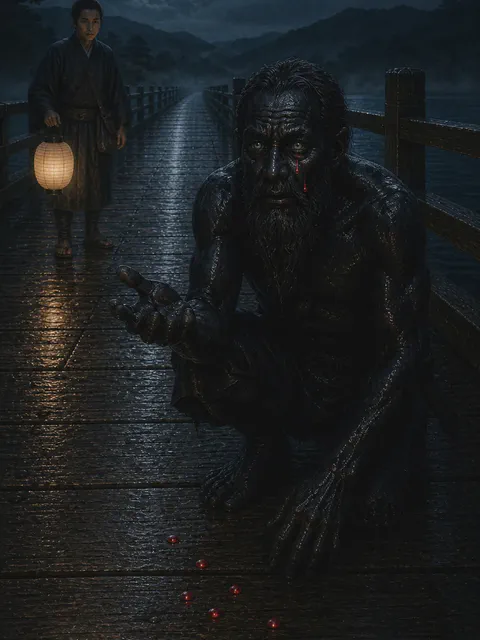
In a story Lafcadio Hearn published in English in 1900, a man on the Long Bridge of Seta shelters a creature banished from the Dragon Palace — and is repaid in tears that harden into jewels, which only come when the grief behind them is real.
Tsuchigumo
土蜘蛛(つちぐも)
A monk appears at a sick warlord's bedside and throws spider silk at him. That is the tale. But the same word, centuries earlier, was what the court called people it wanted to treat as outsiders.