
Okuri-inu: The Dog That Sees You Home
送り犬(おくりいぬ) Okuri-inu ASCII: Okuri-inu
Also known as: Okuri-ōkami, O-inu-sama
Pronunciation: oh-koo-ree ee-noo
A 1936 Gifu account describes a mountain dog that follows a traveler all the way to his door — and leaves only after salt and a word of thanks.
Quick Facts
- Habitat
- Mountain, Road, Forest
- Region
- Takayama (Gifu), Miyagi, Ōtsuki (Yamanashi)
- Recorded period
- 1936 folklore record, 20th-century folklore collections
- Nature
- Mixed
- Danger rating
The danger rating is an editorial summary made for readability. It is not an objective measure found in folklore sources.
Watch the Short
What is Okuri-inu?
Okuri-inu means “the sending dog” — an animal that escorts a traveler along a night road. It is one of the most ambiguous beings in Japanese folklore, because the same behavior can be read as protection or as predation, and the records do not settle the question.
The account featured here was collected in Kamigahora, in the Asahi district of Takayama, Gifu Prefecture, and published in the journal Minzokugaku Kenkyū in 1936. A traveler on a night mountain road realizes a mountain dog is following him. Unnerved, he ducks into a sake shop. When he comes out believing it has gone, the dog is still there — and it follows him the rest of the way home.
Appearance
The 1936 record is silent on the animal’s color, size, eyes, and teeth. It calls it a yamainu, a mountain dog, and leaves the rest unsaid.
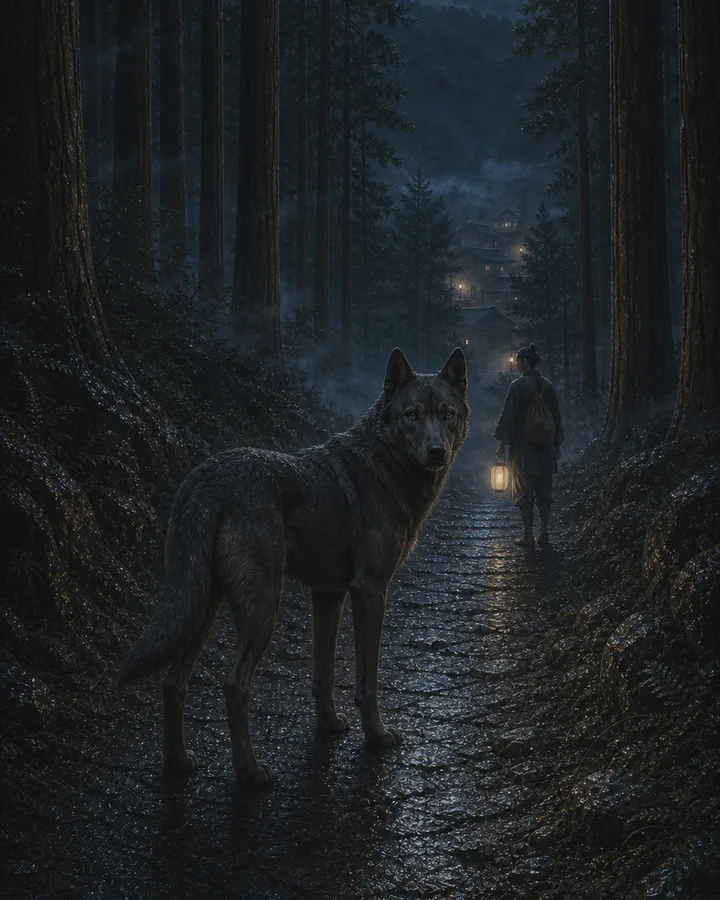
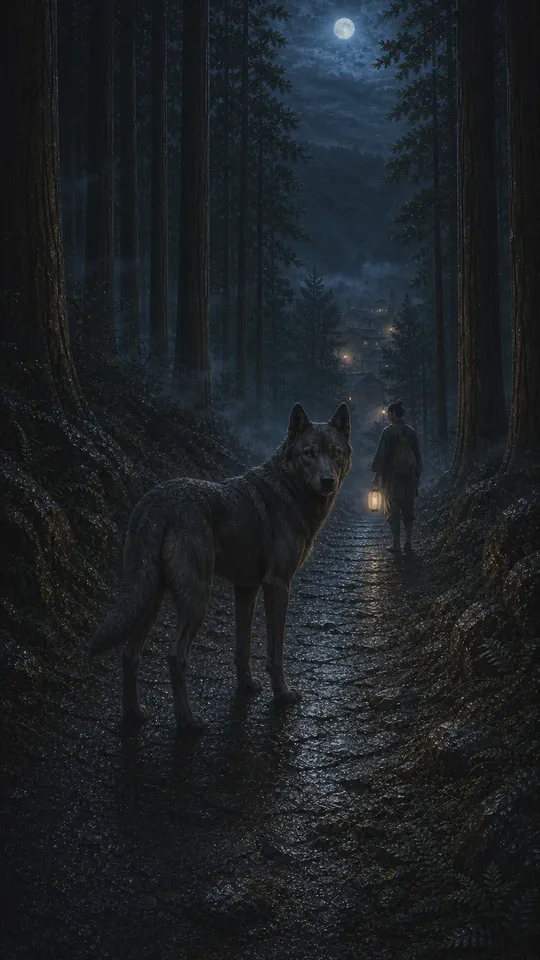
Our illustration fills that gap conservatively: a large, lean, grey-black dog recalling a Japanese native breed or the extinct Japanese wolf, with small triangular ears, a long muzzle, a low tail, and a realistic rain-soaked coat. No glowing eyes, no oversized fangs, no werewolf, no spectral glow — because none of that is in the source, and because the tension of the story depends on the animal looking entirely real.
Behavior and abilities
- It follows at a distance. The escort keeps pace on the night road without closing in.
- It waits. Sheltering indoors does not end the encounter; the dog is still there when the traveler emerges.
- It goes all the way to the door. The escort ends at the threshold of the traveler’s home, not at the edge of the mountains.
- It is dangerous if you fall. The same account records the fear that a traveler who falls while being escorted may be harmed by the dog.
That last point is what makes the okuri-inu so unsettling. For as long as you stay upright, you are being seen home. The moment you stumble, the same animal may become something else.
Folklore accounts and regional variations
Escorting-animal traditions are recorded widely, under names including okuri-inu, okuri-ōkami (“sending wolf”), and o-inu-sama — the last reflecting genuine veneration of wolves as protectors of mountain travelers and crops. The records do not describe one creature with one temperament.
Responses to the danger of falling also differ by region. A 1956 volume of the Miyagi prefectural history records that a traveler who fell could avoid attack by acting as though the stop were intentional — calling out something like “time for a rest.” A 1977 collection from Ōtsuki in Yamanashi describes pretending to pick something up off the ground instead.
These are neighboring solutions to the same predicament, not steps in a single ritual, and neither belongs to the 1936 Gifu account.
Weaknesses and countermeasures
In the Gifu account, the ending is a courtesy rather than a defense. Having reached home safely, the traveler places a handful of salt at his doorway and thanks the dog, telling it that it has done enough and may go. Only then does it leave.
Salt here is not a weapon and not a universal repellent against the okuri-inu; it is the closing gesture of an exchange, offered by someone who has just been escorted through the dark. Reading it as an attack would invert the meaning of the story.
Traditional folklore and later imagery
Documented tradition. A mountain dog that follows a night traveler at a distance, waits out his detours, accompanies him to his door, is feared if he falls on the way, and departs after salt and thanks. Regional records vary in the animal named and the response advised.
Later imagery. Modern usage has pulled the tradition in two directions: the reassuring guardian-dog of illustrated collections, and the predatory okuri-ōkami of the modern idiom — a man who “walks a woman home” with bad intent. Both flatten a figure that the 1936 account leaves deliberately unresolved. The record does not tell us whether the dog was protecting the traveler or waiting for him to fall, and the salt at the doorway suggests he did not know either.
Sources and further reading
- Fieldwork collection Okuri-inu account from Takayama, Gifu (1936), record 2290005 (external link) International Research Center for Japanese Studies The adopted account, published in Minzokugaku Kenkyū in 1936: a mountain dog escorts a traveler home, leaves after salt and thanks at the doorway, and is feared if the traveler falls on the way.
- Fieldwork collection Okuri-inu and okuri-ōkami account, record C0410965-000 (external link) International Research Center for Japanese Studies Shows that the sending-dog and sending-wolf names cover varied local traditions.
- Fieldwork collection Okuri-inu and o-inu-sama account, record 1310058 (external link) International Research Center for Japanese Studies A regional example connecting the escorting dog to protective wolf veneration.
- Reliable secondary Lecture material on okuri-ōkami traditions (external link) Fukuoka City Archaeology Center Public lecture material surveying escorting-animal traditions.
Related yokai
Kamaitachi
鎌鼬(かまいたち)
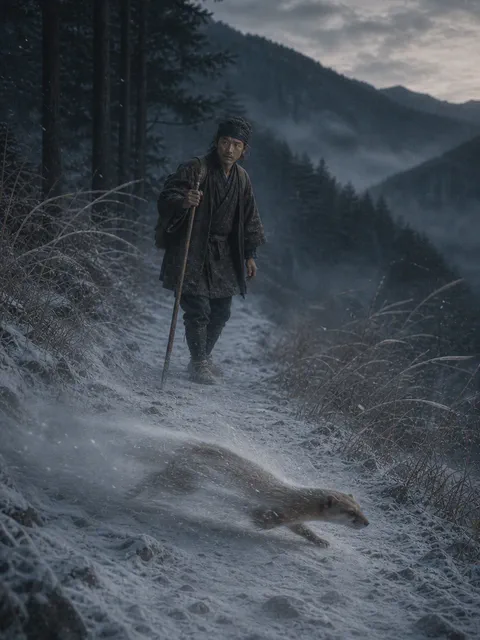
A 1955 Nagano record describes a weasel-like being so fast no one has seen it — known only by the clean cut it leaves on a stumbling traveler's shin.
Inugami
犬神(いぬがみ)
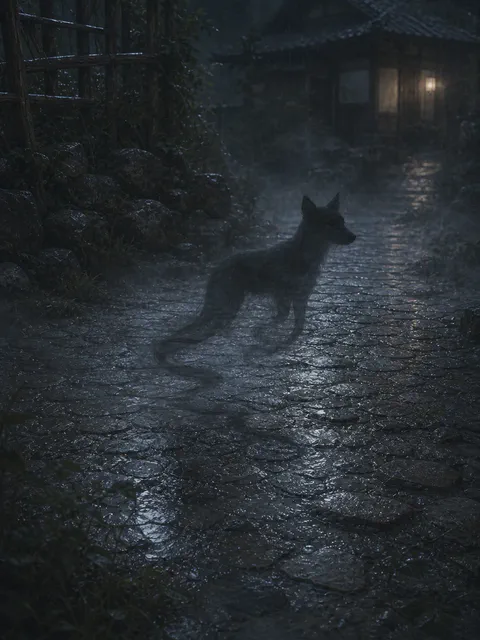
A possessing spirit of western Japan with no agreed-upon body — and a label that excluded entire households from marriage and community life.