
Ōkubi: The Face That Filled the Doorway
大首(おおくび) Ōkubi ASCII: Okubi
Pronunciation: OH-koo-bee
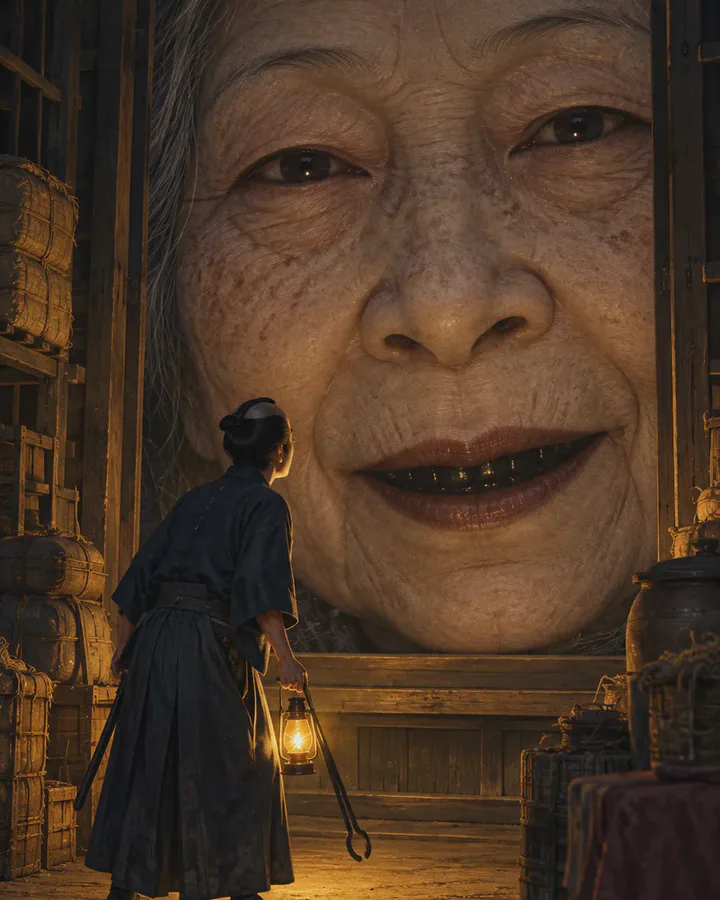
In the Inō Mononoke-roku, set in Miyoshi in 1749, sixteen-year-old Heitarō faces a month of nightly visitations. One night an old woman's face, teeth blackened, fills his doorway. He takes the fire tongs to it.
Quick Facts
- Habitat
- House
- Region
- Miyoshi (Bingo, Hiroshima)
- Recorded period
- Inō Mononoke-roku (set in 1749), Edo-period scrolls
- Nature
- Unknown
- Danger rating
The danger rating is an editorial summary made for readability. It is not an objective measure found in folklore sources.
Watch the Short
What is Ōkubi?
Ō is big. Kubi is a head, or a neck. Ōkubi is the giant head — a face far too large for any body, appearing where no face belongs.
Giant heads turn up in more than one Japanese tradition, and they do not agree with each other. This article follows one of them: a single night in the Inō Mononoke-roku, the record of the yokai that visited a boy in Miyoshi.
The month of visitations
The Inō Mononoke-roku is set in Miyoshi, a castle town in Bingo province, in what is now Hiroshima prefecture. On the first day of the seventh month of 1749, a sixteen-year-old named Inō Heitarō is visited by a monstrous being, and from then on, for a whole month, something comes every night to frighten him.
It does not work. Heitarō refuses to be frightened, night after night, until at the end of the month the visitors give up and leave.
The story mentions real places in Miyoshi and real people of the time, Heitarō among them. It was copied, illustrated, and retold for centuries afterwards, and as it travelled its details shifted — the town, the year, and the boy’s age sometimes dropped out, and new scenes were added.
The face in the doorway
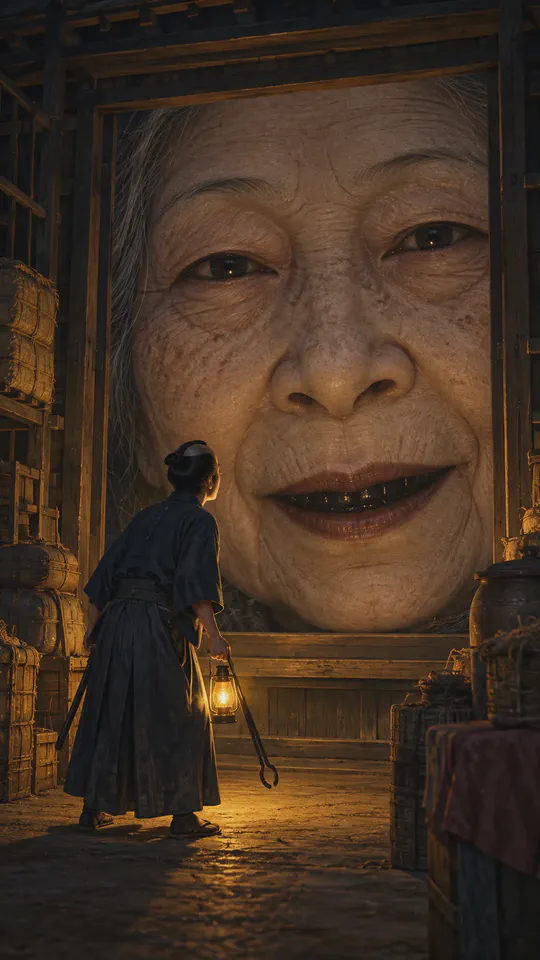
A picture scroll of the story held by the International Research Center for Japanese Studies includes the scene catalogued as Ōkubi. The doorway is full, edge to edge, with the face of an old woman. Her teeth are blackened, as married women’s once were. Heitarō drives a pair of fire tongs into the face.
That is the whole scene: the face, and the boy’s response.
Appearance
An old woman’s face, enormous, filling the frame of a door, with blackened teeth. Our illustration follows the scroll and adds a lantern in Heitarō’s hand and a smile on the face.
Behavior and abilities
- It fills the doorway. It does not chase or speak in the scene; it is simply there, where the way out should be.
- It is one of many. In the Inō Mononoke-roku, Ōkubi is a single night’s visitor in a month of them, not a creature with a story of its own.
Weaknesses and countermeasures
Heitarō’s answer is the point of the whole story: do not be afraid. Faced with a giant face in the doorway, he picks up the fire tongs. The Inō Mononoke-roku is a long demonstration that the visitors have power only over someone who is frightened.
Scroll and later imagery
Documented scene. In the Inō Mononoke-roku tradition, set in Miyoshi in 1749, one of the nightly visitors to Inō Heitarō is a giant old woman’s face with blackened teeth filling his doorway; in the Nichibun scroll, he drives fire tongs into it.
Later imagery. Modern yokai books treat Ōkubi as a type of its own: a giant woman’s head that appears in the sky or over rooftops, sometimes linked to other giant-head stories and to Sekien’s later plate of the same name. Those accounts belong to other sources.
In Miyoshi it is one night among thirty. The face is enormous, it is grinning with blackened teeth, and the sixteen-year-old in front of it is not impressed.
Sources and further reading
- Database Ōkubi (大首), U426_nichibunken_0451_0001_0020 (external link) International Research Center for Japanese Studies An old woman's face fills the doorway, teeth blackened; Heitarō drives fire tongs into it. From the Inō-ke Yōkai-den scroll.
- Museum Inō Mononoke-roku: the yokai story of Miyoshi (external link) Miyoshi Mononoke Museum From 1 July 1749, sixteen-year-old Inō Heitarō of Miyoshi endured a month of nightly visitations; versions changed as the story spread.
- Reliable secondary Inō Mononoke-roku (external link) Miyoshi City Real people and places of mid-Edo Miyoshi, and the variation among versions.
- Reliable secondary Inō Mononoke-roku and Intei Mononoke-roku (external link) Hiroshima Prefecture Heitarō unmoved through the month of July, until the visitors withdraw.
Related yokai
Makura-gaeshi
枕返し(まくらがえし)
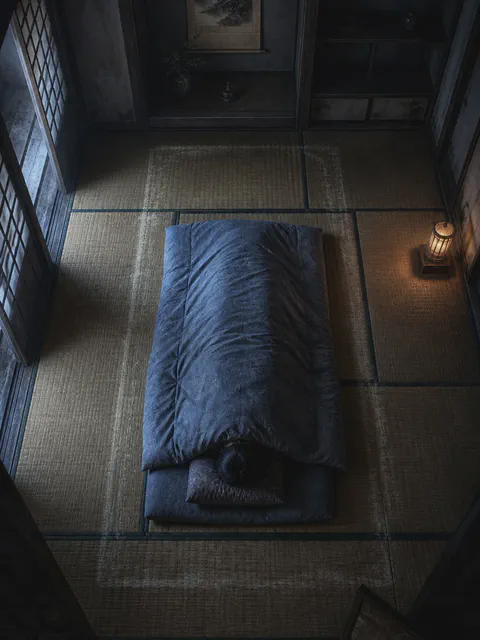
From Niigata in 1935 to Ibaraki in 1998, people recorded going to sleep facing one way and waking facing the other. The culprit changes from house to house; the reversal never does.
Tenjō-sagari
天井下り(てんじょうさがり)
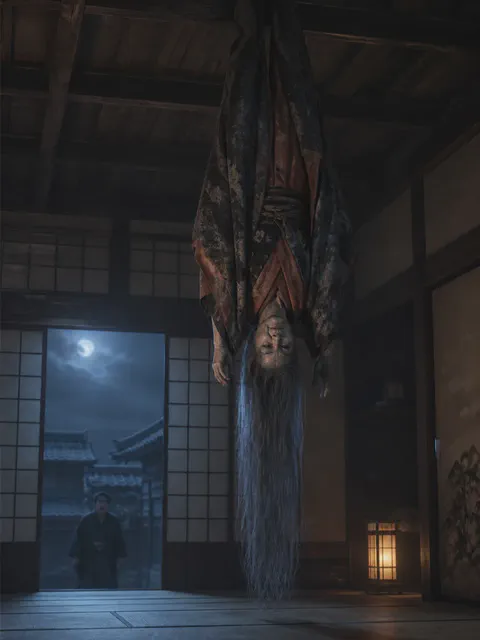
In 1779 Sekien drew an old woman hanging upside down from the ceiling, and wrote a caption that is mostly a joke — about a demon who once escaped through a roof, and a phrase for knocking someone flat.