
Nurikabe: The Invisible Wall Yokai of Fukuoka
塗り壁(ぬりかべ) Nurikabe ASCII: Nurikabe
Also known as: Nuribō
Pronunciation: noo-ree-KAH-beh
A night-road obstruction that stops travelers like a wall, though the early record does not describe a visible body.
Quick Facts
- Habitat
- Road
- Region
- Fukuoka, Onga District
- Recorded period
- 1938 folklore record, 1956 folklore collection
- Nature
- Harmful
- Danger rating
The danger rating is an editorial summary made for readability. It is not an objective measure found in folklore sources.
Watch the Short
What is Nurikabe?
Nurikabe is a night-road phenomenon recorded in Fukuoka’s Onga District. A traveler finds that the way forward has suddenly become like a wall. The road may appear open, yet progress is impossible.
The unsettling point in the early account is not the sight of a monster. It is the contradiction between the road and the traveler’s body: nothing described as visible stands ahead, but movement stops as if a solid surface had appeared.
The name means something like a plastered wall. Later art turned that name into a literal wall-shaped character. The cited records, however, focus on the experience of being blocked and do not describe eyes, a mouth, limbs or even a material wall.
Appearance
The most cautious answer is that no appearance is specified in the cited Onga accounts. Nurikabe is known through its effect. The traveler’s route becomes a wall, and attempts to pass fail.
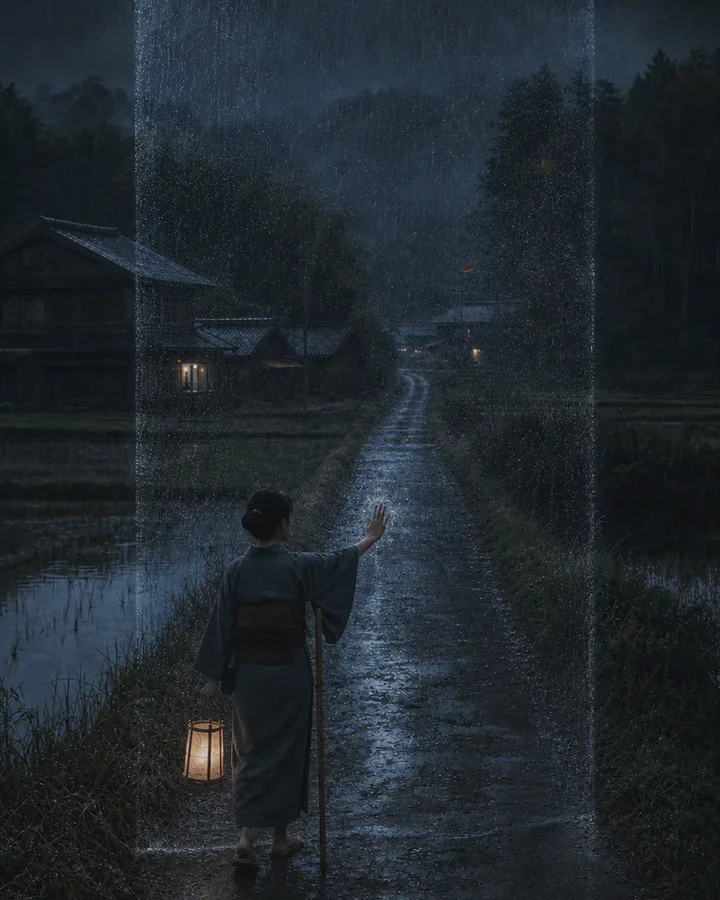
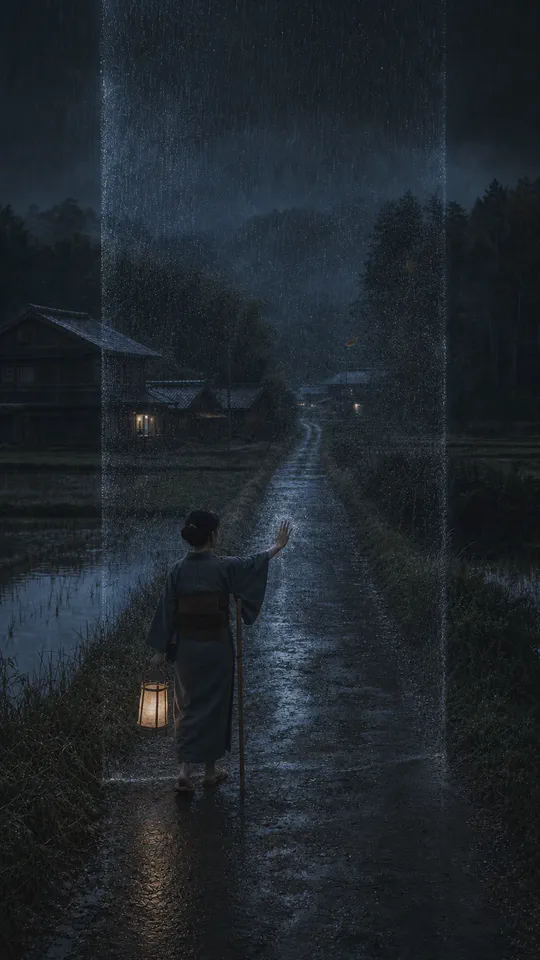
That leaves room for restrained visual interpretation. Rain might stop on an unseen plane. Mist or a leaf might reveal the outline of something that the eye cannot otherwise resolve. Such details are cinematic devices, not claims that the original record mentioned a transparent surface.
The familiar rectangular mascot with a face belongs to modern character design. It is an influential and legitimate part of Nurikabe’s later cultural life, and it is also the reason most people picture a face on something the early record leaves invisible.
Behavior and abilities
The 1938 record says that on a night road, the direction of travel suddenly becomes a wall and the traveler cannot go anywhere. Hitting or sweeping at the upper part does not remove the obstruction.
The solution is unexpectedly low. When the traveler sweeps the lower part with a stick, the barrier disappears. A related record published in 1956 preserves the same basic pattern: the road is blocked like a wall, action directed high does not work, and sweeping near the bottom makes it vanish.
Nurikabe therefore controls space more than it fights. It separates the traveler from the destination, makes ordinary navigation impossible and turns an open road into a trap without needing to chase or physically injure anyone.
Folklore accounts and regional setting
Both records used here identify the tradition with Onga District in Fukuoka Prefecture. Their close similarity suggests that the later entry preserves the same localized account or a closely related version, rather than providing a separate nationwide rule.
That distinction matters because Nurikabe is now one of the most recognizable yokai in popular culture. National fame can make a regional record appear to describe a standardized species found everywhere. The sources instead give us a concise local night-road encounter and one specific response.
The publication years—1938 and 1956—mark the appearance of the descriptions in those works. They do not necessarily date the beginning of the belief.
Weaknesses and countermeasures
In the cited Onga account, striking high is ineffective, while sweeping the lower part with a stick makes the obstruction disappear. This is unusually clear compared with many yokai traditions, which provide no consistent countermeasure.
Even so, it should be framed carefully. The low sweep is documented for this recorded tradition. It does not prove that every later Nurikabe story, game or regional variation must follow the same rule.
Traditional folklore and later imagery
Documented tradition. A traveler on a night road is blocked as though the way has become a wall. The record does not describe a visible body. Action aimed high fails; sweeping low with a stick removes the obstruction. The account is associated with Onga District, Fukuoka.
Later imagery. Illustrated works, animation and games often give Nurikabe a large rectangular body, eyes, a mouth and sometimes limbs. This makes an invisible spatial problem into a memorable character. Our short keeps the obstruction unseen and lets rain, mist, a hand and a wooden staff reveal its plane, while treating those visual clues as interpretation rather than source detail.
Sources and further reading
- Fieldwork collection Nurikabe account from Onga District, record 2180774 (external link) International Research Center for Japanese Studies A 1938 record of a night-road obstruction removed by sweeping its lower part with a stick.
- Fieldwork collection Nurikabe and Nuribō account, record C0410988-000 (external link) International Research Center for Japanese Studies A related Onga account in which action aimed high fails and sweeping low removes the obstruction.
Related yokai
Kappa
河童(かっぱ)
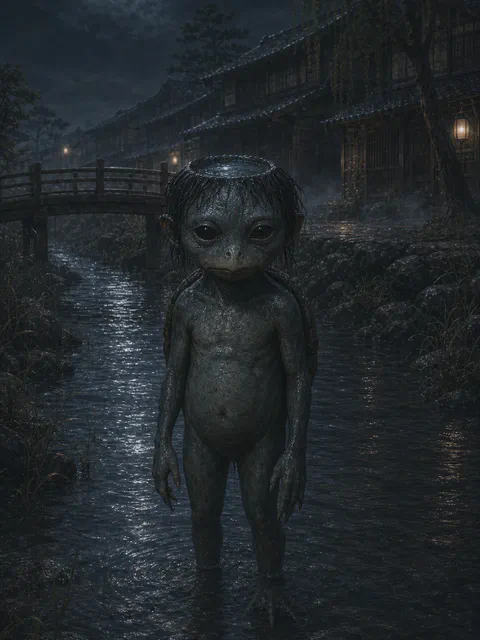
A child-sized water yokai whose strength lives in the water held by the dish on its head.