
Nure-onna: The Woman Who Hands You a Baby
濡女(ぬれおんな) Nure-onna ASCII: Nure-onna
Also known as: 濡れ女
Pronunciation: noo-reh ohn-nah
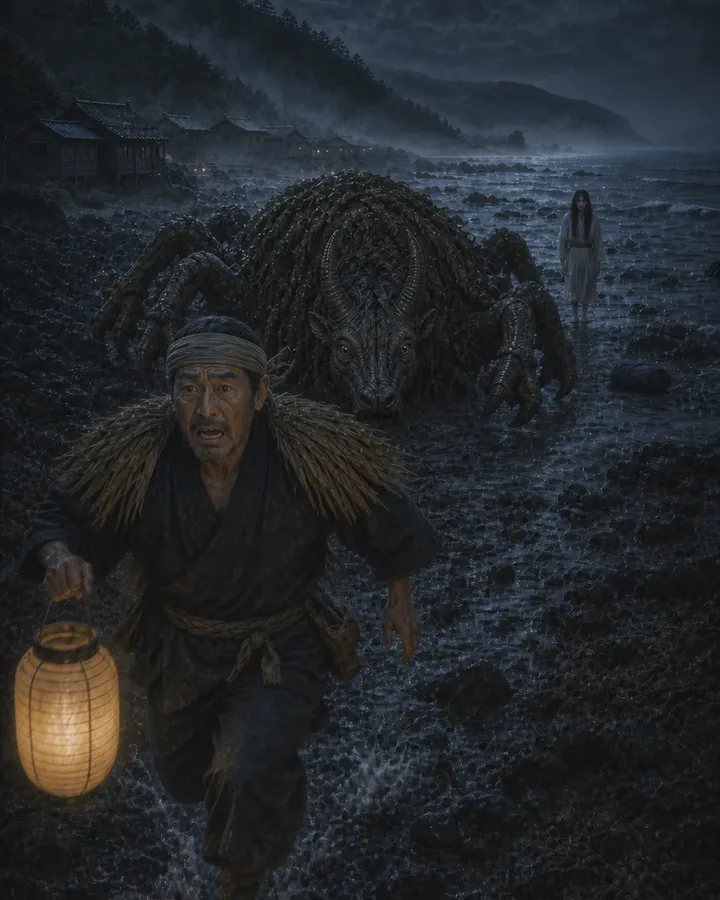
In a 1933 record from Iwami in Shimane, a fisherman walking home at night is given an infant by a wet-haired woman — and when he throws the bundle down and runs, something else comes out of the dark after him.
Quick Facts
- Habitat
- Coast, Road, Sea
- Region
- Iwami (Ōda, Shimane), Ehime, Shizuoka
- Recorded period
- Okada Kenbun's Iwami Ushi-oni tan (1933), an undated illustrated board game
- Nature
- Harmful
- Danger rating
The danger rating is an editorial summary made for readability. It is not an objective measure found in folklore sources.
Watch the Short
What is Nure-onna?
Nure-onna means “wet woman,” and the name is doing less work than it looks like. It is not a description of a single creature. It is a label that turns up attached to several, in places that have nothing to do with each other.
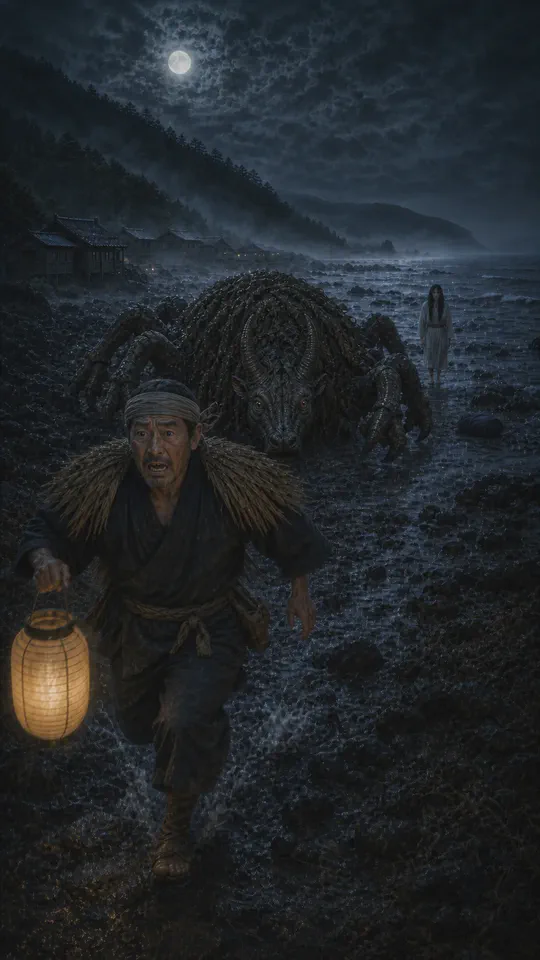
The account this episode follows was published in 1933, in Okada Kenbun’s Iwami Ushi-oni tan, and comes from Iwami in what is now Ōda, Shimane. A fisherman is walking home at night. A woman with wet hair appears on the shore, places an infant in his arms, and is gone.
He gets rid of the bundle and runs. An Ushi-oni comes out of the dark behind him. He reaches a farmhouse, and that is how the story ends — with a man inside a building, and something outside it.
Appearance
In the 1933 story she is a woman. An adult, with long wet hair, standing where the water meets the stones. Nothing about her, in that account, is anything other than human.
The other picture is a different animal entirely. An illustrated board game held by the International Research Center for Japanese Studies shows a Nure-onna in the waves with long hair, a long tongue, the body of a serpent, and human hands. The archive gives that sheet no date, so there is no telling whether the reader met the woman on the shore first or the snake.
Our illustration keeps them apart. The figure standing in the surf is the woman from Iwami.
Behavior and abilities
- She asks. The encounter opens with a request, and the request is easy to grant. Holding something for a moment costs nothing.
- She leaves. Once the infant is in his arms, she is no longer there.
- She is not the thing that chases. In the Iwami account, the pursuit belongs to the Ushi-oni.
The structure here is worth sitting with. Nothing is done to the fisherman by force. He is handed an object, and the trouble begins after he accepts it.
The name and what travels under it
Search the folklore databases for Nure-onna and the results do not converge. In Ehime there are records of a woman in white who gets a traveler to carry something heavy. In Shizuoka a wet passenger vanishes from a boat. Librarians compiling the Shimane materials for the Collaborative Reference Database found the Ushi-oni pairing sitting in the local sources — which is to say it is a feature of that region’s stories rather than of the name.
So there is no master version. What holds these together is a coastline, a woman who is wet, and an approach that the person on the receiving end consents to. Everything else varies: her body, her intent, what happens next, and whether anything happens next at all.
Weaknesses and countermeasures
The Iwami account offers exactly one thing, and it is not a technique. The fisherman survives by getting inside a farmhouse.
No charm is named, no phrase, no ritual, no correct way to refuse the baby. The record does not even say that throwing the bundle down was the right move, only that he did it and then ran. A door was what worked.
Documented records and later imagery
Documented records. A wet-haired woman on a night shore in Iwami, 1933, who hands a fisherman an infant and disappears; an Ushi-oni that pursues him; a farmhouse that ends it. Separately, an undated illustrated sheet giving a serpent-bodied, long-tongued Nure-onna among the waves. Separately again, a scatter of records under the same name in Ehime, Shizuoka and elsewhere, whose contents do not match.
Later imagery. Modern collections have largely settled on the snake — a fixed hybrid, half woman and half serpent, filed under the heading of seductive monsters. It is a clean design and it resolves the ambiguity, which is precisely the problem. The 1933 record is frightening for the opposite reason: there is no monster visible in it at first. Only a woman who needs someone to hold something, and a man who did.
Sources and further reading
- Fieldwork collection Nure-onna and Ushi-oni, from Okada Kenbun, "Iwami Ushi-oni tan" (1933) (external link) International Research Center for Japanese Studies A fisherman on a night road in Iwami, Shimane, is handed an infant by a wet-haired woman; when he throws the bundle down and runs, an Ushi-oni pursues him. He reaches a farmhouse and survives.
- Museum Nure-onna in Shinpan Yōkai Tobimeguri Sugoroku (external link) International Research Center for Japanese Studies An illustrated board game showing a Nure-onna with long hair, a long tongue, a serpent's body and human hands among the waves. The archive record gives no date for the sheet.
- Database Reference case on Ushi-oni and Nure-onna materials in Shimane (external link) Collaborative Reference Database, National Diet Library Librarian-compiled survey of the regional sources for the pairing.
- Database Nure-onna entries by region (external link) International Research Center for Japanese Studies Nationwide result set showing how far the name spreads and how little the entries under it have in common.
Related yokai
Ushi-oni
牛鬼(うしおに)
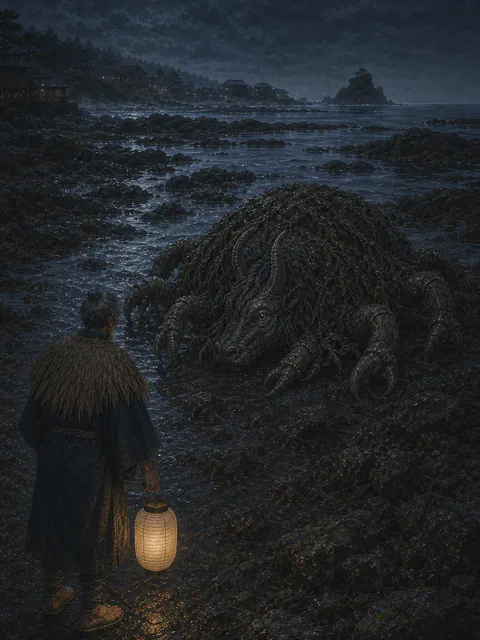
Toriyama Sekien's 1776 print shows a bull-like head on a squat clawed body at the water's edge — and tells us nothing else about it.
Iso-onna
磯女(いそおんな)
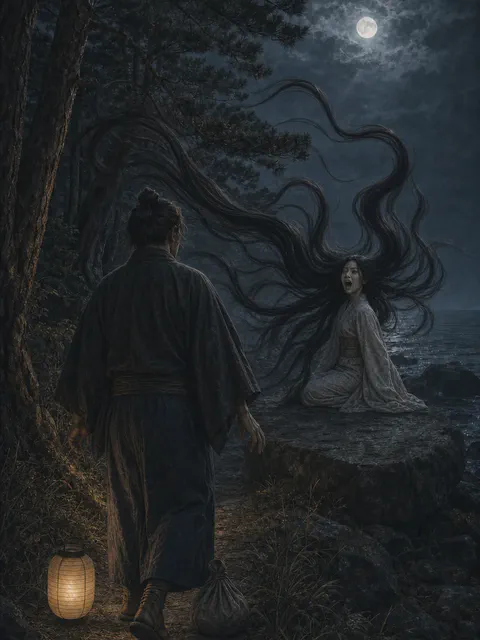
A 1929 record from Mizuho in Nagasaki describes a wrestler who tried to speak to a black-haired woman sitting on a shore stone at night — and other accounts from the same coastline describe something else entirely under the same name.