
Nurarihyon (ぬらりひょん): The Old Man Who Steps Out of the Palanquin
A long-headed figure from the Edo yokai scrolls, a floating ball off Okayama, and a rank invented in the twentieth century
滑瓢(ぬらりひょん) Nurarihyon ASCII: Nurarihyon
Also known as: Nūrihyon
Pronunciation: noo-rah-ree hyohn
Nurarihyon (ぬらりひょん) is an old man with a bald, elongated head who appears in the Edo-period yokai scrolls and in Toriyama Sekien’s picture book of 1776, where he steps out of a palanquin in fine clothes with a pipe in his hand. The pictures carry no text but the name. Off Okayama the same name belongs to a head-sized ball that floats on the Seto Inland Sea and sinks when a hand reaches for it. The old man who walks into a busy house as if he owned it, and the “supreme commander of the yokai”, are twentieth-century additions that grew out of one caption written in 1929.
Quick Facts
- Habitat
- House, Sea, Road
- Region
- Japan, Okayama (Seto Inland Sea), Akita (Inaniwa)
- Recorded period
- Edo yokai scrolls (c. 1700–1832), Gazu Hyakki Yagyō (1776), twentieth-century reference books
- Nature
- Unknown
- Danger rating
The danger rating is an editorial summary made for readability. It is not an objective measure found in folklore sources.
Watch the Short
The Yokai Files short for Nurarihyon is coming soon.
What is Nurarihyon?
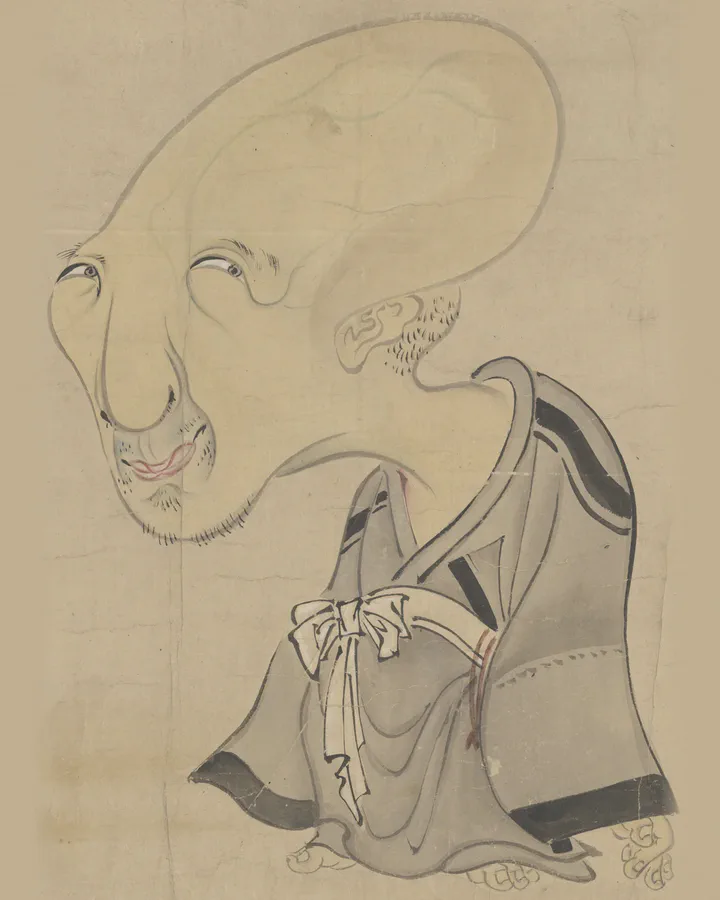
In a picture book of 1776 an old man arrives somewhere. A hired palanquin stands at the left of the plate with its poles on the ground. The man has climbed out of it onto a veranda and is already past the sliding door, a pipe in his hand and a fine robe over his shoulders. Inside, a candle burns on its stand and a potted tree waits on a shelf. His head is bald and far too long, swelling backward like a gourd. The name is written above him, and that is all that is written: nothing about who he is, whose house this is, or what happens next.
That is the nurarihyon of the Edo period, and it is nearly the whole of him. The same long-headed old man had been painted in 1737, in a scroll of thirty named monsters; he is in a scroll of the late seventeenth or early eighteenth century now kept in Utah, and in another of 1832. In every one he is a figure with a name and no story.
What does nurarihyon mean?
The name is written in kana. The kanji 滑瓢, “slippery gourd”, are a later dictionary spelling. Nurari is slick, smooth, slipping out of the grip; hyon is something odd and unlooked-for, or the sound of a thing bobbing up. Put together, the name describes something that cannot be got hold of. In the 1776 print the name is spelled nūrihyon, and the earlier scrolls show that this was a slip of the brush. There is a further play in the picture: nurarin was a word for stepping down from a vehicle, and stepping down from a vehicle is exactly what the print shows.
Appearance
Bald, with a head that bulges backward far beyond any human skull; a wrinkled old face; well dressed, in kimono and haori or in a priest’s robe; sometimes with a staff. The pictures agree with one another closely because they were copied from one another. The scroll of 1737 claims descent from an original by the painter Kano Motonobu, and Sekien’s print belongs to the same lineage. Apart from the head there is nothing monstrous about him, which is the point of the picture: an elderly gentleman of some means, arriving.
The sea ball of Okayama
Off the coast of Okayama, in the Seto Inland Sea, a nurarihyon is something else: a round thing about the size of a human head, floating on the waves. Reach for it and it sinks, then surfaces a little way off, and the game goes on for as long as the fisherman cares to play. An account published in 1984 counted it among the umi-bōzu of the coast and explained the name from the game itself, nurari for the slipping away and hyon for the bob back up. Large jellyfish and octopus have been suggested as what was seen. The ball and the old man share nothing but the name.
There is one more trace, on land and far from the sea. A travel diary of 1814 describes a slope at Inaniwa in Dewa, now Yuzawa in Akita, where nurarihyon, otoroshi and nozuchi were said to pass in a night procession of a hundred demons, so that some people called it the monster hill. It is the one place where the name is attached to an actual road, and even there it is a name in a list.
Behavior and abilities
The Edo material records none, and what it shows is small:
- He steps out of a palanquin. The one act Sekien gives him. Where he has come from and whose gate he has reached are not shown.
- He is dressed for a visit. Fine clothes, a pipe, and the manner of a man who expects to be let in.
- He walks with the others. On the Dewa slope of 1814 he is one name among the night parade.
- The sea ball cannot be caught. It sinks under the hand and comes up again out of reach.
The famous behaviour is later. Reference books of the last sixty years describe an old man who strolls into a house at dusk while the household is at its busiest, sits down, drinks the tea and smokes the tobacco, and is taken by everyone for the master of the house, so that nobody thinks to put him out; only after he has gone does anyone wonder who he was. No Edo text tells it, and no field collection has it. It was built outward from the print, from the palanquin and the veranda and the pipe, and from one caption. In 1929 an illustrated survey of Japanese monsters reprinted Sekien’s plate and described the figure beneath it as the chief of the monsters, come calling while the lamps of early evening were being lit. The caption was a guess about a wordless picture, and the house-guest and the chieftain both grew out of it.
Weaknesses and countermeasures
None are recorded. The old man has no weakness, no charm against him, and no harm attached to him that would make anyone want one; the sea ball’s only trick is that it cannot be held. The twentieth-century house-guest has a weakness of a different kind. He is harmless because everyone is polite, and the story works only because nobody asks him who he is.
Documented tradition and later imagery
Documented tradition. A bald, long-headed old man in good clothes, painted in the yokai scrolls from around 1700, in Sawaki Sūshi’s Hyakkai Zukan (1737), in Toriyama Sekien’s Gazu Hyakki Yagyō (1776), where he steps out of a palanquin, and in a scroll of 1832, with no text beyond the name; a name in a list of night-walkers on a slope in Dewa in 1814; and, off Okayama, a floating head-sized ball that sinks when grabbed, written down in 1984.
Later imagery. The caption of 1929 made him the chief of the monsters. From the 1960s the yokai reference books of Mizuki Shigeru and Satō Arifumi gave him the house he walks into and the title of supreme commander of the yokai; in the television series of 1985 he called himself that and became the standing enemy of Kitarō, and he has held the rank ever since, in manga and games, as a lord with a clan behind him and a night parade at his command.
The rank is modern. The Edo picture is quieter and stranger: a well-dressed old man with a swollen head, getting down from a hired palanquin at somebody’s gate, already halfway inside, and nobody in 1776 thought it necessary to say whose gate it was.
Sources and further reading
- Museum Nurarihyon, from the Gazu Hyakki Yagyō (1776) (external link) Toriyama Sekien; Wikimedia Commons scan The plate: a bald old man with a long swollen head stepping from a palanquin onto a veranda, pipe in hand, a candle and a potted tree inside. The name is written "nūrihyon" and there is no caption.
- Library Gazu Hyakki Yagyō bibliographic record (画図百鬼夜行) (external link) National Diet Library Search Bibliographic record for Sekien's 1776 picture book.
- Museum Nurarihyon, from Sawaki Sūshi's Hyakkai Zukan (1737) (external link) Sawaki Sūshi; Wikimedia Commons scan The same long-headed old man forty years before Sekien, with only the name written in.
- Museum Sawaki Sūshi, Hyakkai Zukan (百怪図巻), 1737 (external link) Fukuoka City Museum A 1737 scroll of thirty named yokai, each with only its name written in; the colophon says it copies an original by Kano Motonobu. Includes Otoroshi.
- Library Nurarihyon in the Bakemono no e scroll (化物之繪) (external link) Harold B. Lee Library, Brigham Young University A painted scroll of thirty-five monsters from the late seventeenth or early eighteenth century, with the nurarihyon as a bald old man with an elongated head, labelled "nurarihiyon". The hero image is this painting.
- Library Fujisawa Morihiko (ed.), Yōkai Gadan Zenshū, Nihon-hen jō (妖怪画談全集 日本篇上), 1929 (external link) National Diet Library Search Bibliographic record of the 1929 survey whose caption under Sekien's plate called the nurarihyon the chief of the monsters who comes calling in the early evening; the origin of the house-guest and supreme-commander images.
- Database Nurarihyon (ぬらりひょん) (external link) Wikipedia (Japanese) Collects the scroll lineage, the Okayama sea account of 1984, the 1814 travel-diary passage on the slope at Inaniwa, the wording of the 1929 caption, the research that traced the modern image to it, and the 1985 television series.
- Database Nurarihyon (external link) Wikipedia (English) How the "supreme commander of the yokai" image arose in the twentieth century.
- Reliable secondary Nurarihyon, Okayama (Seto Inland Sea coast) (external link) Mononoke Mitsuketa Used only for the sea area of the Okayama account, the Bisan Strait and Kojima Bay.
- Database GeGeGe no Kitarō (1985 TV series) (external link) Wikipedia (English) Air dates (1985–88) and the nurarihyon episode of the third television series.
Where it was recorded
- 1984
Seto Inland Sea coast (Bisan Strait and Kojima Bay), Okayama
Folklore record
A head-sized ball floating on the sea that sinks when grabbed and surfaces out of reach; counted among the umi-bōzu
- 1814
Inaniwa, Yuzawa, Akita
Folklore record
A slope where nurarihyon, otoroshi and nozuchi were said to pass in night procession, called the monster hill
Places named in the records behind this article. Coordinates are approximate. View on the map
In manga
- GeGeGe no Kitarō ゲゲゲの鬼太郎 Keeps the traditional forms, invents the stories
- Hozuki's Coolheadedness 鬼灯の冷徹 Uses the names, reinvents the rest
- Nura: Rise of the Yokai Clan ぬらりひょんの孫 Uses the names, reinvents the rest
Where to see it
- Mizuki Shigeru Road 水木しげるロード Street
- Mizuki Shigeru Memorial Museum 水木しげる記念館 Museum
Related yokai
Otoroshi
おとろし
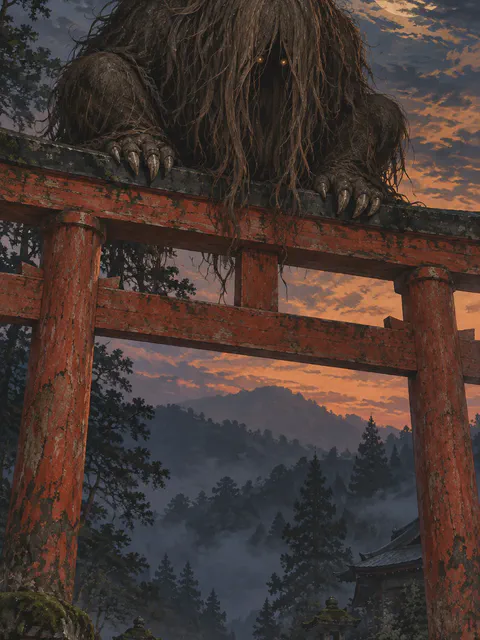
Otoroshi appears in a 1737 scroll and in Sekien's 1776 book as a hunched, hairy creature — on top of a torii in Sekien's version. Neither says what it does. The story about it dropping on the impious was read out of the picture later.
Umi-bōzu
海坊主(うみぼうず)
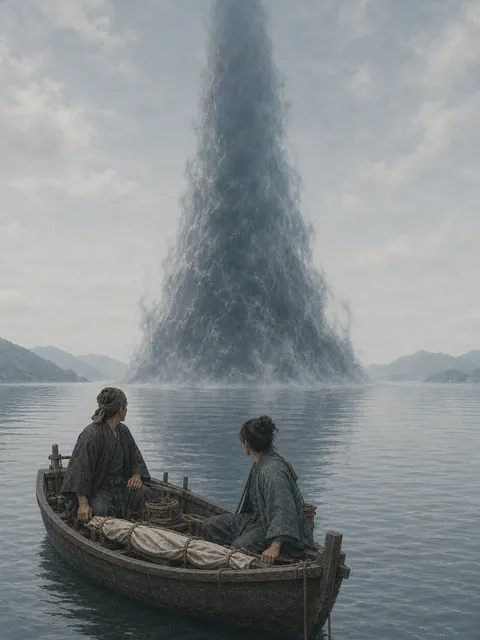
One account describes a vast Buddha-like shape crossing ahead of a boat on a clear, windless day, then slowly thinning until it vanished.


Mikoshi-nyūdō
見越入道(みこしにゅうどう)
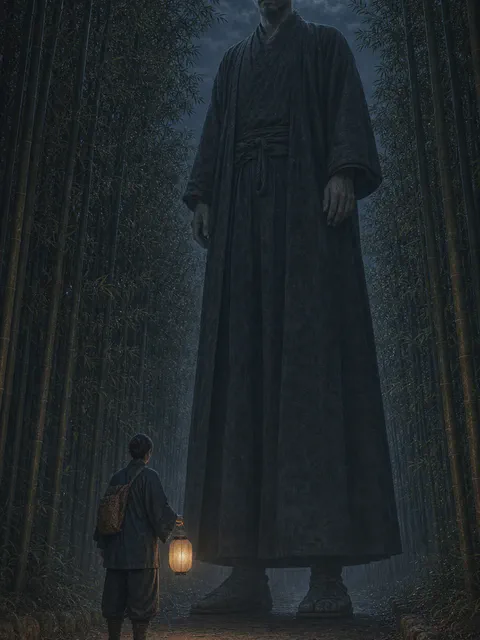
A 1938 Nagasaki record warns of bamboo rustling over a night road and a looming figure that must be recognized aloud.