Nue: The Cry Above the Palace
鵺(ぬえ) Nue ASCII: Nue
Pronunciation: noo-eh
In The Tale of the Heike, a black cloud and a bird's cry sicken the emperor until an archer shoots the creature down — and the versions disagree on what fell.
Quick Facts
- Habitat
- Sky, Temple shrine
- Region
- Kyoto
- Recorded period
- The Tale of the Heike (Kamakura period onward), reign of Emperor Konoe (1141-1155)
- Nature
- Harmful
- Danger rating
The danger rating is an editorial summary made for readability. It is not an objective measure found in folklore sources.
Watch the Short
What is Nue?
The nue is the most famous chimera in Japanese literature, and its story belongs to a book rather than to a village. It appears in The Tale of the Heike, the medieval war narrative that took shape from the Kamakura period onward and survives in many variant versions.
In the episode, during the reign of Emperor Konoe (1141–1155), a black cloud gathers each night above the Shishinden, the ceremonial hall of the imperial palace, and something inside it cries. The emperor falls ill and is gripped by terror. The archer Minamoto no Yorimasa is called to deal with it, looses an arrow into the cloud, and brings the creature down.
This is a story about a court, a sickness, and a marksman — not a field record of an animal.
Appearance
Here the sources are openly inconsistent, and that inconsistency is the most interesting thing about the nue.
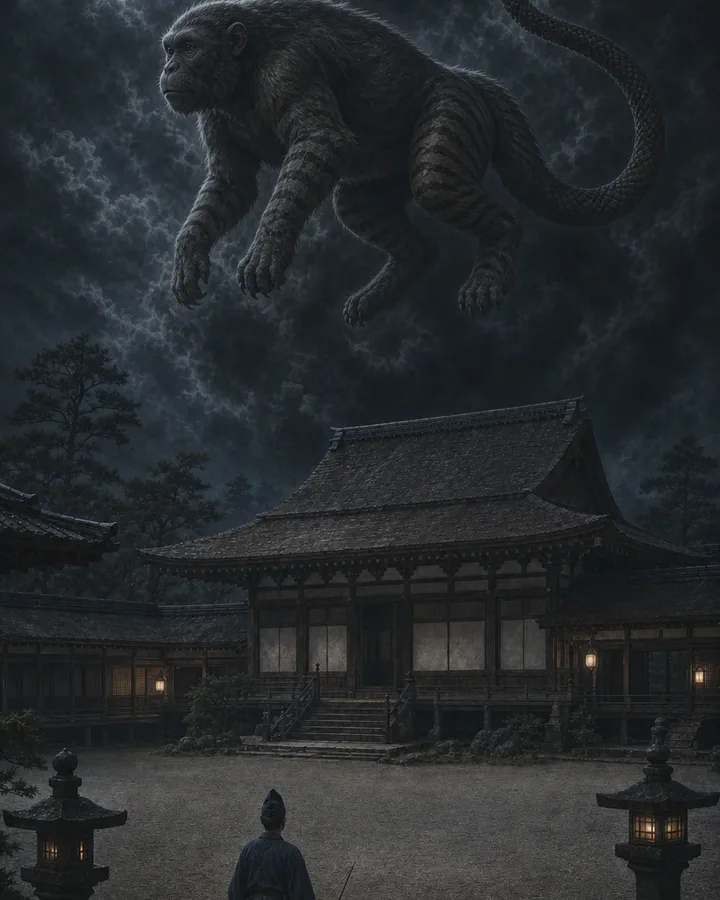
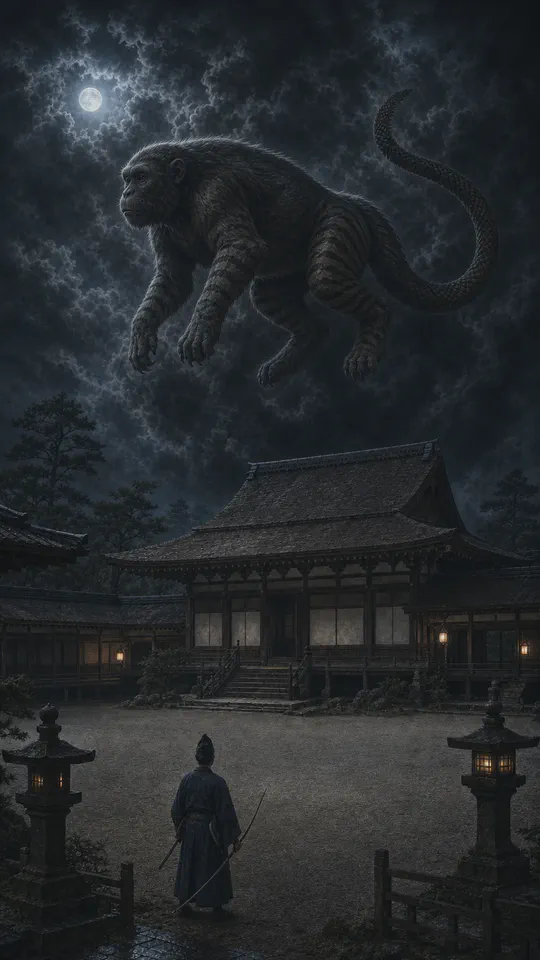
One illustrated edition describes the fallen creature with a monkey’s head, a tanuki’s body, a tiger’s limbs, and a snake for a tail — the combination our short adopts. Other versions of the tale distribute the parts differently. There is no single canonical body.
Our illustration therefore treats the creature as one animal rather than a collage: the same dark brown coat and consistent skeleton throughout, desaturated tiger striping, and a single snake tail continuing from the spine. No wings, no horns, no human hands, no extra heads or legs.
Behavior and abilities
- It arrives in black cloud. The creature is never simply seen; it comes wrapped in weather above the palace roofline.
- It cries in the night. The voice, not the body, is what the court experiences.
- The emperor sickens. In the tale, the illness and dread are attributed to its presence.
- An arrow ends it. Yorimasa shoots into the cloud, and the creature falls.
Our short stops at the moment before the shot — the archer in the courtyard, the thing still circling overhead, the outcome not yet decided.
Folklore accounts and regional variations
The word nue originally referred to a bird — the White’s thrush, whose thin, whistling night call is genuinely eerie and was long considered ominous. The name attached to the creature in the tale because of that voice.
This produces the question the episode never quite answers: was the nue a monster, or a name that grew out of a sound in the dark? The tale supplies a body and an arrow; the older word supplies only a cry. Kyoto preserves a monument at the Nue Pond connected to the narrative, and illustrated editions in archives and museums show how differently artists imagined the creature over the centuries.
The bird itself is still out there, still calling on summer nights in the hills. It is a thrush. A twelfth-century court heard it over the palace and built a monster around the sound.
Weaknesses and countermeasures
Within the story, the answer is simply Yorimasa’s bow. That is a plot resolution, not a documented rule about a species — there is no charm, sutra, or protective practice against the nue in our sources, because the nue is an episode rather than a folk hazard.
Traditional folklore and later imagery
Documented tradition. A narrative episode in The Tale of the Heike: a black cloud over the palace, a bird-like cry, an emperor’s illness, an archer’s arrow, and a creature whose described parts differ between versions. The name comes from a real bird’s call.
Later imagery. Modern games and illustration have hardened the nue into a fixed monster design — always the same monkey-tiger-snake composite, often winged, often with fire or lightning attacks. Fixing the body is precisely what the older material refuses to do. The unresolved question is better than the answer: something was up there, everyone heard it, and no two accounts agree on what came down.
Sources and further reading
- Primary text The Tale of the Heike, digital exhibition (external link) National Archives of Japan The Nue episode: a creature in black cloud over the palace, the emperor's illness, and Minamoto no Yorimasa's arrow. A medieval war tale, not a record of a living animal.
- Museum Exhibition on monster-slaying tales (妖怪退治伝) (external link) National Archives of Japan Exhibition material on illustrated versions of monster-slaying narratives.
- Museum About The Tale of the Heike (external link) Hyogo Prefectural Museum of History Explains the textual history and the existence of many variant versions.
- Reliable secondary Nue Pond monument (鵺池碑) (external link) City of Kyoto A Kyoto monument attached to the Nue narrative.