
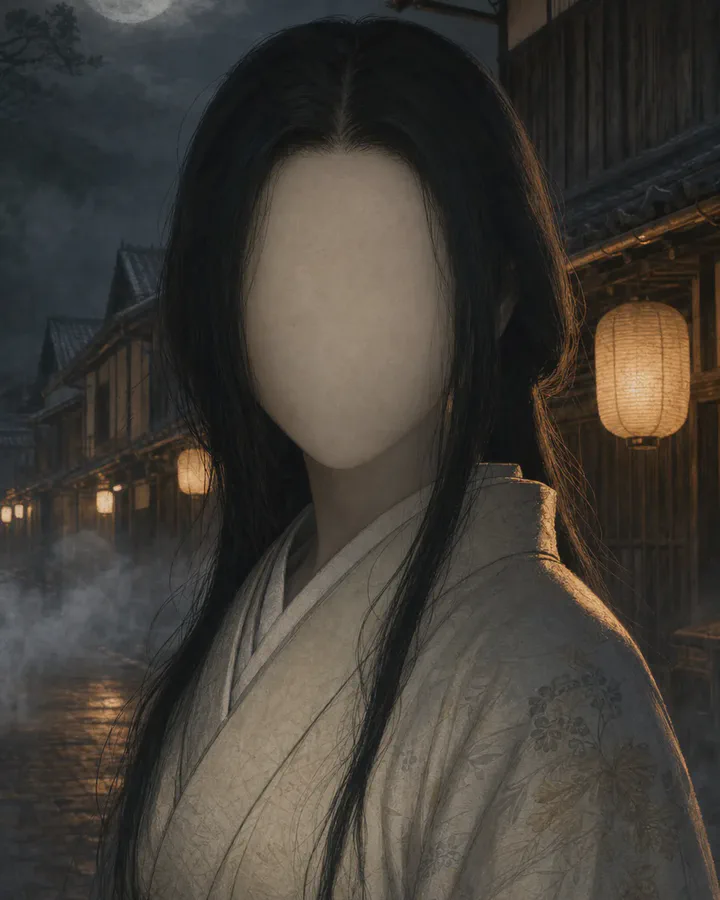
Noppera-bō: Japan's Faceless Yokai
のっぺらぼう Noppera-bō ASCII: Noppera-bo
Also known as: Mujina
Pronunciation: noh-peh-rah boh
A human-looking figure whose face vanishes when a traveler comes close.
Quick Facts
- Habitat
- Street, Road
- Region
- Japan
- Recorded period
- Edo period, modern folklore collections
- Nature
- Harmful
- Danger rating
The danger rating is an editorial summary made for readability. It is not an objective measure found in folklore sources.
Watch the Short
What is Noppera-bō?
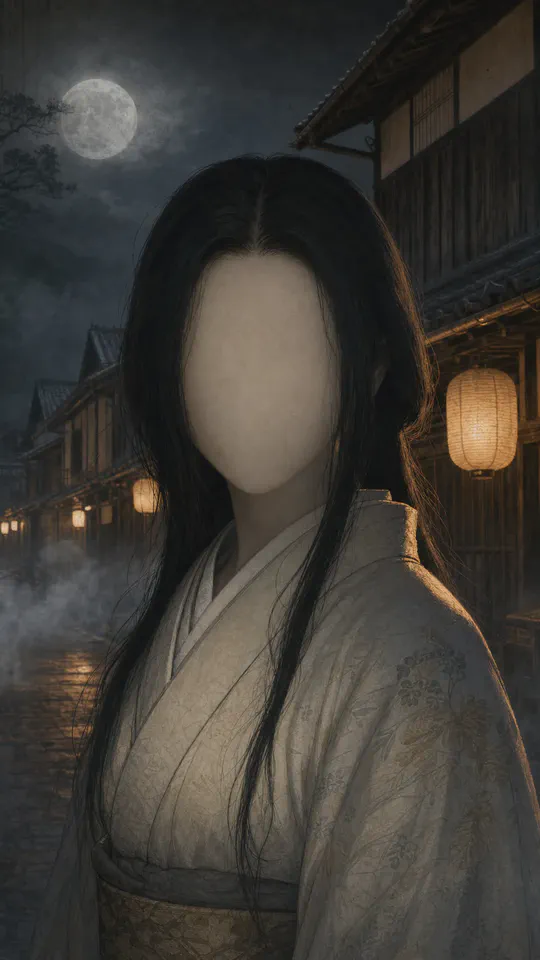
Noppera-bō is the faceless figure of Japanese folklore. In a typical account, a traveler meets what looks like an ordinary person on a quiet street at night. When the traveler comes close — often to offer help or start a conversation — the figure turns, and its face is a smooth blank: no eyes, no nose, no mouth.
The word noppera-bō describes the apparition itself, but in many recorded tales the faceless figure is not an independent creature. It is a shape taken by something else — most often a shapeshifting animal playing a trick on humans.
Appearance
Until the moment of the reveal, there is nothing unusual to see. The figure looks like a normal townsperson: frequently a woman standing alone by a road, riverbank, or moat at night. The horror of the encounter lies in this ordinariness — the yokai imitates a human almost perfectly and fails, or chooses to fail, at only one thing.
When the figure turns or wipes a hand across its face, the features are gone, leaving skin as smooth as an egg.
Behavior and abilities
Noppera-bō frightens people; that is essentially the whole of its recorded behavior. Accounts rarely describe physical harm. The classic story structure is a double shock: the traveler flees from the first faceless figure and meets another person — a soba vendor, a colleague, a passerby — who listens to the frightened story and then asks, “Was it a face like this?” before revealing the same smooth blank.
This staging suggests intelligence and coordination, which is one reason the tales often attribute the prank to shapeshifters rather than to a wandering spirit.
Folklore accounts and regional variations
Faceless-encounter stories appear in collections from various parts of Japan, and the being blamed for them varies by region. In many tellings the culprit is a mujina (a badger-like animal), a tanuki, or a fox — animals credited in Japanese folklore with the power to take human form.
The best-known version outside Japan is “Mujina,” retold in English by Lafcadio Hearn in Kwaidan (1904). It is set on the Akasaka road in Tokyo, where a merchant meets a weeping woman by the Kii-no-kuni-zaka slope; she turns to show a faceless surface, and the soba vendor he runs to delivers the second reveal. Hearn’s title preserves the traditional attribution: the faceless woman is a mujina in disguise.
Because accounts differ from region to region, no single canonical “noppera-bō legend” exists. What the records share is the encounter pattern — an ordinary meeting, a blank face, and flight — rather than a fixed identity for the being behind it.
Weaknesses and countermeasures
No consistent countermeasure is documented. The tales are structured as pranks: the yokai wins the moment the human is frightened, and the stories end with the victim’s flight rather than a confrontation. Unlike many yokai, noppera-bō has no widely recorded banishing method, protective charm, or physical weakness.
Traditional folklore and later imagery
Two layers should be kept separate:
Documented tradition. Regional tales of faceless encounters, usually explained as shapeshifting animals (mujina, tanuki, fox) tricking humans. The faceless figure is a disguise or momentary apparition, not a species with its own life and habits.
Later imagery. Modern fiction, manga, and games often present noppera-bō as an independent category of yokai — a faceless person who lives among humans, frequently shown wiping its face away with one hand in a single dramatic gesture. The gesture and the “faceless race” framing are popular conventions built on top of the older prank tales, and Hearn’s much-reprinted retelling did a great deal to fix the two-stage reveal as the standard form of the story worldwide.
Sources and further reading
- Database Database of Folklore and Yokai Phenomena (怪異・妖怪伝承データベース) (external link) International Research Center for Japanese Studies Use individual records; do not generalize one local account nationwide.
- Primary text Kwaidan: Stories and Studies of Strange Things — “Mujina” (external link) Lafcadio Hearn (1904); Project Gutenberg edition Hearn's retelling of a Tokyo (Akasaka) faceless-encounter tale. A literary retelling of oral tradition, not a fieldwork transcript; treat details as Hearn's framing.
Related yokai
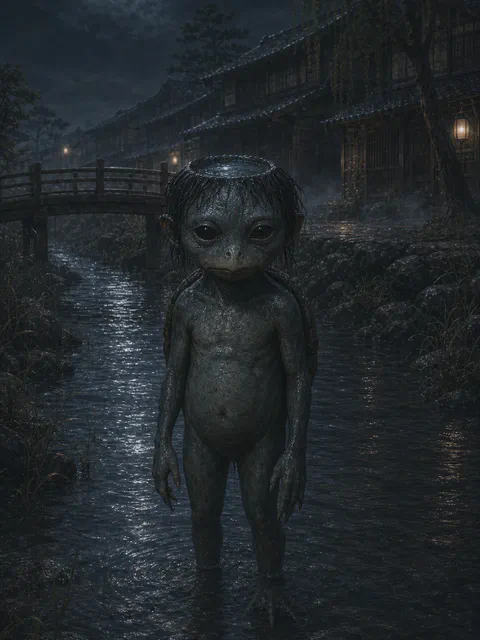
Kappa
河童(かっぱ)
A child-sized water yokai whose strength lives in the water held by the dish on its head.