
Nobusuma: The Thing That Covers Your Eyes
野衾(のぶすま) Nobusuma ASCII: Nobusuma
Pronunciation: noh-boo-soo-mah
A 1938 Tokyo record describes something like a flying squirrel that drifts down onto a traveler and covers the eyes and mouth — and stops there.
Quick Facts
- Habitat
- Forest, Road, Mountain
- Region
- Tokyo
- Recorded period
- Konjaku Gazu Zoku Hyakki (1779), 1938 folklore record
- Nature
- Harmful
- Danger rating
The danger rating is an editorial summary made for readability. It is not an objective measure found in folklore sources.
Watch the Short
What is Nobusuma?
Nobusuma is written with characters meaning “field” and fusuma, the sliding panel of a Japanese room — a name that has sent a lot of modern retellings in the wrong direction. In the records, it is an animal.
The account featured here appears in Yanagita Kunio’s Yōkai Meii (“Glossary of Yokai”), published in the journal Minkan Denshō in 1938 and describing a Tokyo tradition. Nobusuma, it says, is something like a flying squirrel — or a bat. It comes down softly onto a person walking at night and covers their eyes and mouth.
That is the whole encounter. What makes it frightening is not damage. It is being made blind, outdoors, in the dark, without warning.
Appearance
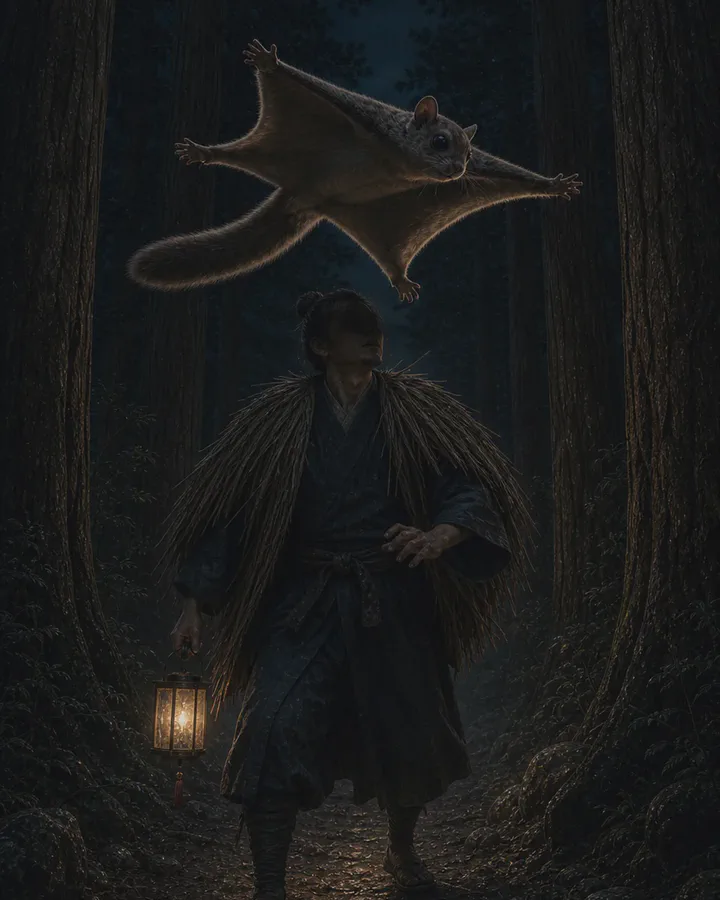
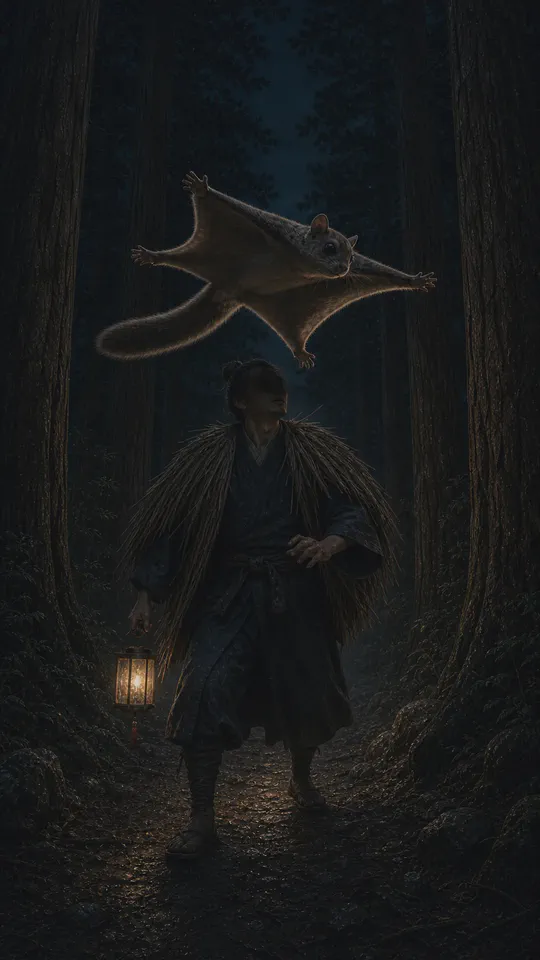
Our illustration follows the animal the record names: a single realistic flying squirrel, grey-brown, with round ears, large black eyes, a long tail, and the gliding membrane stretched between its limbs.
In flight that membrane reads for a moment as a single dark sheet — which is almost certainly where the fusuma in the name comes from — but it never becomes actual cloth. The creature has a body, four limbs, and a tail throughout.
Toriyama Sekien had already drawn a nobusuma in his Konjaku Gazu Zoku Hyakki of 1779, and his caption is even plainer than the Tokyo account: it says the thing is a flying squirrel. Two records, more than a century and a half apart, and neither of them describes a monster.
Behavior and abilities
- It arrives from above. The approach is a glide, not a charge, and it is silent.
- It covers the face. The eyes and the mouth, together, for a moment.
- It does nothing else. No bite, no blood, no suffocation, no lasting injury appears in the source.
The horror of the nobusuma is entirely about sensory deprivation. For as long as it is on you, you cannot see the road, and you cannot call out.
Folklore accounts and regional variations
The name attached itself to several things over time. Sekien’s print identifies a real animal. The 1938 Tokyo material describes a night-road encounter with something resembling that animal or a bat. Elsewhere the word appears in connection with other creatures entirely, including old bats and, in some regions, animals thought to have lived long enough to change.
There is also a persistent confusion worth clearing up. The nobusuma is not a cloth yokai. The flying white bolt that wraps around travelers is the ittan-momen, a separate tradition from Kagoshima with its own record. The resemblance is in the silhouette of a glide, and in a name that happens to contain a word for a sliding panel.
Weaknesses and countermeasures
The Tokyo record names no charm, no gesture, and no defense — and no lasting harm for one to prevent. The encounter ends on its own. What survives is the memory of a few seconds during which the night road disappeared.
Traditional folklore and later imagery
Documented tradition. An animal — a flying squirrel, or a bat — that glides down onto a night traveler and covers the eyes and mouth. Sekien’s 1779 caption identifies it flatly as a flying squirrel. Neither source describes injury.
Later imagery. Modern encyclopedias and games have made the nobusuma much larger and much hungrier: a blanket-like creature that smothers its victims, drinks their blood, or is reclassified as a vampire bat monster. Those versions need the animal to be dangerous. The older records are stranger for refusing that: the thing that landed on your face was a squirrel, and the worst it did was take away the road.
Sources and further reading
- Fieldwork collection Nobusuma entry from Yanagita Kunio's Yōkai Meii (1938) (external link) International Research Center for Japanese Studies The adopted Tokyo account, published in Minkan Denshō in 1938: something like a flying squirrel or a bat that drifts in and covers a traveler's eyes and mouth.
- Library Konjaku Gazu Zoku Hyakki digitized copy (external link) Cultural Japan; Kyushu University Sekien's 1779 book, where the Nobusuma caption identifies it as a flying squirrel.
- Museum Nobusuma image record (external link) International Research Center for Japanese Studies Catalogue record for a historical depiction of the gliding creature.
- Academic paper Yokai Given Form — Toriyama Sekien's Gazu Hyakki Yagyō (external link) Kyoto University of Advanced Science, Faculty of Humanities Academic discussion of how Sekien's prints fixed visual forms for named yokai.
Related yokai
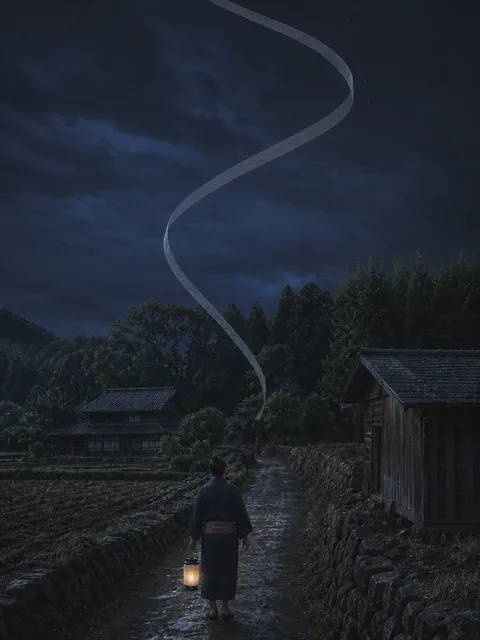
Ittan-momen
一反木綿(いったんもめん)
A white bolt of cloth that flutters across a rural night road, dazzles a traveler and attacks.
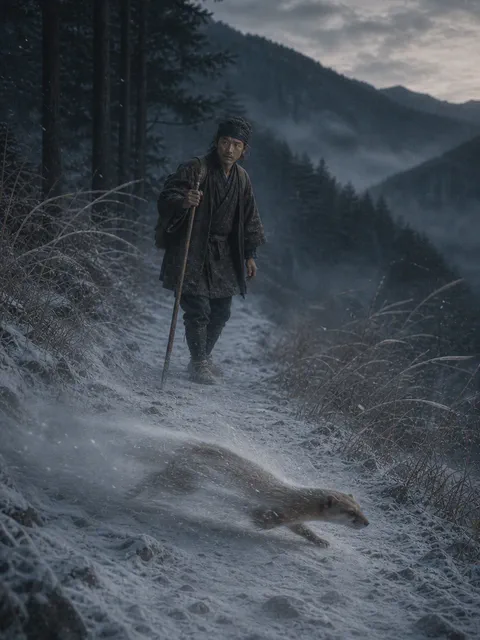
Kamaitachi
鎌鼬(かまいたち)
A 1955 Nagano record describes a weasel-like being so fast no one has seen it — known only by the clean cut it leaves on a stumbling traveler's shin.