
Ningyo: A Fish with a Human Face
人魚(にんぎょ) Ningyo ASCII: Ningyo
Pronunciation: NEEN-gyo
The Japanese ningyo of the old illustrated encyclopedias is not a mermaid — it is a fish body carrying a human face, with no arms and nothing to seduce anyone with. The famous story attached to it is not about romance either.
Quick Facts
- Habitat
- Sea, Coast
- Region
- Wakasa and Obama in Fukui for the Happyaku Bikuni tradition
- Recorded period
- Wakan Sansai Zue (c. 1712), Edo-period ningyo material, Happyaku Bikuni traditions recorded in many places
- Nature
- Unknown
- Danger rating
The danger rating is an editorial summary made for readability. It is not an objective measure found in folklore sources.
Watch the Short
What is Ningyo?
Ningyo is usually translated “mermaid,” and the translation does most of the damage before anyone gets to the sources.
Terajima Ryōan’s Wakan Sansai Zue, the illustrated encyclopedia completed around 1712, describes the ningyo through the material it quotes as having the body of a fish and the face of a person. Not the upper half of a woman. Not a torso, not arms, not hair arranged over anything. A fish, with a human face on it.
Once you have that image you cannot get the other one back, and the tradition starts making a different kind of sense.
Appearance
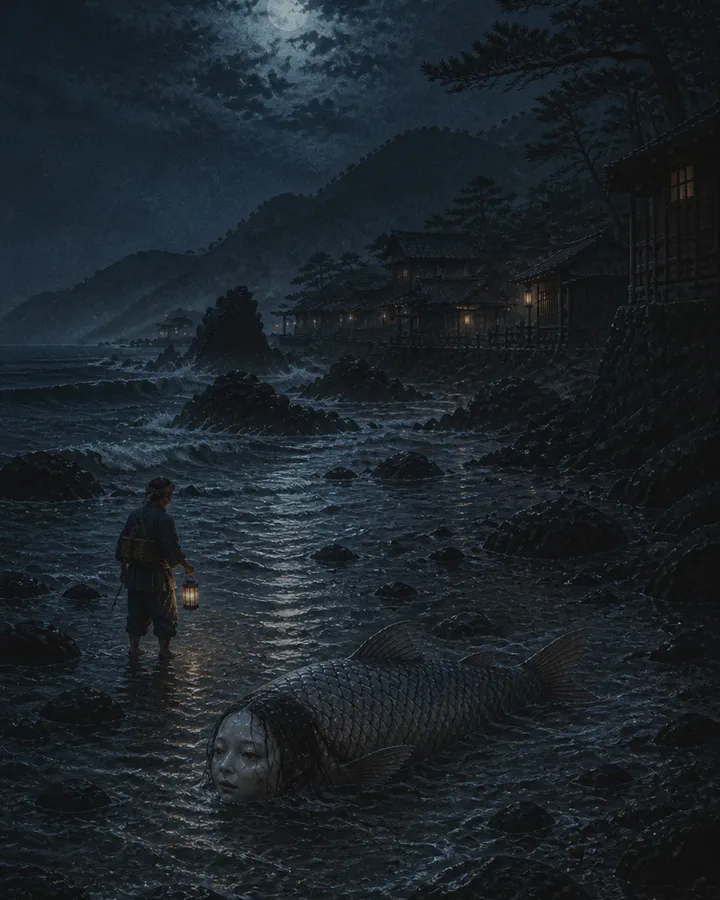
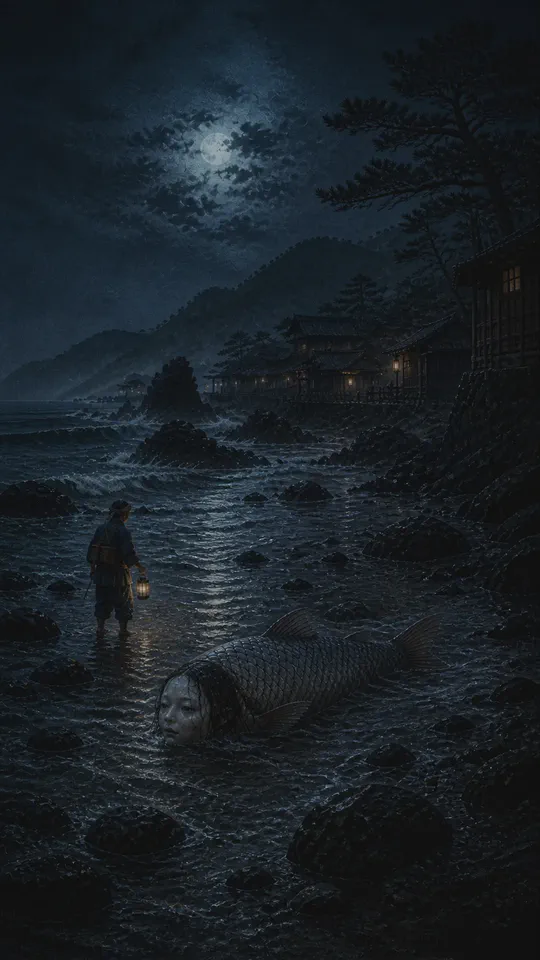
Our illustration follows the encyclopedia: a heavy fish body, scaled and finned, lying in the shallows, with a human face set at the front of it. There are no arms. There is no waist. Nothing about it is arranged to be attractive.
It is beached, which is how most people in the old accounts encountered one — not swimming past a boat and singing, but washed up, or caught, and looked at.
The face is the horror and also the reason anyone kept a record. A fish is ordinary. A fish that appears to be looking back is worth writing down.
Behavior and abilities
- It has almost no behaviour. The encyclopedia entries describe what it is, not what it does. There is no luring, no singing, no drowning of sailors.
- It is caught. The tradition’s events happen after someone lands one.
- Its flesh stops a person ageing. This is the whole of its power, and it only takes effect in somebody else.
The woman who ate it
The famous story is not about the ningyo at all. It is about what happened to someone who ate one.
A girl eats flesh brought home from a strange catch — in most tellings without knowing what it is — and then does not get old. Everyone around her does. She outlives her family, outlives her husband, outlives everyone who remembers her as a child, becomes a nun, and spends centuries walking from province to province. She is called Happyaku Bikuni, the eight-hundred-year nun.
Wakasa, on the Fukui coast, holds the strongest version of this. The Wakasa History Museum keeps images of her, and the town of Obama has the legend firmly attached to it.
The versions do not agree, and the number in her name is a number in a name. Other regions tell it with different lengths, different endings, and different places where she finally stopped. What is constant across them is not eight hundred years. It is that the reward was indistinguishable from a punishment.
Weaknesses and countermeasures
The question does not apply, and noticing why is the point of the entry.
The ningyo is not a danger to anybody. It is caught, it is landed, and it is eaten. In its own tradition it is closer to a fish that turned out to be a mistake than to a monster anyone had to survive.
The harm in the story is real, but it lands on the person who ate. There is no protection recorded because nothing is attacking. A woman ate something she should have been told about, and the consequence took the rest of her life to arrive in full.
Documented sources and later imagery
Documented sources. The Wakan Sansai Zue and the wider body of Edo-period ningyo material describe a fish’s body with a human face. Separately, the Happyaku Bikuni traditions — recorded across many regions, with Wakasa and Obama holding the best-known form — tell of a woman who ate ningyo flesh, stopped ageing, became a nun, and travelled for centuries.
Later imagery. The Western mermaid arrived and took the word. Modern Japanese ningyo are frequently drawn with a woman’s upper body, arms, long hair, and a decorative tail, which makes them a different creature wearing the same name — and it quietly changes the story, because a beautiful woman in the water is something that happens to sailors, while the ningyo of the old books is something that happens to whoever cooks it.
The two traditions here were never one thing. An illustrated encyclopedia recorded an anatomy. A legend recorded a woman who lived far too long. Joining them into a single Japanese mermaid loses the strangeness of both.
Sources and further reading
- Library Wakan Sansai Zue (倭漢三才図会) bibliographic record (external link) National Diet Library Search Catalogue record establishing the work, its compiler, and its dating.
- Museum Happyaku Bikuni exhibitions (external link) Wakasa History Museum, Fukui Prefecture Museum holding the Happyaku Bikuni images and material tying the legend of the woman who ate ningyo flesh and stopped ageing to Obama in Wakasa.
- Library Edo no ningyo-tachi (江戸の人魚たち) National Diet Library Survey of Edo-period ningyo material and of the Happyaku Bikuni and Shiro Bikuni traditions. Consulted in the library's own edition; no stable public URL recorded.
Related yokai

Samebito
鮫人(さめびと)
In a story Lafcadio Hearn published in English in 1900, a man on the Long Bridge of Seta shelters a creature banished from the Dragon Palace — and is repaid in tears that harden into jewels, which only come when the grief behind them is real.
Umi-bōzu
海坊主(うみぼうず)
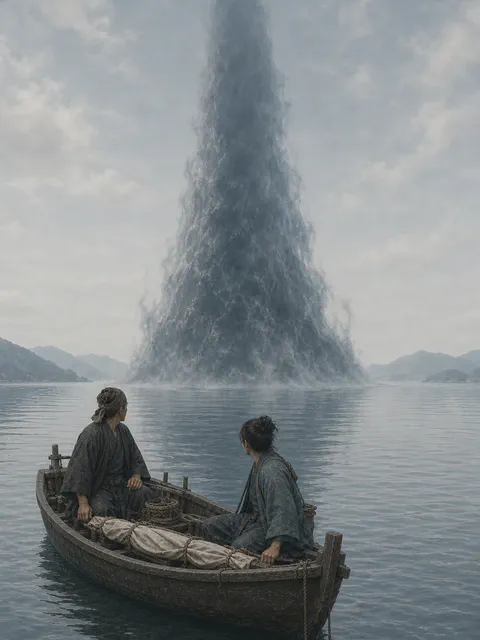
One account describes a vast Buddha-like shape crossing ahead of a boat on a clear, windless day, then slowly thinning until it vanished.