
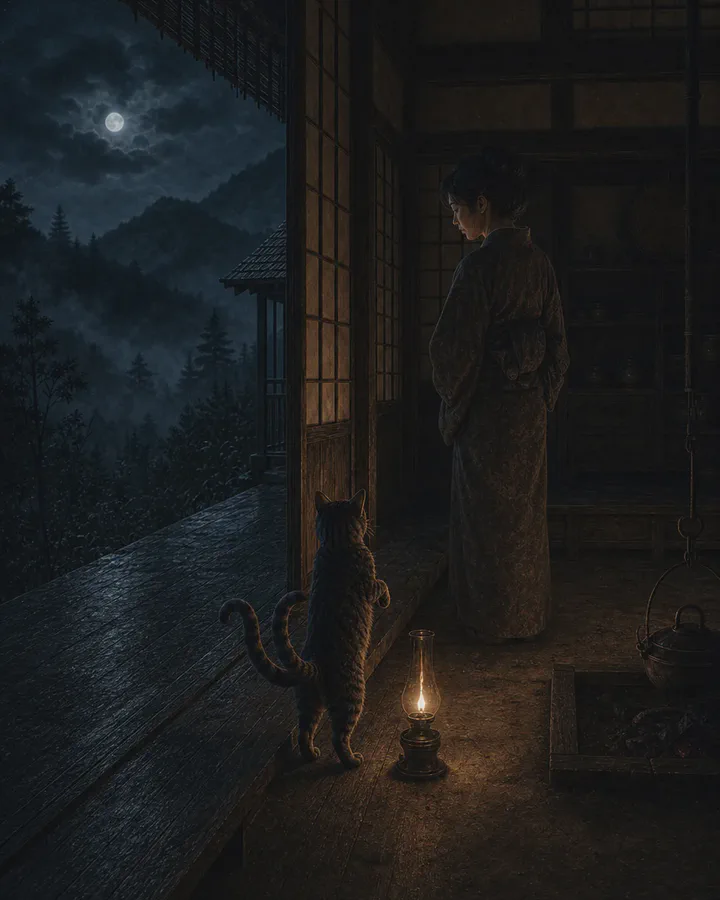
Nekomata: The Two-Tailed Cat Yokai
猫又(ねこまた) Nekomata ASCII: Nekomata
Also known as: 猫股
Pronunciation: neh-koh-MAH-tah
A 1931 Kagawa record describes an aging cat whose tail divides in two and that rises to dance on its hind legs.
Quick Facts
- Habitat
- House, Mountain
- Region
- Marugame (Kagawa), Shintomi (Miyazaki)
- Recorded period
- Tsurezuregusa (14th century), Gazu Hyakki Yagyō (1776), 1931 folklore record
- Nature
- Mixed
- Danger rating
The danger rating is an editorial summary made for readability. It is not an objective measure found in folklore sources.
Watch the Short
What is Nekomata?
Nekomata is a name for supernatural cats in Japanese literature and folklore, but the word has not always described one standardized creature. Some texts place nekomata deep in the mountains. Other accounts describe a household cat that changes after growing old.
The account featured here comes from the Marugame area of Kagawa Prefecture and was published in 1931. It says that an aging cat may become a nekomata: its tail divides into two, and it stands on its hind legs to dance. That compact description supplies the central image of this episode — an ordinary old cat made uncanny by one physical change and one almost human posture.
That is one documented regional account, and the same name is used differently elsewhere. Kagawa’s answer is not Japan’s answer.
Appearance
The Kagawa record gives the nekomata two defining features:
- A divided tail. One tail becomes two rather than being cut or wounded.
- An upright posture. The cat rises onto its hind legs and dances.
Toriyama Sekien’s 1776 picture book Gazu Hyakki Yagyō helped establish a famous visual form: a two-tailed cat standing upright. Sekien’s print is an important Edo-period image, but it is not an illustration made for the 1931 Kagawa account. More than a century separates the two, and neither was made with the other in view.
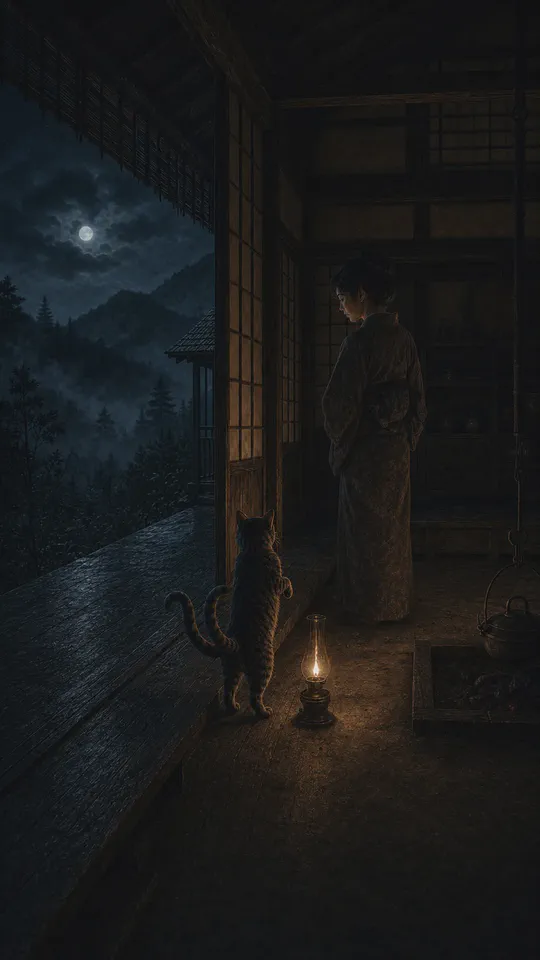
Our illustration keeps the animal at the size of an ordinary domestic cat. It has dark tabby fur, two naturally divided tails, and no clothing or human face. This avoids the giant monster cat, cat-eared person, and elaborately costumed performer common in modern fantasy.
Behavior and abilities
In the adopted record, transformation is expressed through movement rather than attack. The old cat stands and dances on two legs. The account does not say that it speaks, takes human form, casts spells, or grows to enormous size.
The same Kagawa source also records a local response. A household may prepare rice with azuki beans and fish, place a red hand towel on the cat, and send it away without bringing harm to the house. This is a specific ritual from that record, not a universal weakness shared by every nekomata story.
Other supernatural-cat traditions include speech, disguise, revenge, or performance, but those details are often associated with bakeneko stories or with separate local accounts. Japanese folklore does not provide a single biological checklist that cleanly divides every bakeneko from every nekomata. For this series, the visible two-tailed form is used to keep the two episodes clear without claiming that all historical sources did the same.
Folklore accounts and regional variations
The name nekomata is much older than the 1931 Kagawa record. Section 89 of the fourteenth-century Tsurezuregusa mentions a rumor that a nekomata lives in the deep mountains and eats people.
The story then undercuts its own terror. A priest walking alone at night believes the feared creature has leapt upon him. In the end, the attacker is his own dog, excited to see its master. The passage proves that the name was already known, but it does not say that this mountain nekomata is an old household cat or that it has two tails.
A later account from Miyazaki also connects old cats with nekomata or nekomata beliefs, showing how long life and transformation recur without making every regional version identical. Age, habitat, appearance, and behavior shift from source to source.
Weaknesses and countermeasures
There is no universal method for defeating a nekomata.
The food and red-towel response belongs to the 1931 Kagawa account. It is a way of sending the transformed cat away without harm, not proof that those objects work against every supernatural cat. The older mountain rumor in Tsurezuregusa supplies no comparable defense, and its encounter ends as a case of mistaken identity.
None of this is really about cats. The folklore reflects human ideas about age, familiarity, and the unsettling possibility that a long-lived animal might understand more than it reveals.
Traditional folklore and later imagery
Documented tradition. A 1931 Kagawa record says an aging cat may become a nekomata, grow two tails, and dance upright. Tsurezuregusa preserves an older mountain rumor but does not describe an old domestic cat or a divided tail. Sekien’s 1776 print supplies a famous two-tailed visual form.
Later imagery. Modern games, animation, manga, and fantasy art often give nekomata enormous bodies, blue fire, magical powers, human speech, costumes, or cat-human hybrid forms. Those designs are creative descendants of the tradition rather than portraits of it. The older records are more varied — and sometimes much simpler — than the modern composite.
Sources and further reading
- Fieldwork collection Nekomata account from Marugame, Kagawa, record 0640390 (external link) International Research Center for Japanese Studies The adopted 1931 account: an old cat becomes a nekomata, its tail divides in two, it dances upright, and a local food-and-red-towel response is recorded.
- Fieldwork collection Cat and nekomata account from Shintomi, Miyazaki, record C4510104-000 (external link) International Research Center for Japanese Studies Regional comparison for beliefs connecting old cats and nekomata.
- Library Gazu Hyakki Yagyō (画図百鬼夜行) (external link) National Diet Library Search Bibliographic record for the historical picture book associated with Sekien's kodama image.
- Museum Toriyama Sekien's Nekomata image (external link) International Research Center for Japanese Studies Historical two-tailed upright-cat image; not an illustration of the 1931 Kagawa record.
- Library Tsurezuregusa section 89 and the nekomata (external link) National Diet Library Discusses the older mountain-nekomata rumor and the story's mistaken-identity ending; it does not describe an old household cat or two tails.
Related yokai
Bakeneko
化け猫(ばけねこ)
Stories of old cats that speak, perform, dress like people or take human form—and the separate cat yokai they keep getting confused with.
Wanyūdō
輪入道(わにゅうどう)
In Toriyama Sekien's 1779 picture book, a single ox-cart wheel rolls through the night by itself — and anyone who sees it is said to lose their soul.