

Namahage (なまはげ): The Frightening Visitors Oga Welcomes Home
Akita's masked New Year's Eve deities, and the meal that ends every visit
なまはげ Namahage ASCII: Namahage
Also known as: Oga no Namahage
Pronunciation: NAH-mah-HAH-geh
Namahage (なまはげ) are the masked visiting deities of the Oga Peninsula in Akita. On New Year’s Eve, young men of each district put on fierce carved masks and thick capes of straw and go from house to house, stamping and roaring, asking whether there are any lazy people or crying children inside — and then the head of the house receives them formally with food and sake, and they leave a blessing of health and good harvests for the year. It is a living rite, performed in seventy-one districts in 2025 and inscribed by UNESCO in 2018.
Quick Facts
- Habitat
- House
- Region
- Oga (Akita)
- Recorded period
- living New Year's Eve rite
- Nature
- Helpful
- Danger rating
The danger rating is an editorial summary made for readability. It is not an objective measure found in folklore sources.
Watch the Short
What is Namahage?
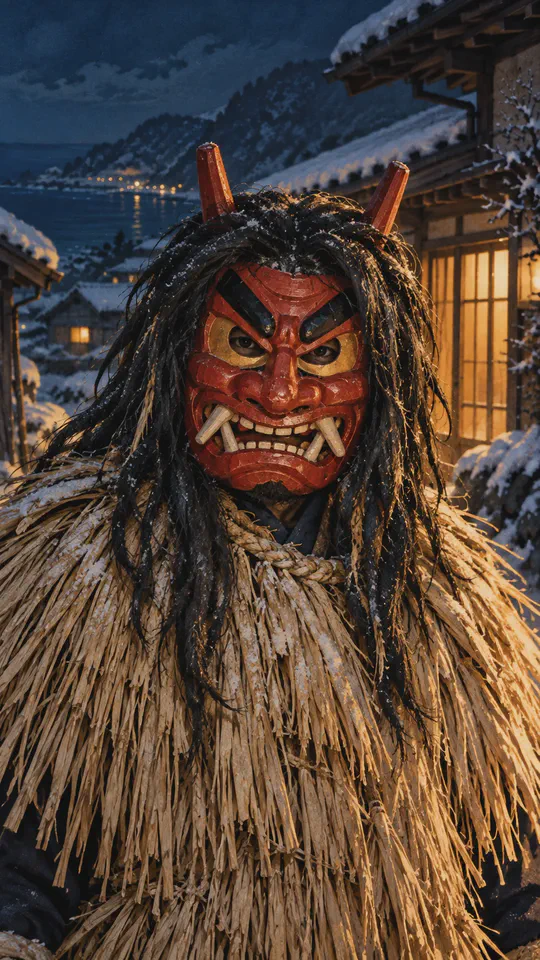
It is the last night of the year on the Oga Peninsula, a knob of land jutting into the Japan Sea from Akita, and the snow is deep. There is a roar outside, and stamping, and the door bangs open. Two huge figures come in — carved masks with horns and fangs, red or blue, and bodies lost in shaggy capes of straw — and they stamp through the rooms shouting: Any crying children here? Any children who won’t listen to their parents? Any lazybones in this house?
And then the head of the household kneels, and bows, and offers them a seat and a cup of sake and a tray of food, and the Namahage sit down. They ask after the family’s year. They are told the children have been good. They leave a blessing — health, a good harvest, the bounty of mountain and sea — and go on to the next house.
The Namahage are not creatures anyone avoids. They are visitors every house prepares for.
What does namahage mean?
The name is written in kana, なまはげ, and Oga explains it through the local dialect. Sitting too long by the hearth in winter leaves red heat-blisters on the skin, called namomi. Peeling the namomi off — namomi hagi — means stripping away the idleness that produced them, and namomi-hagi wore down to namahage. The name is a threat to the lazy, built into the word. It is pronounced NAH-mah-HAH-geh.
The visit
Oga City describes the Namahage as raihōshin, visiting deities who come at the turn of the year. The rite used to be held at Little New Year in January; it now takes place on December 31. Each household prepares food and sake in advance and entertains the Namahage formally, by customs handed down in that district, and the evening ends in hospitality. The visitors are guests as well as a threat. In 2025 the rite was held in seventy-one districts.
Appearance
There is no single Namahage mask. Oga City’s gallery shows how they differ from district to district in shape, colour and material — red and blue faces, horned and hornless, carved wood, papier-mâché, bark, even metal colanders. The straw cape, the kede, and the straw leggings are shared. Our illustration is our own: a red horned mask and a straw cape before a snowbound farmhouse, and not a reconstruction of any one district.
Behavior and abilities
- They visit every house. Going door to door is the rite.
- They rebuke. Idleness, disobedience and laziness are named aloud.
- They bless. Health and good harvests for the coming year.
The fright is real and it is intended, especially for the children. It is one part of a visit that ends with a meal.
Weaknesses and countermeasures
None are needed. The household’s answer to the Namahage is hospitality, not defence.
Living rite and wider fame
Living rite. Oga no Namahage, an Important Intangible Folk Cultural Property of Japan since 1978, and part of “Raihō-shin, ritual visits of deities in masks and costumes,” inscribed by UNESCO in 2018: masked visiting deities who come to each house on New Year’s Eve and are received with food and sake. A separate winter festival, the Namahage Sedo Matsuri in February, stages them for visitors.
Wider fame. Abroad, the Namahage are often shown as Japanese monsters that frighten children, filed next to the oni whose masks they resemble. The most frightening visitors of the year are the ones Oga invites in.
Sources and further reading
- Primary text Oga no Namahage, Important Intangible Folk Cultural Property (external link) Oga City New Year's Eve visits by masked young men, the rebuke of idleness, the blessings, and the households' formal hospitality.
- Primary text Masks of each district (external link) Oga City Gallery showing how masks differ in shape and material from district to district.
- Museum Oga no Namahage (external link) Namahage Museum Distinguishes the New Year's Eve visits from the February Sedo festival.
- Reliable secondary Raiho-shin, ritual visits of deities in masks and costumes (external link) UNESCO Intangible Cultural Heritage Inscription of ten visiting-deity rites, including Oga, in 2018.
Where it was recorded
- undated
Oga Peninsula, Akita
Living rite
Masked visiting deities on New Year's Eve, received with food and sake
Places named in the records behind this article. Coordinates are approximate. View on the map
On the timeline
In the glossary
In manga
- Nura: Rise of the Yokai Clan ぬらりひょんの孫 Uses the names, reinvents the rest
Where to see it
- Namahage Museum and Shinzan Folklore Museum なまはげ館・男鹿真山伝承館 Museum
- Namahage Sedo Festival なまはげ柴灯まつり Festival
Related yokai
Oni
鬼(おに)
The horned, red-skinned oni with a club is a late composite. The word first named an invisible spirit of the dead, then hell's wardens, mountain monsters, outsiders — and even the figure who once chased oni away.
Zashiki-warashi
座敷童子(ざしきわらし)
In Tōno Monogatari, an unfamiliar child crosses the corridor of an old house — and the family that shelters the spirit is said to prosper.