
Mokumokuren: The Eyes in an Abandoned House
目目連(もくもくれん) Mokumokuren ASCII: Mokumokuren
Also known as: 目目蓮
Pronunciation: moh-koo-moh-koo-ren
Rows of human eyes appear across old shoji in Toriyama Sekien's 1781 picture-book image.
Quick Facts
- Habitat
- House
- Region
- Japan
- Recorded period
- Edo period
- Nature
- Unknown
- Danger rating
The danger rating is an editorial summary made for readability. It is not an objective measure found in folklore sources.
Watch the Short
What is Mokumokuren?
Mokumokuren is the name given to an uncanny image of many eyes appearing across the paper panels of an old shoji wall. Its clearest early source is Toriyama Sekien’s illustrated book Konjaku Hyakki Shūi, first published in 1781.
Sekien depicts a ruined interior. The shoji are worn, the room is empty, and dozens of paired eyes look out from the paper. His caption does not present a village witness, a victim, or a battle with a monster. Instead, it makes a joke: a house containing so many “eyes” must have belonged to a player of Go, a board game in which enclosed spaces are called eyes.
The result is both visual and verbal. An abandoned house appears to watch its visitor, while the caption turns those eyes into a playful clue about an absent resident.
Appearance
Sekien’s Mokumokuren has no independent head, torso, hands, or feet. The yokai is the combination of the old room, the paper screens, and the many pairs of eyes spread across them.
The eyes are human in scale and arranged within the shoji panels. They are not one enormous eye, a wall of flesh, or a cloud of floating eyeballs. The paper surface remains visible, which makes the impossible detail feel embedded in an otherwise recognizable domestic space.
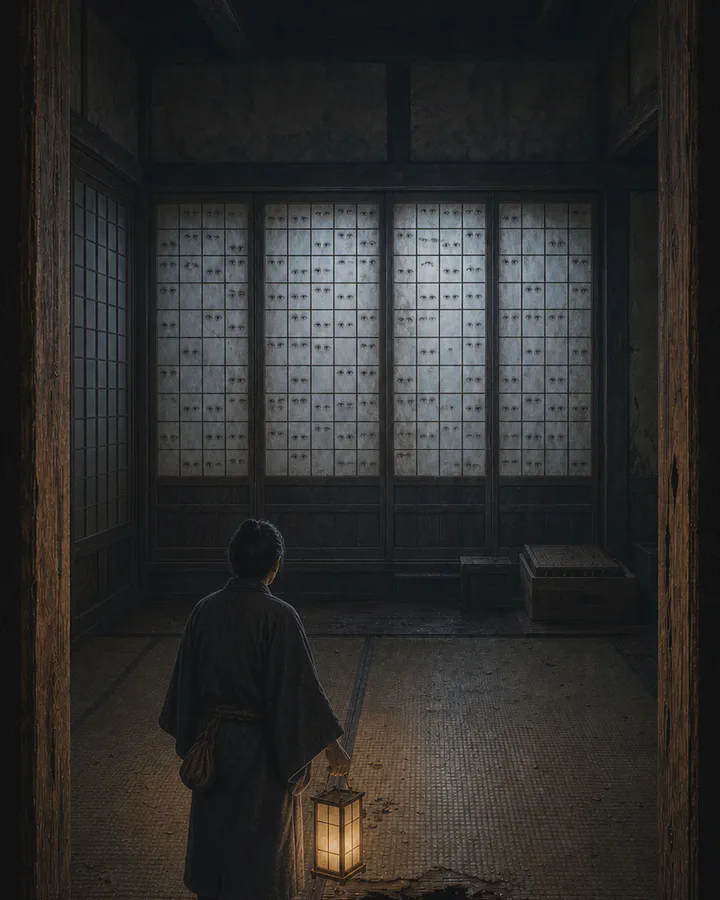
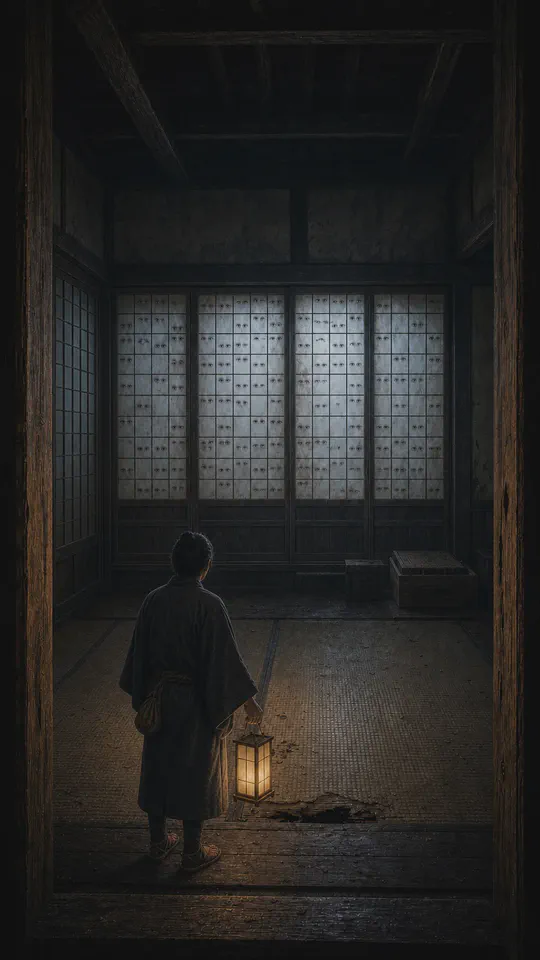
Our illustration follows that basic composition. A traveler carrying a lantern stands before four old shoji panels as many small pairs of eyes open across the paper. The traveler and gradual opening are cinematic additions used to turn a single historical image into a short sequence; they are not events narrated by Sekien.
Behavior and abilities
The 1781 print and caption provide remarkably little behavior:
- The house has many eyes. The visual premise is the primary evidence.
- The eyes appear on the shoji. No separate creature is identified behind the paper.
- The caption makes a Go pun. It imagines the ruined house as the former home of a player surrounded by “eyes.”
- No attack is described. The source does not say that Mokumokuren steals eyes, bites intruders, traps a traveler, or pursues anyone outside.
Modern animation naturally makes the eyes blink, open in sequence, or follow a person across the room. Those motions extend Sekien’s still image. They should be presented as adaptation rather than as a complete set of traditional abilities.
Source history and interpretation
The National Diet Library’s digitized copy places Mokumokuren in the lower volume of Hyakki Yagyō Shūi, in an 1805 printing of the work first issued in 1781. Bibliographic records from the National Diet Library and CiNii identify the larger multi-volume publication, while the Tokyo Museum Collection records Sekien as the artist and dates the work to 1781.
These sources support a picture-book origin, not a collected oral account tied to one village or prefecture. Calling the image “folklore” in a broad modern sense is reasonable, but the evidence here is a published artistic invention or arrangement whose caption depends on learned wordplay.
The name is also visually suggestive. Whether written 目目連 or 目目蓮 in later references, it evokes a connected multitude of eyes. That does not make it interchangeable with Hitotsume-kozō, Dodomeki, Tenome, or other eye-related yokai, each of which has different sources and imagery.
Weaknesses and countermeasures
Sekien’s print and caption provide no countermeasure.
The source does not say that replacing the shoji paper makes Mokumokuren disappear, that cleaning the room prevents it, or that the eyes can be removed and sold. Those solutions belong to later retellings. The 1781 image offers nothing to do about the eyes at all.
Because no attack is described, the print does not require a combat weakness. Its effect comes from being watched in a room that should be empty, not from a documented struggle with a physical monster.
Traditional source and later imagery
Documented source. Toriyama Sekien’s 1781 picture-book image shows many pairs of eyes across the shoji of a ruined house. The caption jokes that the building may once have belonged to a Go player because it contains so many “eyes.”
Later imagery. Modern depictions often add a visitor, moving eyes, torn paper, a haunting caused by neglect, an attack, or a method of banishment. Some portray individual eyeballs peering through holes, while others turn the entire building into a living creature. These are understandable expansions of a strong visual idea, but they exceed what Sekien’s caption states.
Mokumokuren needs little added violence. A deserted room, a dim lantern, and a wall that suddenly looks back are enough.
Sources and further reading
- Primary text Mokumokuren in Hyakki Yagyō Shūi, lower volume, frame 6 (external link) National Diet Library Digital Collections Digitized 1805 printing containing Sekien's image and caption; the work was first published in 1781 and the caption makes a pun on the eyes of Go.
- Library Hyakki Yagyō, three volumes and three supplementary volumes (external link) National Diet Library Search Bibliographic record for the multi-volume publication containing the supplementary work.
- Museum Konjaku Hyakki Shūi (external link) Tokyo Museum Collection Museum record identifying Toriyama Sekien and dating the work to 1781.
- Library Hyakki Yagyō Shūi, three volumes (external link) CiNii Books Bibliographic record for editions and holdings of the three-volume supplementary work.
- Museum Toriyama Sekien's Mokumokuren (external link) Wikimedia Commons Public image reference for Sekien's composition; use the primary text for the caption.
Related yokai
Zashiki-warashi
座敷童子(ざしきわらし)
In Tōno Monogatari, an unfamiliar child crosses the corridor of an old house — and the family that shelters the spirit is said to prosper.

Wanyūdō
輪入道(わにゅうどう)
In Toriyama Sekien's 1779 picture book, a single ox-cart wheel rolls through the night by itself — and anyone who sees it is said to lose their soul.