
Mikoshi-nyūdō: The Yokai That Grows as You Look Up
見越入道(みこしにゅうどう) Mikoshi-nyūdō ASCII: Mikoshi-nyudo
Also known as: 見越し入道
Pronunciation: mee-koh-shee nyoo-DOH
A 1938 Nagasaki record warns of bamboo rustling over a night road and a looming figure that must be recognized aloud.
Quick Facts
- Habitat
- Road, Mountain
- Region
- Nagasaki, Kaminoyama (Yamagata), Tōei (Aichi)
- Recorded period
- 1932 folklore record, 1938 folklore record, modern folklore collections
- Nature
- Harmful
- Danger rating
The danger rating is an editorial summary made for readability. It is not an objective measure found in folklore sources.
Watch the Short
What is Mikoshi-nyūdō?
Mikoshi-nyūdō is a looming, humanlike yokai encountered on a road at night. Its name plays on looking over or looking up, and many retellings describe a figure that becomes taller the farther a traveler raises their gaze.
The account featured here was published in 1938 and catalogued for Nagasaki Prefecture. A person walking at night hears bamboo or bamboo grass rustling overhead. The danger is not avoided by pretending nothing is there. The traveler must recognize the presence and call out, “Mikoshi-nyūdō, I see through you.”
The story makes looking itself part of the encounter. A shape on the road becomes an impossible vertical presence, while survival depends on naming what has been perceived.
Appearance
No single body defines Mikoshi-nyūdō in every source.
The name nyūdō can describe the shaven-headed appearance associated with a lay monk, and historical illustrations often use a large bald or closely shaven humanlike head. That visual language does not mean that real Buddhist clergy are the subject of the fear, nor does it make robes, prayer beads, or temple insignia required features.
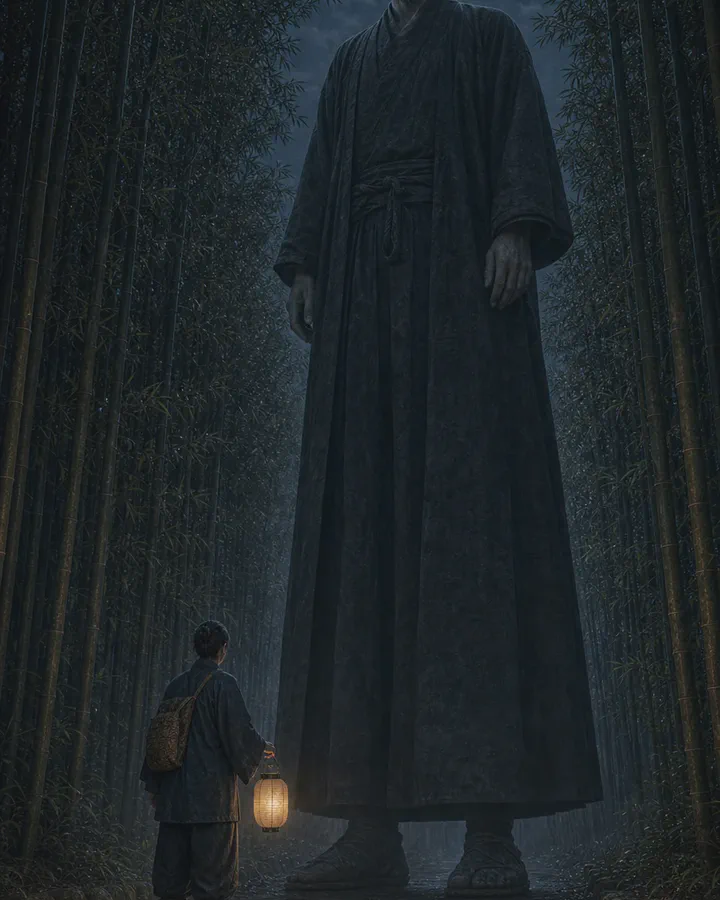
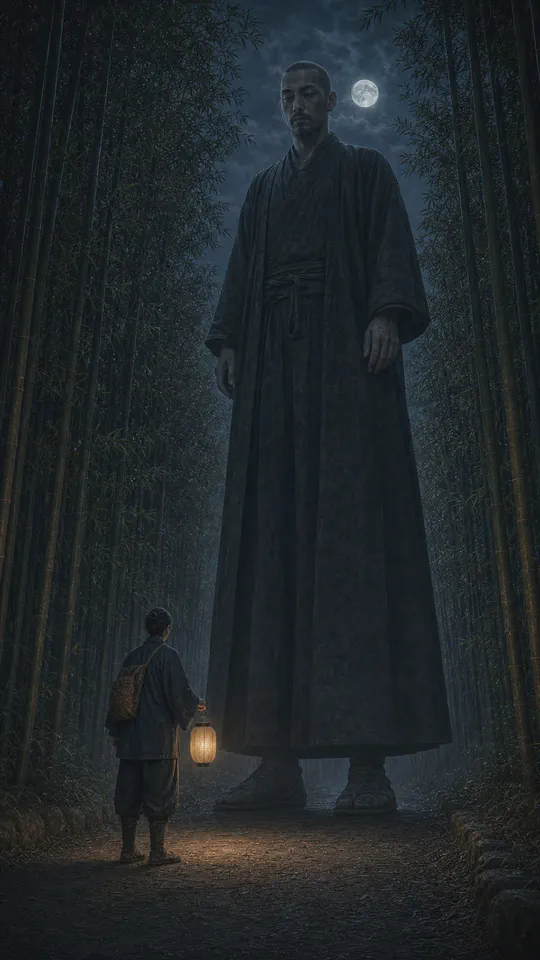
Our illustration uses a tall, thin male figure in an unmarked dark robe. His feet remain on the road while his shoulders and head rise beyond the bamboo. A small traveler and lantern establish the scale. The whole body stretches, which keeps this figure distinct from Rokurokubi, whose most recognizable feature is an elongated or separated neck.
Other historical images give related figures one eye, a long tongue, or even a portable shrine. These are valuable examples of visual variation, not parts of one mandatory anatomy.
Behavior and abilities
The 1938 Nagasaki record gives the encounter a clear progression:
- Rustling comes from above. Bamboo moves over a traveler on the night road.
- Silence is dangerous. If the traveler passes without responding, the bamboo may fall and kill them.
- Recognition breaks the threat. The traveler must call out that Mikoshi-nyūdō has been seen through.
The familiar idea that the giant rises with a person’s gaze makes the yokai especially suited to a vertical image, but not every collected record describes its growth in exactly the same way. The Nagasaki account emphasizes sound, danger from bamboo, and the required phrase.
A record from Kaminoyama in Yamagata gives a related response with different wording. When the person says a phrase often rendered as “Mikoshi-nyūdō, I have looked beyond you,” the huge figure becomes smaller and disappears. That shrinking ending belongs to its own account. The Nagasaki record ends differently.
Folklore accounts and regional variations
Mikoshi-nyūdō traditions are distributed across more than one prefecture. The Nagasaki and Yamagata examples share the importance of speaking to the figure, but their wording and results are not identical.
A 1932 record from Tōei in Aichi Prefecture preserves the fear attached to a place where Mikoshi-nyūdō was said to appear. It helps establish the name’s regional spread without proving that the same bamboo, same phrase, and same shrinking action occurred everywhere.
Printed games and popular pictures also diversified the image. One nineteenth-century-style game board depicts a tall “mikoshi” figure, while another example combines a one-eyed being with a portable shrine. Those images show artists playing with a name and a silhouette, centuries and hundreds of kilometers away from a bamboo grove in Nagasaki in 1938.
Weaknesses and countermeasures
In the adopted accounts, the countermeasure is verbal recognition.
The Nagasaki traveler must declare, “Mikoshi-nyūdō, I see through you.” The Yamagata example uses a similar but not identical phrase and ends with the figure shrinking away. The wording matters because folklore is transmitted locally; replacing every regional formula with one standardized spell would erase the differences preserved by the records.
The sources used here do not establish a universal weapon, charm, or physical weak point. Striking the figure, using a Buddhist object, refusing ever to look upward — those rules circulate widely, and none of them is in this record.
Traditional folklore and later imagery
Documented tradition. A 1938 Nagasaki record describes rustling bamboo over a night traveler, mortal danger if the traveler stays silent, and a phrase that identifies Mikoshi-nyūdō. A Yamagata account uses related words and describes the giant shrinking and vanishing. An Aichi record preserves a separate place-based tradition.
Later imagery. Modern depictions often combine every possible feature: endless growth, a single eye, a long tongue, monk’s robes, a portable shrine, and spectacular attacks. Historical sources and images do not require that complete package. The essential fear can remain much simpler — a personlike shape on a dark road, the sound of bamboo overhead, and the realization that looking up has made the figure impossibly tall.
Sources and further reading
- Fieldwork collection Mikoshi-nyūdō account from Nagasaki, record 2180788 (external link) International Research Center for Japanese Studies The adopted 1938 account: bamboo rustles above a night traveler, silence is dangerous, and the traveler must identify Mikoshi-nyūdō aloud.
- Fieldwork collection Mikoshi-nyūdō account from Kaminoyama, Yamagata, record 1140544 (external link) International Research Center for Japanese Studies A regional example in which a related spoken phrase makes the giant shrink and disappear.
- Fieldwork collection Mikoshi-nyūdō account from Tōei, Aichi, record 0900011 (external link) International Research Center for Japanese Studies A 1932 place-based record useful for showing the tradition's regional spread.
- Reliable secondary Yokai Hyakunin Isshu and Mikoshi-nyūdō (external link) National Diet Library Monthly Bulletin 770 National Diet Library discussion of historical Mikoshi-nyūdō imagery.
- Museum Mikoshi figure from Shinpan Yōkai Tobimawari Sugoroku (external link) International Research Center for Japanese Studies Historical popular-print example showing one visual treatment of a towering mikoshi figure.
- Museum One-eyed mikoshi image with a portable shrine (external link) International Research Center for Japanese Studies A distinct visual example; do not treat its one eye or shrine as universal Mikoshi-nyūdō features.
Related yokai
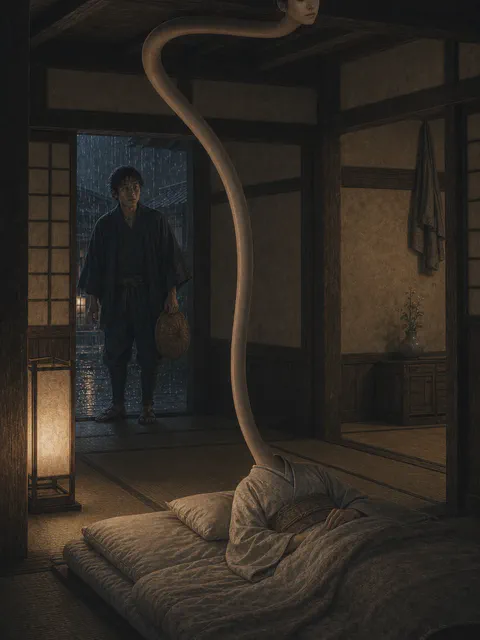
Rokurokubi
轆轤首(ろくろくび)
A seemingly human figure whose neck stretches at night—and one name that once covered more than one uncanny form.
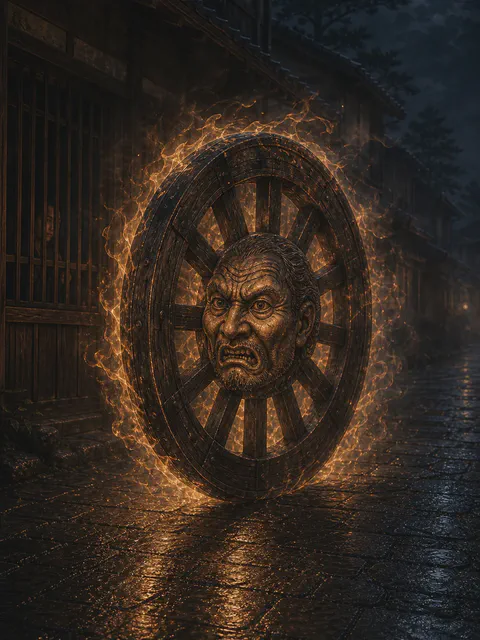
Wanyūdō
輪入道(わにゅうどう)
In Toriyama Sekien's 1779 picture book, a single ox-cart wheel rolls through the night by itself — and anyone who sees it is said to lose their soul.
Tengu
天狗(てんぐ)
A mountain being associated with flight, impossible voices, disappearances, and more than one familiar face.