
Kudan (件): The Human-Faced Cow That Never Lied
Japan's prophesying calf, from an 1836 broadsheet of good news
件(くだん) Kudan ASCII: Kudan
Also known as: Kudabe, Kutabe
Pronunciation: KOO-dahn
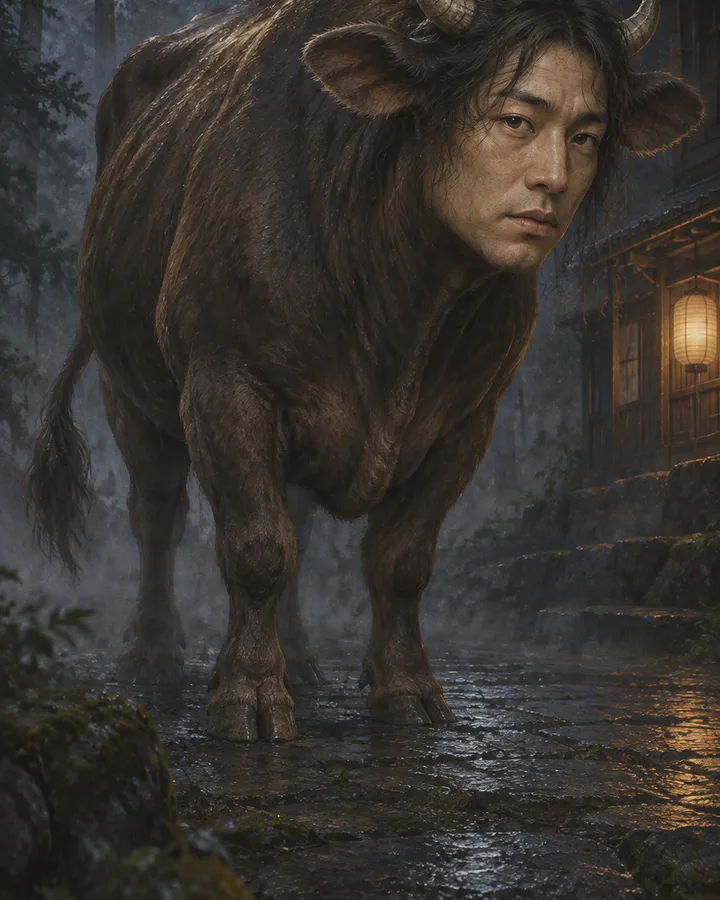
Kudan (件, “person-cow”) is a calf with a human face, born to an ordinary cow, that speaks a prophecy and is always right. It is known from the broadsheets and rumours of nineteenth-century western Japan. An 1836 sheet from Tango reports one on Mt. Kurahashi and promises that any house that puts up its picture will prosper, escape misfortune and see good harvests. Other kudan of the same century foretold famine, epidemics and war.
Quick Facts
- Habitat
- Mountain, Field
- Region
- Tango (Kyoto), Kaminoseki (Yamaguchi)
- Recorded period
- 1836 broadsheet, 19th-century rumours
- Nature
- Helpful
- Danger rating
The danger rating is an editorial summary made for readability. It is not an objective measure found in folklore sources.
Watch the Short
What is Kudan?
In the twelfth month of 1836 a broadsheet went on sale in the Yosa district of Tango, on the Japan Sea coast north of Kyoto. It reported that a kudan — a beast with a cow’s body and a human face — had appeared on Mt. Kurahashi, and it made a promise. Any house that put up this picture would prosper, escape misfortune, and see good harvests. A copy survives in the Yamaguchi Prefectural Archives, in a collection of rumours and news kept by the Mōri family, and a related sheet is titled, in effect, The Beast Called Kudan, Announcing a Great Harvest.
That is the kudan at its most hopeful. It was not always.
What does kudan mean?
The name is written 件, a single character made of 人, a person, on the left and 牛, a cow, on the right — the person-cow, spelled out in the shape of the word. It is pronounced KOO-dahn.
The same character is the ordinary word for “the matter in question,” and old documents close with the formula yotte kudan no gotoshi, “and so, as stated above.” A popular explanation says the phrase comes from the kudan, whose word was never wrong, so that “as the kudan says” came to mean “this is true.” It is a good story and not an established etymology.
Two faces
Kudan appeared in many places in western Japan in the late Edo period — one was said to have been born at Kaminoseki, in Suō, in 1819 — and they foretold good years, famine and epidemics alike. Later rumours had a kudan born before the Sino-Japanese and Russo-Japanese wars, and again during the Second World War, each time to announce disaster.
So the creature has two faces in the record: the bringer of good news on the 1836 sheet, and the bearer of warnings everywhere else. They share a body, a name, and a reputation for being right.
Appearance
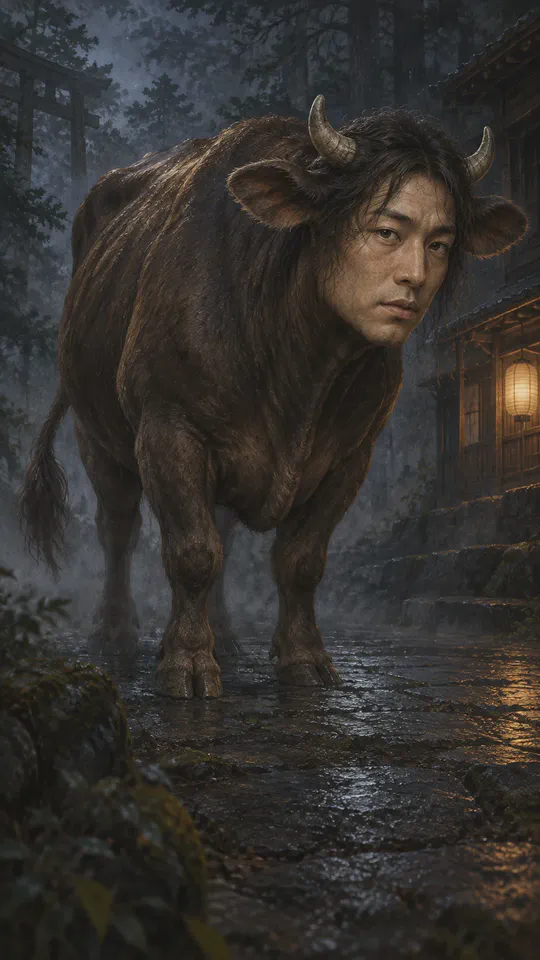
A cow’s body with a human face. The Yamaguchi copy shows a cow lying down with a human profile. Our illustration stands it on a misty mountain path, calm-faced, with short horns; it is our own design.
Behavior and abilities
- It appears in a particular place. Mt. Kurahashi, in the 1836 sheet.
- It promises. Prosperity and harvest, through its picture.
- Its word is true. Kudan were said never to be wrong.
Weaknesses and countermeasures
None are recorded. The 1836 kudan is not a danger; its picture is the protection. Like the amabie ten years later, it is a messenger whose only demand is to be copied and put on the wall.
Documented broadsheet and later imagery
Documented broadsheet. A copy of an 1836 broadsheet from Yosa, Tango: a human-faced cow at Mt. Kurahashi whose picture brings prosperity, protection and good harvests to the house that displays it. Other nineteenth-century kudan reported across western Japan foretold harvests, famine and disease; twentieth-century rumours tied them to wars.
Later imagery. Modern accounts make the kudan a creature of grim prophecy — born, speaking one catastrophe, and dying within days — and sometimes a cow-bodied woman rather than a human-faced cow. The 1836 sheet is gentler than the legend that followed it. A strange animal came down a mountain with good news and asked only to be put up on the wall.
Sources and further reading
- Library Yotte kudan no gotoshi: the honest prophesying monster (external link) Yamaguchi Prefectural Archives A copy of an 1836 broadsheet from Yosa, Tango, of a human-faced cow at Mt. Kurahashi; also an 1819 kudan at Kaminoseki.
- Academic paper Kutabe, the announcer of epidemics (external link) Hosoki Hitomi; Bulletin of the Tateyama Museum of Toyama 27 (2020) Introduces a kudan broadsheet announcing a great harvest; Kutabe itself is a separate creature.
- Reliable secondary Yokai world: kudan and amahiko (external link) Saku City, Gorobei Memorial Museum Transcription of a local kudan document; gives Tanba where others give Tango.
Where it was recorded
- 1836
Mt. Kurahashi, Yosa District (Tango), Kyoto
Print or picture
Broadsheet: a kudan whose picture brings prosperity and harvest
- 1819
Kaminoseki, Yamaguchi
Modern rumour
A kudan said to have been born here
Places named in the records behind this article. Coordinates are approximate. View on the map
On the timeline
In the glossary
In manga
- In/Spectre 虚構推理 Uses the names, reinvents the rest
- Nura: Rise of the Yokai Clan ぬらりひょんの孫 Uses the names, reinvents the rest
Related yokai
Amabie
アマビエ
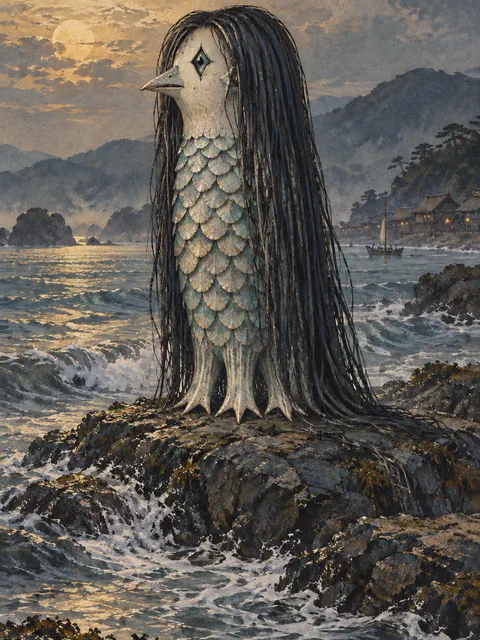
A printed sheet dated 1846 tells of a creature with long hair and a beak that rose from the sea off Higo, foretold six years of good harvests and an epidemic, and asked people to copy its picture and show it around.
Kirin
麒麟(きりん)
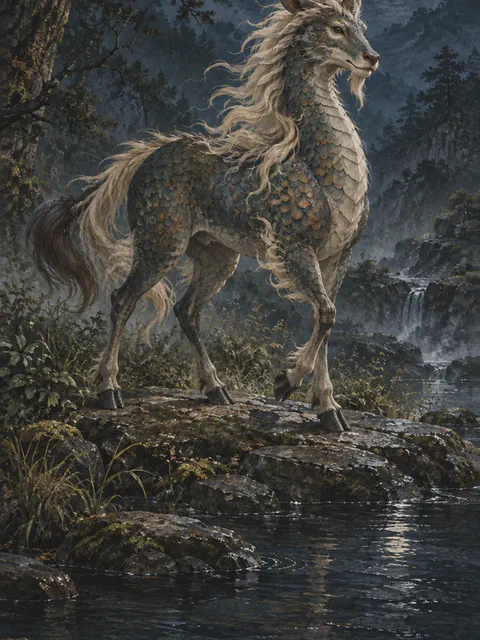
The kirin is an auspicious beast of Chinese origin, shown in Japanese art from the eighth century: deer-bodied, one-horned, and said to appear only when the world is well governed. It harms no living thing — not even the grass.

Hakutaku
白澤(はくたく)
A beast from Chinese legend that named every harmful thing in the world for the Yellow Emperor, and whose image — nine eyes, six horns, a human face — was carried by Edo travelers and set beside pillows during the cholera epidemic of 1858.