
Konaki-jiji: An Old Man's Face, a Baby's Cry
児啼爺(こなきじじい) Konaki-jiji ASCII: Konaki-jiji
Also known as: 子泣き爺
Pronunciation: koh-nah-kee-JEE-jee
A 1938 record from the Miyoshi mountains of Tokushima gives an old man's appearance and an infant's cry, in a single line. The famous part — that it grows unbearably heavy once you pick it up — is not in it.
Quick Facts
- Habitat
- Mountain, Forest
- Region
- Miyoshi district, Tokushima
- Recorded period
- a record in Tabi to Densetsu (1938)
- Nature
- Unknown
- Danger rating
The danger rating is an editorial summary made for readability. It is not an objective measure found in folklore sources.
Watch the Short
What is Konaki-jiji?
The record is one line and it is built out of a mismatch.
A card in the folklore database of the International Research Center for Japanese Studies, drawing on a 1938 issue of Tabi to Densetsu, summarises the konaki-jiji of Miyoshi district in Tokushima: it is deep in the mountains, it looks like an old man, and it makes the crying sound of an infant.
That is the whole thing. Two facts that do not belong together, in a place where you are alone.
Appearance
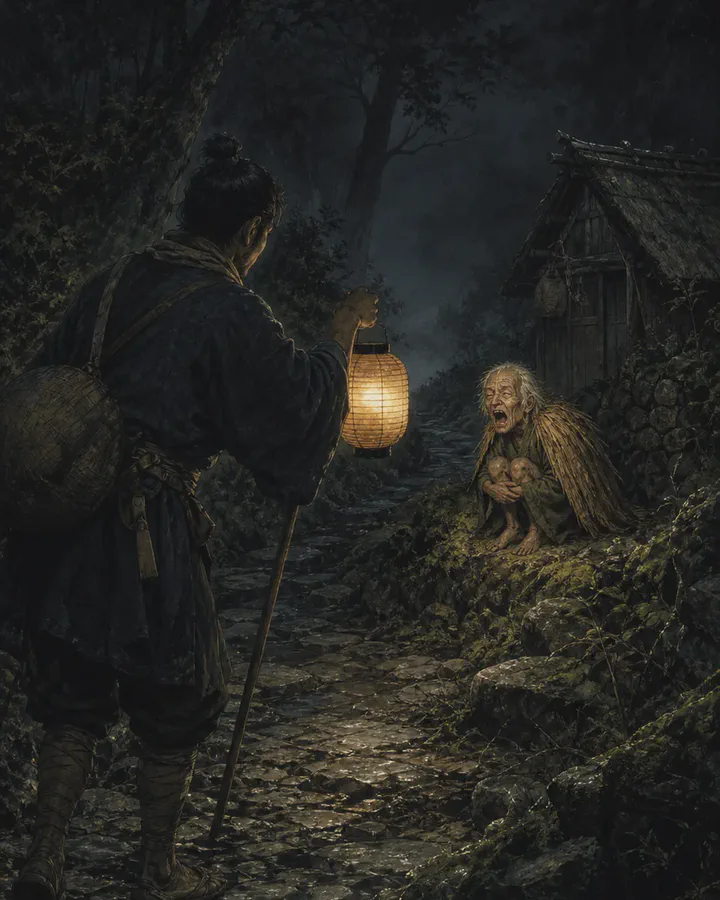
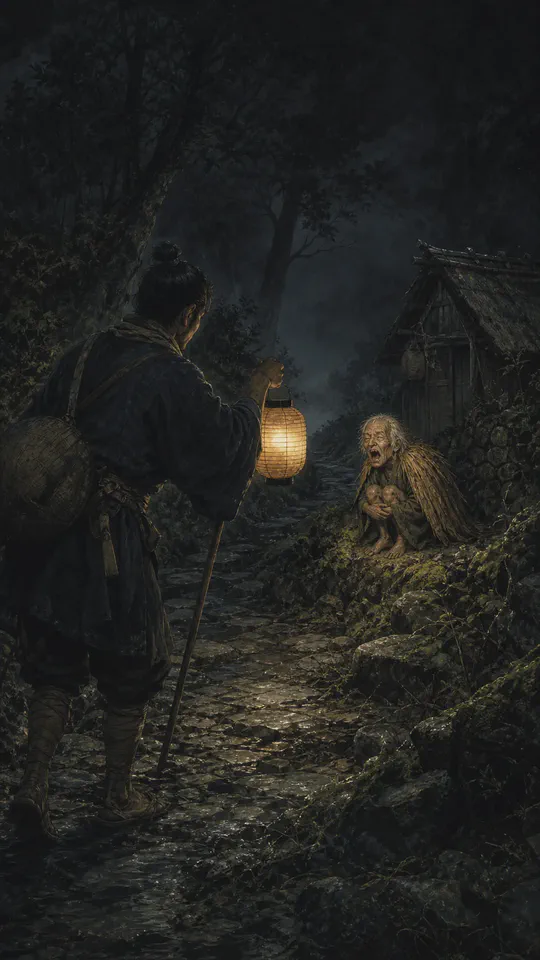
An old man, in the mountains. Our illustration keeps to that: a small elderly figure in a straw cape, crouched at the side of a stone path near a hut, with a traveller stopped a few paces off holding up a lantern.
The mouth is open because that is where the horror lives. The sound you have been hearing is a baby. The thing making it is not.
No real infant appears in our images, and the record does not require one — the crying is an attribute of the old man, not evidence of a child.
Behavior and abilities
- It is in the deep mountains. Not in villages, not on roads near houses.
- It looks old. The word in the name is jiji, an old man.
- It cries like an infant. The two halves of the name are the two halves of the creature.
The record specifies no attack, no pursuit, and no outcome for anyone who meets it.
The famous part is not in the record
Almost everyone who knows this creature knows one thing about it: you hear crying, you find what appears to be a baby, you pick it up out of pity, and it becomes heavier and heavier until you cannot put it down.
That version is not in the 1938 summary.
Where it came from is a documented question rather than a mystery. Researchers have pointed to the joining of konaki-jiji with other traditions about things that grow heavy when carried, and to the tidying-up that happens when scattered regional material is organised into a national catalogue of yokai. After Mizuki Shigeru, the heavy version became the version, through comics and television and everything downstream of them.
The same database card raises a related problem. It reports an identification of konaki-jiji with gogya-naki — but gogya-naki is described as a one-legged creature walking in the mountains whose cry is taken as a sign of coming earthquakes. Same card, same name attached, and a fairly different creature. This page keeps them apart.
Weaknesses and countermeasures
None are recorded, and there is nothing recorded to defend against.
This is worth stating clearly because the popular version has a very specific danger — the weight, the inability to let go, the crushing. Remove that, and the 1938 record leaves an encounter with no stated consequence at all.
What remains is the sound. Someone deep in the mountains hears a baby crying, which is already wrong, and finds an old man, which is worse.
Yamashiro today
Yamashiro in Tokushima has a stone statue of the konaki-jiji and presents itself as yokai country, and there has been fieldwork and local rediscovery there, including work drawing on Takeda Akira’s records.
That is modern reception, and it is genuine — but a statue put up in the present is not evidence of where a tradition started. The 1938 record gives Miyoshi district, and that is as precise as the source gets.
Documented record and later imagery
Documented record. From Tabi to Densetsu, 1938, for Miyoshi district in Tokushima: deep in the mountains, the appearance of an old man, and the crying voice of an infant. The same database card reports an identification with gogya-naki, a one-legged mountain creature whose cry was read as a warning of earthquakes.
Later imagery. The heavy baby. It is a superb piece of horror — pity turned into a trap, the moment you realise you cannot let go — and it is a later construction, assembled from adjacent traditions and fixed in place by twentieth-century popular culture.
The line from 1938 is quieter and harder to shake. There is no trap in it and nothing to survive. There is only a sound in the mountains that belongs to a baby, coming out of a face that does not.
Sources and further reading
- Fieldwork collection Konaki-jiji and Gogya-naki, card 2180717 (external link) International Research Center for Japanese Studies From Tabi to Densetsu, 1938. Miyoshi district, Tokushima: deep in the mountains, the appearance of an old man and the cry of an infant. The same card reports the identification with Gogya-naki, which is described quite differently.
- Academic paper Contents tourism, chapter on Tokushima fieldwork Hokkaido University Collection of Scholarly and Academic Papers Interviews in Tokushima, Takeda Akira's records, and the local rediscovery of a creature that imitates a child's crying.
- Reliable secondary Our Yoshinogawa, volume 15 Tokushima River and National Highway Office, MLIT Survey work in Yamashiro and the Konaki-jiji stone statue, as modern reception rather than evidence of where the tradition began.
Related yokai
Kawa-akago
川赤子(かわあかご)
Toriyama Sekien drew an infant-shaped creature rising from the water plants of a mountain river in 1779, watching a man on a raft — and admitted in the caption that he was guessing about what it was.
Yamauba
山姥(やまうば)
A man carries a woven object home from the hills, and that night a woman's voice demands the return of her ashinaka.