
Kodama: When an Ancient Tree Answers Your Voice
木霊(こだま) Kodama ASCII: Kodama
Also known as: 木魂
Pronunciation: koh-DAH-mah
Kodama can mean both a presence within an old tree and the echo that returns from a mountain — but Japanese tradition gives it no single fixed body.
Quick Facts
- Habitat
- Forest, Mountain
- Region
- Japan
- Recorded period
- Gazu Hyakki Yagyō (1776), modern folklore collections
- Nature
- Neutral
- Danger rating
The danger rating is an editorial summary made for readability. It is not an objective measure found in folklore sources.
Watch the Short
What is Kodama?
Kodama is a Japanese word with two closely connected meanings. It can refer to a spirit or presence believed to inhabit a tree, and it can also mean the echo that returns a voice from a mountain or valley.
Japanese dictionaries preserve the link between them: an echo was once understood as the reply or work of a spirit dwelling among the trees. That connection makes kodama less like one creature with a standard body and more like a way of understanding an old forest as alive, responsive, and deserving of care.
The account featured here concerns kodama-nuki, or “removing the kodama,” before an ancient tree is cut. It records a practice for a tree more than a hundred years old: a small branch is cut from it and laid across another tree. The act recognizes that something more than timber may be present.
Appearance
No single appearance defines kodama across Japanese tradition.
The spirit may be understood as residing inside the tree without ever emerging from it. The tree itself — its age, size, roots, and unusual shape — can carry the whole sense of presence. An echo may reveal that presence through sound rather than sight.
Toriyama Sekien included an image titled Kodama in his 1776 picture book Gazu Hyakki Yagyō. A small humanlike figure appears beside an old tree. It is an important historical image, but it is one artist’s Edo-period visualization, not proof that every local tradition imagined the spirit in the same form.
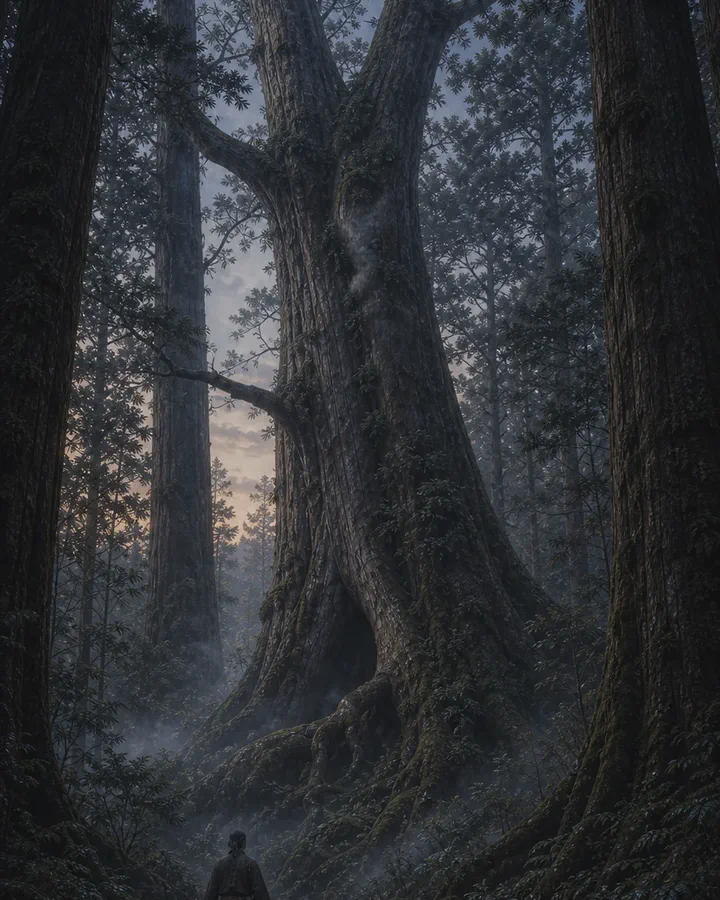
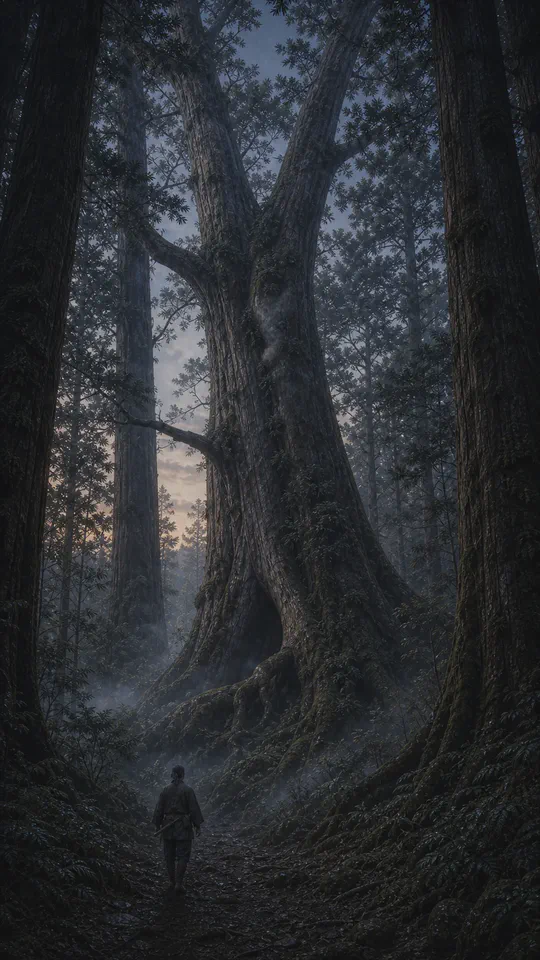
Our illustration therefore keeps the figure ambiguous. Moss, bark, shadow, and mist almost align into a human profile, but the tree has no literal eyes, mouth, or limbs.
Behavior and abilities
Kodama traditions are quieter than many modern tree-spirit stories suggest:
- Dwelling in old trees. A remarkable tree may be treated as the home or body of a presence that should not be disturbed casually.
- Returning sound. The word kodama also names an echo, preserving the idea that the mountain or forest answers a human voice.
- Requiring respectful preparation. The recorded kodama-nuki practice gives a concrete action to perform before cutting a tree more than a century old.
The adopted account does not say that a kodama calls a person’s name, chases travelers, or attacks woodcutters. Those ideas make effective fiction, and every one of them was added later.
Folklore accounts and regional variations
The database entry for kodama-nuki comes with a small puzzle of its own. Its location field identifies Ikeda in Miyoshi District, Tokushima, while the publication it cites is a 1956 volume titled Miyagi Prefectural History: Folklore 3 — two prefectures at opposite ends of the country. The rite is documented; which hillside it belongs to is not.
The larger idea is widespread: exceptional trees can be inhabited, protected, or dangerous to cut without acknowledgment. But the name of the presence, the rite used, and the consequences of ignoring it vary by place. Kodama is one word among several. Yamabiko, another term for a mountain echo, occupies neighboring ground without being the same thing.
Weaknesses and countermeasures
The source does not describe a weakness or a method for defeating kodama. Kodama-nuki is better understood as a rite of respect and transfer before felling an old tree, not as an exorcism performed after an attack.
That distinction matters. The human response in the record is not to fight the forest, but to acknowledge age, presence, and responsibility before changing it.
Traditional folklore and later imagery
Documented tradition. Kodama may refer to a presence within a tree and to the echo returned by a mountain or valley. A collected account records kodama-nuki before cutting a tree more than a hundred years old. Historical art includes humanlike imagery, but no universal body is documented.
Later imagery. Contemporary animation, games, and illustration often turn kodama into small, pale humanoids that gather in groups, glow, speak, or guide visitors through a magical forest. Those designs have become globally recognizable, but they belong to specific modern works and should not be projected backward as the standard figure of older folklore. The older idea can be more elusive: the ancient tree itself may be all that ever appears.
Sources and further reading
- Fieldwork collection Kodama-nuki account, record C0411007-000 (external link) International Research Center for Japanese Studies Records a rite before cutting a tree more than a hundred years old. The catalogue location and cited publication title do not align neatly, so do not assign the practice to one prefecture without qualification.
- Reliable secondary Kodama / Kodama (木霊・木魂) (external link) The Japan Kanji Aptitude Testing Foundation Defines the tree-spirit and echo senses and explains their traditional connection.
- Reliable secondary Kodama (木霊) (external link) Kotobank Dictionary aggregation for the word's tree-spirit and echo meanings.
- Museum Kodama by Toriyama Sekien (external link) Wikimedia Commons Historical image from Gazu Hyakki Yagyō; do not treat it as a universal documented body.
- Library Gazu Hyakki Yagyō (画図百鬼夜行) (external link) National Diet Library Search Bibliographic record for the historical picture book associated with Sekien's kodama image.