Kitsune: The Foxfire That Never Stayed Still
狐(きつね) Kitsune ASCII: Kitsune
Also known as: 狐火, 狐の火
Pronunciation: kit-soo-neh
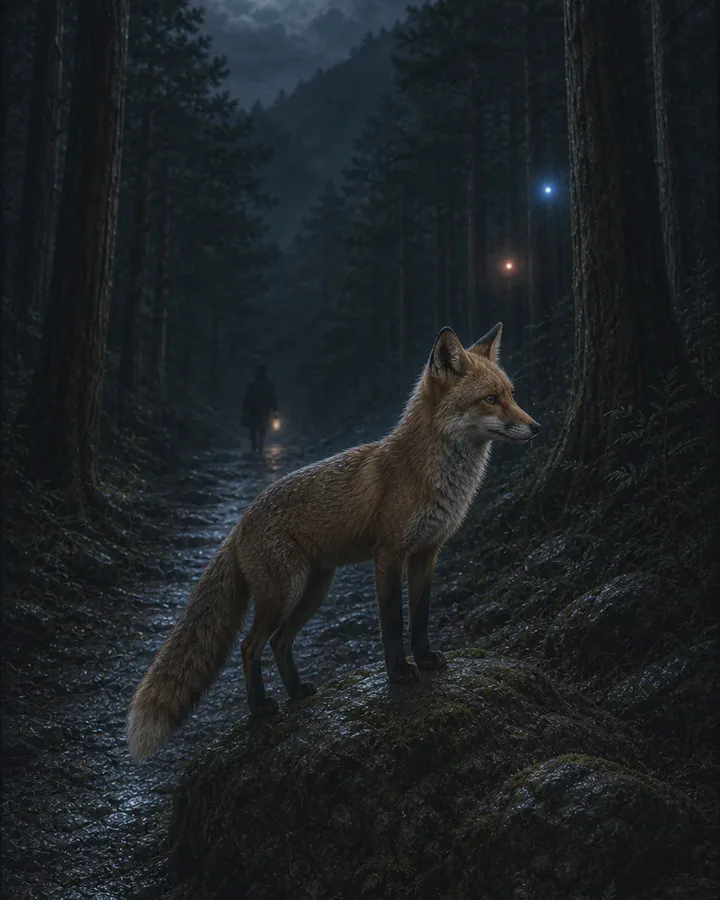
A 1930 account from Toyooka describes blurred blue or red foxfire moving restlessly from beyond the mountain to somewhere close by.
Quick Facts
- Habitat
- Mountain, Forest, Road
- Region
- Toyooka (Hyōgo), Ōji (Edo)
- Recorded period
- 1930 folklore record, Edo-period art
- Nature
- Unknown
- Danger rating
The danger rating is an editorial summary made for readability. It is not an objective measure found in folklore sources.
Watch the Short
What is Kitsune?
Kitsune is the Japanese word for fox, but in folklore it can also refer to a wide family of strange foxes, transformations, possessions, voices, lights, and encounters. Those traditions differ by region and source. They do not form one universal biography with a fixed number of tails or a single relationship to the gods.
This page focuses on one small part of that larger field: kitsune no hi, or “fox fire.” The account featured in our short video was published in 1930 from material collected in Toyooka, Hyōgo Prefecture. It describes lights that were blue or red, indistinct around the edges, and always moving. They might flicker beyond a mountain and then appear closer to the observer.
The record does not tell a complete adventure. It names no traveler, victim, shrine, spell, or speaking fox. Its strength lies in a simple visual mystery: a light seen where no ordinary lamp should be, shifting position before its watcher can decide how far away it is.
Appearance
The 1930 Toyooka account gives the foxfire three clear visual qualities:
- It may be blue or red. The record allows both colors rather than one mandatory supernatural hue.
- Its outline is blurred. This is not a sharply defined torch, lantern, or ball with a solid surface.
- Its position changes continually. Distance is unstable: the light seen beyond the mountain can soon seem to be on this side.
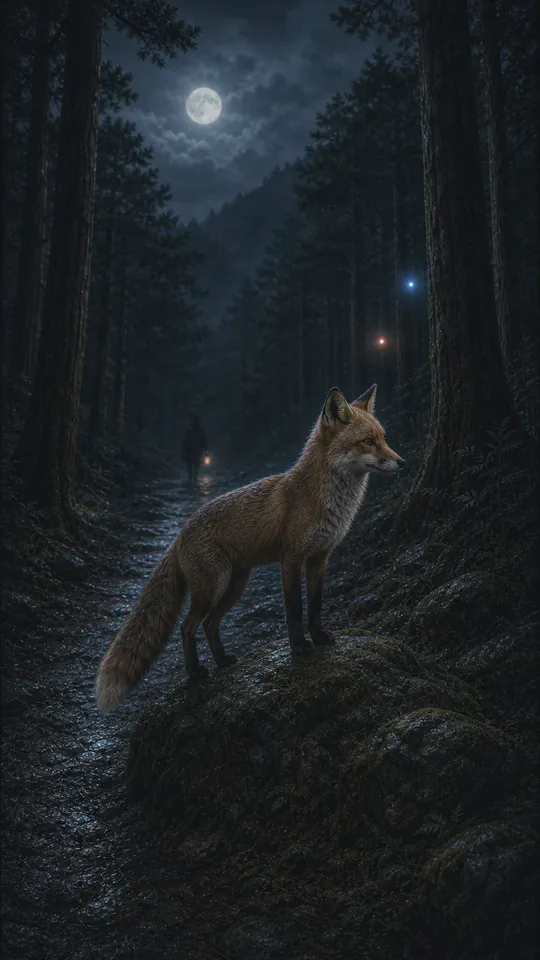
The account’s summary does not describe the body of a fox beside the light. Our illustration therefore separates evidence from adaptation. The lights follow the recorded colors and indistinct edges; the single Japanese red fox is a cinematic visual association, shown as an ordinary four-legged animal rather than a white shrine fox, a human shapeshifter, or a many-tailed monster.
Historical artists also placed foxes and fire together. Toriyama Sekien included Kitsunebi in his illustrated yokai books, while Utagawa Hiroshige’s approximately 1857 print of Ōji shows foxes gathering with fires on New Year’s Eve. Those works demonstrate important foxfire imagery, but neither is an illustration of the 1930 Toyooka field record.
Behavior and abilities
The adopted Toyooka account supports only a limited set of claims:
- The lights remain in motion. They do not stay at one point like a fixed beacon.
- They confuse near and far. A flicker beyond the ridge may soon appear on the observer’s side of the mountain.
- Their source is not explained. The record calls them fox fire but does not describe a fox producing flame with its mouth, tail, or paws.
- No attack is recorded. The summary does not say that the lights burn, chase, possess, injure, or kill anyone.
Our short turns this description into a journey along a wet mountain road. A traveler sees the lights change position while a fox emerges from mist. That sequence gives motion to the account, but the traveler, road, and visible fox are editorial reconstruction rather than missing details recovered from the 1930 text.
Foxfire, Inari, and regional traditions
Foxes can serve as messengers of Inari in shrine traditions, but that does not make every supernatural fox identical with Inari. The distinction is visible in the sources used here.
Hiroshige’s Ōji print belongs to a specific New Year’s Eve tradition. The Metropolitan Museum of Art describes foxes gathering near an old tree before paying homage at Ōji Inari, with farmers counting the fires to predict the rice harvest. That setting joins foxfire, agricultural divination, and Inari in one particular place.
The Toyooka account does not mention Ōji, New Year’s Eve, crop prediction, a shrine, or divine messengers. It records moving blue or red lights. Combining the two sources into a single nationwide rule would erase the local context of both.
Nine-tailed foxes, fox possession, fox weddings, human transformation, and white shrine foxes also have their own textual and regional histories. They may be related through a wider field of fox traditions, but none is required to explain the short Toyooka description.
Weaknesses and countermeasures
The 1930 account gives no weakness, protective rite, or method for extinguishing the lights.
It does not recommend prayer, iron, dogs, fire, salt, a particular route, or a spoken formula. Because no attack is described, the source also does not set up a combat problem that needs to be solved. The uncertainty comes from watching distance and direction stop behaving as expected.
Turning away, continuing home, refusing to follow the lights — all sensible enough in a modern retelling, and none of them in the Toyooka record. The observer simply watches, and the lights carry on moving.
Documented account and later imagery
Documented account. A 1930 fieldwork record from Toyooka describes foxfire as blue or red, blurred, and continually shifting between the far side of the mountain and somewhere closer. It does not describe a fox’s body, an attack, or a connection to a shrine.
Historical and later imagery. Sekien pictured Kitsunebi in an Edo-period yokai book. Hiroshige depicted the separate Ōji New Year’s Eve tradition, in which foxes gather with fires before visiting an Inari shrine. Modern stories often add human transformation, multiple tails, speech, pursuit, or magical combat.
Our video keeps the adopted record at its center: two uncertain colors, a wet mountain road, and a light that never remains where the watcher first saw it.
Sources and further reading
- Fieldwork collection Kitsune no hi from Toyooka, Hyōgo, record 2260088 (external link) International Research Center for Japanese Studies The adopted 1930 account describes foxfire as blue or red, blurred, and continually moving between the far side of a mountain and somewhere closer.
- Library Kitsunebi in the National Diet Library's Toriyama Sekien image collection (external link) National Diet Library Image Bank Library exhibition index identifying Kitsunebi among the yokai illustrated by Toriyama Sekien.
- Museum New Year's Eve Foxfires at the Changing Tree, Ōji (external link) The Metropolitan Museum of Art Museum record for Hiroshige's circa-1857 print and its distinct Ōji tradition of foxes, foxfire, Inari worship and harvest prediction.
Related yokai
Bakeneko
化け猫(ばけねこ)
Stories of old cats that speak, perform, dress like people or take human form—and the separate cat yokai they keep getting confused with.
Nekomata
猫又(ねこまた)
A 1931 Kagawa record describes an aging cat whose tail divides in two and that rises to dance on its hind legs.
Tengu
天狗(てんぐ)
A mountain being associated with flight, impossible voices, disappearances, and more than one familiar face.