Kirin (麒麟, Qilin): The Gentle Beast That Appears Under Good Rule
East Asia's one-horned auspicious animal — and why the giraffe borrowed its name
麒麟(きりん) Kirin ASCII: Kirin
Also known as: Qilin, Kirin beast
Pronunciation: KEE-reen
Kirin (麒麟; Chinese qilin) is the auspicious beast of East Asian tradition, ranked with the dragon and the phoenix: the body of a deer, the tail of an ox, the hooves of a horse, a single horn, and hair of five colours. It is said to appear only when the world is well governed, to live a thousand years, and to harm no living thing — walking without treading on an insect or bending a blade of grass. Depicted in China by the fifth century BCE and in Japan by the eighth century CE, it also lent its name to the giraffe.
Quick Facts
- Habitat
- Field, Forest
- Region
- China, Japan
- Recorded period
- Chinese antiquity, Japanese art from the 8th century
- Nature
- Helpful
- Danger rating
The danger rating is an editorial summary made for readability. It is not an objective measure found in folklore sources.
Watch the Short
What is a kirin?
It has the body of a deer and the tail of an ox, the hooves of a horse and a single horn, and its coat shows five colours. It lives a thousand years, or three. It walks so carefully that it treads on no insect and bends no blade of grass. And it cannot be seen whenever you like: it appears only when the world is well governed, and its appearance is the sign that it is.
That is the kirin — qilin in Chinese — one of the auspicious beasts of East Asian tradition alongside the dragon, the phoenix and the tortoise. It is imaginary, and it is good news. It was depicted in China by the fifth century BCE and in Japan by the eighth century CE, among the treasures of the Shōsōin.
What does kirin mean?
The name is written 麒麟, two characters built on the deer radical 鹿. In the old Chinese usage ki (麒) was the male and rin (麟) the female; the pair together named the species. The Japanese reading is KEE-reen.
In modern Japanese the same word means the giraffe. When a giraffe was brought from Africa to the Chinese court in 1419, it was presented as the legendary beast — a one-horned, cloven-hoofed, gentle animal of many colours that had appeared under a virtuous emperor — and when a stuffed giraffe was shown in Japan in 1877 the name came with it. The African animal borrowed the name of the imaginary one, not the other way round.
Appearance
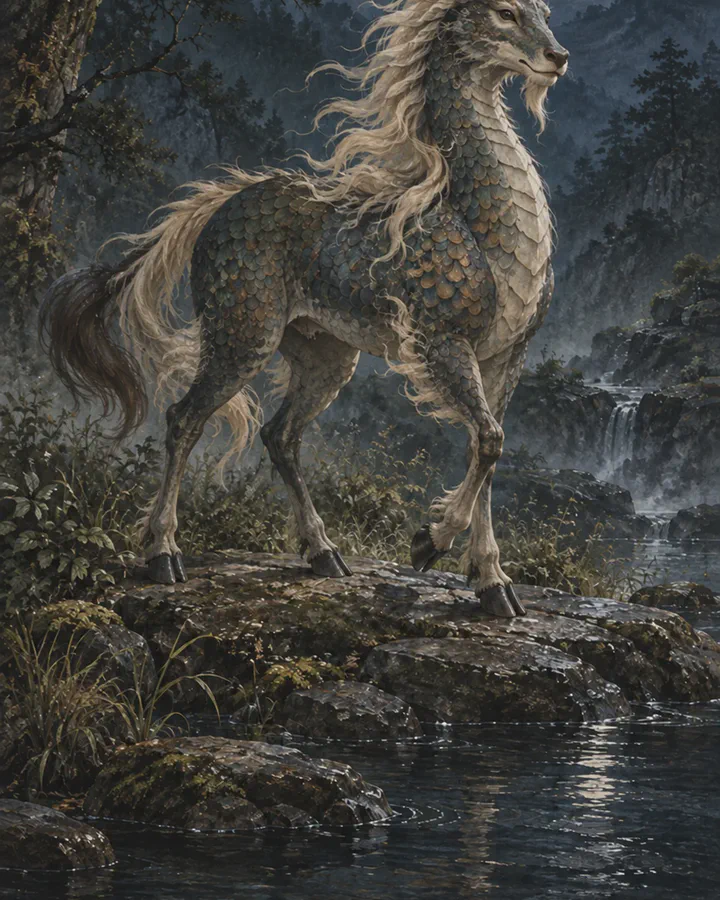
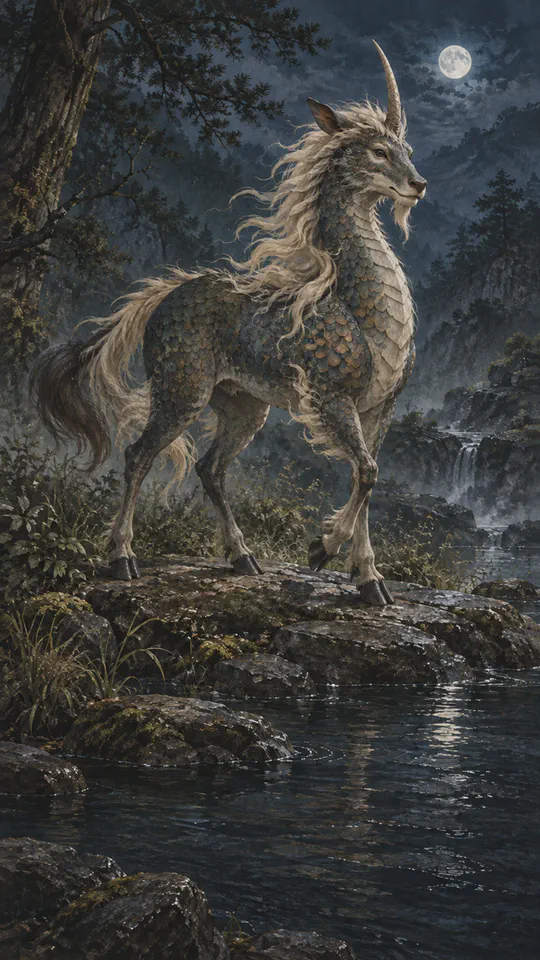
Deer body, ox tail, horse hooves, one horn, five-coloured hair. The form varies by period and place: some images give it scales like a dragon’s, some a flaming mane, and modern designs sometimes add wings. There is no single correct kirin. Our illustration keeps the deer-like body, the hooves, the single horn and a long pale mane, and sets it beside a still stream at night.
Behavior and abilities
- It appears under good rule. Its presence is the omen.
- It harms nothing. Not insects, not grass. It is a benevolent beast that injures no living creature and no plant.
- It lives very long. A thousand years or more.
Its defining quality is restraint. It is strong — it carries a horn — and it uses none of that strength against anything alive.
Weaknesses and countermeasures
None are needed. A kirin is not a threat; its whole meaning is that it is not one. It belongs with the hakutaku and the kudan among the beasts whose appearance is a message rather than a danger.
Documented tradition and later imagery
Documented tradition. An auspicious imaginary beast of Chinese origin, depicted in Japan from the eighth century: deer body, ox tail, horse hooves, one horn, hair of five colours; it appears only when the world is well governed, lives a thousand years, and harms no living thing. The giraffe took its name in 1419 in China and 1877 in Japan.
Later imagery. Games and anime make the kirin a fierce, lightning- wielding beast, often winged and dragon-headed, and the name is now better known in the West from a beer label. The older kirin is more interesting for what it refuses to do. Its strength is real; its gentleness is a choice.
Sources and further reading
- Museum "The phantom animal kirin" (2012) (external link) Tokyo National Museum Deer body, ox tail, horse hooves, one horn; appears only under good government; in Japanese art from the eighth century; distinct from the giraffe.
- Museum Qilin, collection no. 34499 (external link) National Museum of History, Taiwan The benevolent beast that harms no living creature or plant; scaled depiction.
- Museum Kirin ornament (external link) The Museum of the Imperial Collections, Sannomaru Shozokan A modern winged example, for comparison only.
On the timeline
In the glossary
In manga
- Hozuki's Coolheadedness 鬼灯の冷徹 Uses the names, reinvents the rest
Related yokai
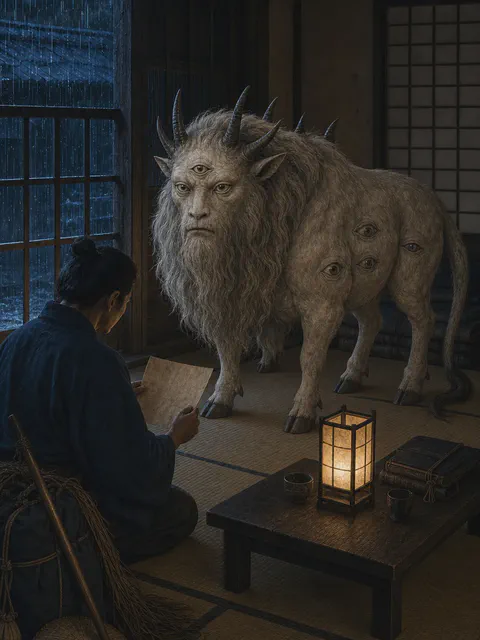
Hakutaku
白澤(はくたく)
A beast from Chinese legend that named every harmful thing in the world for the Yellow Emperor, and whose image — nine eyes, six horns, a human face — was carried by Edo travelers and set beside pillows during the cholera epidemic of 1858.
Kudan
件(くだん)
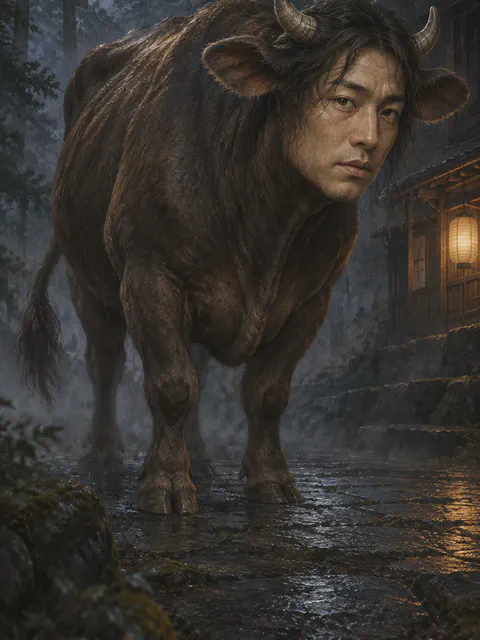
An 1836 broadsheet from Tango described a kudan — a cow's body with a human face — and promised that any house that put up its picture would prosper. Other kudan of the same century foretold disaster instead.

Shin
蜃(しん)
Old records describe a creature at the coast whose breath rises over the water and takes the shape of towers. The sources never agreed on what it was — and the Japanese word for a mirage is still its name.