
Kawauso: The Otter That Walks Ahead of You
川獺(かわうそ) Kawauso ASCII: Kawauso
Pronunciation: kah-wah-oo-soh
A 1956 Gunma record describes a figure on a riverside road at dusk who glances back and beckons — and is not a traveler, but an otter in human form.
Quick Facts
- Habitat
- River, Pond
- Region
- Shōwa Village (Gunma), Ōnan (Shimane)
- Recorded period
- 1956 folklore record, 1959 folklore record
- Nature
- Harmful
- Danger rating
The danger rating is an editorial summary made for readability. It is not an objective measure found in folklore sources.
Watch the Short
What is Kawauso?
Kawauso is simply the Japanese word for a river otter — and in folklore, for an otter credited with taking human form. Japan’s native otter was once common in rivers across the country and is now extinct, which gives these records a melancholy they did not originally carry.
The account featured here was collected in Shōwa Village, Tone District, Gunma Prefecture, and published in the local folklore journal Jōmō Minzoku in 1956. At dusk on an overcast evening, someone walking a riverside road notices a figure a little way ahead — described as a beautiful woman. She glances back. Then she beckons. Follow her, the account says, and you are drawn into the water.
Appearance
The horror of this tradition is not a body but a disguise. The record is about something almost human: a figure on a path at the hour when detail fails.
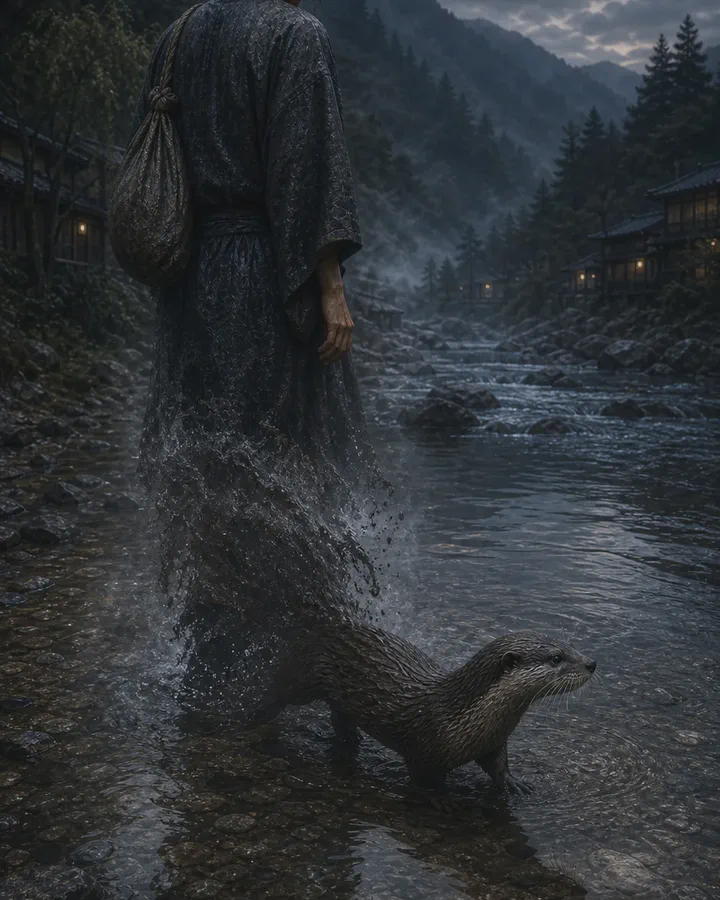
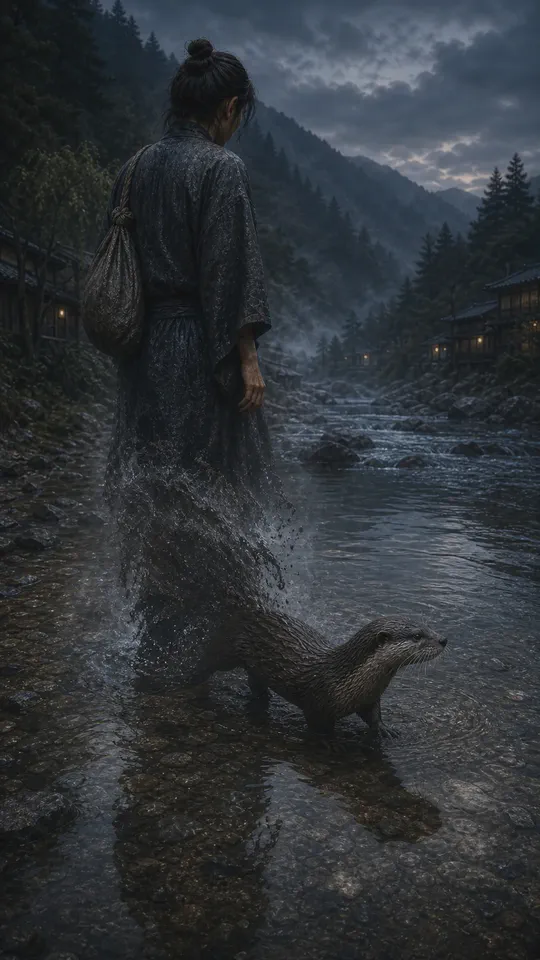
Our illustration therefore never resolves the face. It begins with a real otter, wet-furred and low to the ground, and lets it become a grey-clad figure through reflection and mist — with the truth showing only at the edges: a cuff, wet footprints, a low glint at ground level. At the end the figure slips under, and only an otter’s head remains among the ripples. The account calls her beautiful, but nothing in it turns on seduction. What it turns on is politeness: someone ahead of you on the road wants your attention, and the ordinary thing to do is go and see.
Behavior and abilities
- It takes human form. The central ability in both records we cite.
- It walks ahead of you. The figure appears on the path in front, not beside or behind.
- It looks back and beckons. The invitation is the trap.
- It leads to the water. The path ends at the river.
The account never shows what happens in the water. It stops at the moment of choice, which is the only moment that was ever any use to a listener.
Folklore accounts and regional variations
A 1959 record from Ōnan in Shimane Prefecture describes kawauso taking the form of a young woman to deceive people — the same transformation motif in a distant region, told with its own details. That is variation, not confirmation of a single national legend, and this article presents the Gunma record as one local account.
Otter names and kappa names also overlap in places. A 1982 record from Ishikawa lists them together, which is a fair reflection of how river communities sorted the things in their water — by where you met them rather than by what they were.
How this differs from the kappa
It is worth being explicit, since the two are often confused. This tradition gives the creature no shell, no beak, no water-filled dish on the head, no sumo challenges, and no cucumbers. Nothing about it is designed to be recognized.
Its power is the opposite of the kappa’s. The kappa is unmistakable; the kawauso is a river animal that has become nearly human, standing on a road at the exact hour when you cannot be sure.
Weaknesses and countermeasures
The Gunma account records no charm, no gesture, and no protective ritual — only an implicit instruction contained in the story itself: do not follow the figure that beckons you toward the water. The warning is the countermeasure.
Traditional folklore and later imagery
Documented tradition. Otters credited with taking human form to mislead people, recorded in Gunma in 1956 and in Shimane in 1959, with the Gunma account centering on a beckoning figure on a riverside road at dusk.
Later imagery. Modern collections often flatten the kawauso into a comic trickster — a cheerful otter in a straw hat, a minor prankster in a lineup of yokai, or a variant kappa. The 1956 record has none of that lightness. Its subject is an animal that had learned the shape of a person well enough to be followed, and a stretch of road where being polite to a stranger was the wrong instinct.
Sources and further reading
- Fieldwork collection Kawauso account from Gunma (1956), record 1090009 (external link) International Research Center for Japanese Studies The adopted account from Shōwa Village, Tone District, published in Jōmō Minzoku: a figure ahead on a riverside road beckons, and following it leads into the water.
- Fieldwork collection Kawauso account from Shimane (1959), record 0700093 (external link) International Research Center for Japanese Studies A separate regional record of an otter deceiving people in human form.
- Museum Kawauso image record (external link) International Research Center for Japanese Studies Catalogue record for a historical depiction of the otter yokai.
- Fieldwork collection Kappa and kawabiso account from Ishikawa (1982), record 0540002 (external link) International Research Center for Japanese Studies Shows that otter names and kappa names overlap in some regions.
Related yokai
Kappa
河童(かっぱ)
A child-sized water yokai whose strength lives in the water held by the dish on its head.
Bake-danuki
化け狸(ばけだぬき)
Morinji tradition tells of the monk Shukaku, an inexhaustible iron kettle, and the mujina or tanuki form revealed while he slept.