Kawa-akago: The One Even the Cataloguer Could Not Place
川赤子(かわあかご) Kawa-akago ASCII: Kawa-akago
Pronunciation: kah-wah-ah-KAH-go
Toriyama Sekien drew an infant-shaped creature rising from the water plants of a mountain river in 1779, watching a man on a raft — and admitted in the caption that he was guessing about what it was.
Quick Facts
- Habitat
- River
- Region
- unspecified in Sekien's plate, a mountain river
- Recorded period
- Toriyama Sekien's Konjaku Gazu Zoku Hyakki (1779)
- Nature
- Unknown
- Danger rating
The danger rating is an editorial summary made for readability. It is not an objective measure found in folklore sources.
Watch the Short
What is Kawa-akago?
Kawa-akago means “river infant,” and the entire creature is one picture in one book.
In 1779 Toriyama Sekien published Konjaku Gazu Zoku Hyakki, the sequel to his illustrated catalogue of demons. On one plate, something small rises out of the water plants of a mountain river. It has the shape of an infant. Further upstream a man stands on a raft with a fishing line, and the thing in the weeds is looking at him.
That is the whole scene. Nothing is happening.
Appearance
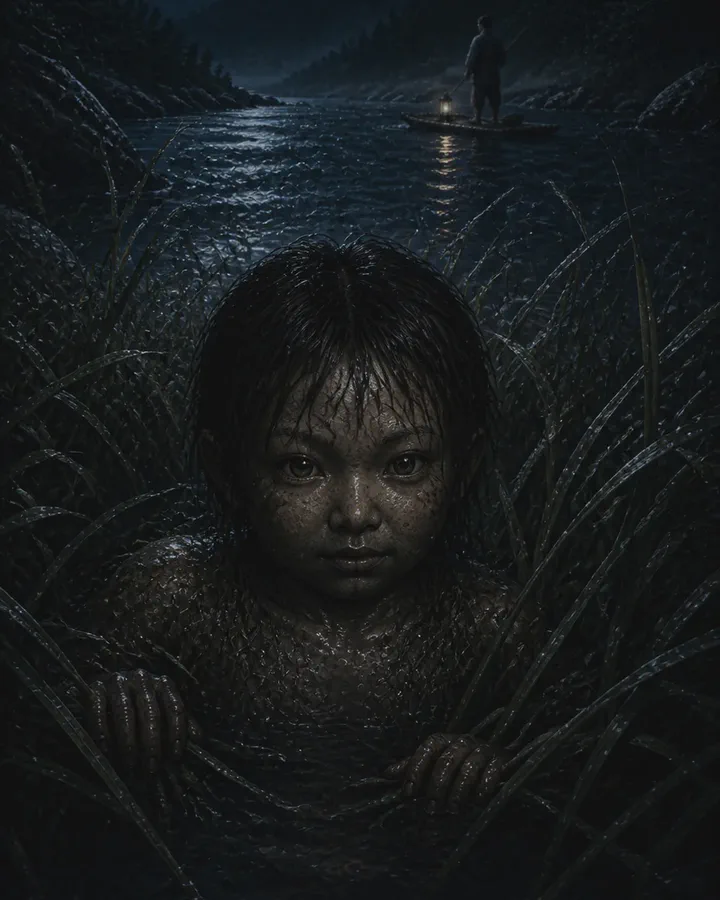
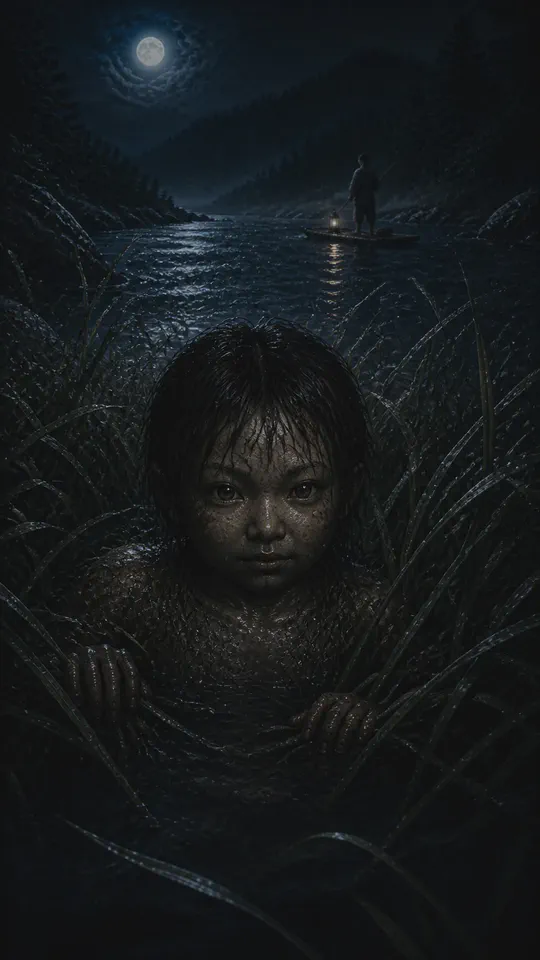
Sekien’s plate gives an infant-shaped figure emerging from the reeds to about chest height. Our illustration follows it: small, wet, low in the water among the grasses, with the raft and the angler kept at a distance up the river.
We have deliberately kept it from reading as a real baby. The skin is river-stone brown, the eyes reflect like an animal’s, the fingers are too long. Sekien’s line drawing could leave the resemblance ambiguous. A photographic image cannot, and the resemblance is not the point of the picture.
The point of the picture is that it is watching someone.
What the caption actually says
Here is the part that matters, and it is short. Sekien writes that there is a creature among the water plants of mountain rivers with the shape of an infant, and that it is probably of the same kind as the kawatarō and the kawawarawa — the river-boy creatures we would now file under kappa.
Probably. The man compiling the catalogue of Japan’s monsters got to this one and hedged.
There is no attack in the caption. No crying, no calling out, no luring anyone into the water, no laughing afterwards. Sekien describes a shape, a habitat, and a guess about which family it belongs to.
Behavior and abilities
- It is in the water plants. That is where the caption puts it and where the plate shows it.
- It looks like an infant. Stated as appearance, not as disguise.
- It watches. The angler is in the frame, and the creature’s attention is on him.
- It might be a kind of kappa. Sekien’s own suggestion, offered as one.
The crying river at Arida
A separate record exists, and it is worth keeping separate.
Fieldwork collected in 1960 in the Arida district of Wakayama, published the following year, describes crying heard from a river called the Naki-kawa — the weeping river. A priest of the Shin sect recited sutra, and it stopped.
That is a sound in a specific place with a specific outcome. It is not Sekien’s plate under a different name, and nothing connects them except that both involve a river and something infant-like. Put them together and you get the modern version of Kawa-akago: a creature that cries like a baby to draw people to the bank and drowns them.
Sekien wrote none of that.
Weaknesses and countermeasures
None, and for once the reason is unusually clean. A weakness implies a threat, and the source records no threat. There is nothing to defend against because nothing in the 1779 caption is described as happening to anybody.
What the plate leaves behind is smaller and harder to shake: a thing the size of a baby, in the weeds, at night, watching a man who has not noticed it.
Documented plate and later imagery
Documented plate. Sekien, 1779: an infant-shaped creature among the water plants of a mountain river, watching an angler on a raft, tentatively assigned by the artist to the kawatarō and kawawarawa. Separately, a 1960 record from Arida in Wakayama of crying heard from the Naki-kawa that ceased after a priest recited sutra.
Later imagery. Modern collections have supplied the missing behaviour. The Kawa-akago now cries deliberately, imitates a lost baby, waits for someone kind enough to come down the bank, and pulls them under. It is a complete monster with a method, and it is an invention built to fill the space Sekien left.
The plate is better without it. An artist cataloguing every strange thing in the country reached this one, drew what he had, and wrote down that he was not sure — which is the most honest entry in the book.
Sources and further reading
- Museum Toriyama Sekien, Konjaku Gazu Zoku Hyakki (今昔画図続百鬼), 1779 (external link) Tokyo Museum Collection The 1779 sequel to Sekien's illustrated demon catalogue, containing both Kawa-akago and Suiko.
- Museum Kawa-akago, from Konjaku Gazu Zoku Hyakki (external link) Wikimedia Commons The plate itself: a small infant-shaped creature rising from the water plants of a mountain river, watching an angler on a raft. Sekien's caption guesses it belongs with the kawatarō and kawawarawa.
- Fieldwork collection Akago no nakigoe (赤子の泣声), Arida, Wakayama (external link) International Research Center for Japanese Studies Collected 1960, published 1961. Crying is heard from the Naki-kawa and stops after a Shin sect priest recites sutra. A separate record from Sekien's plate, not the same creature under another name.
Related yokai
Kappa
河童(かっぱ)
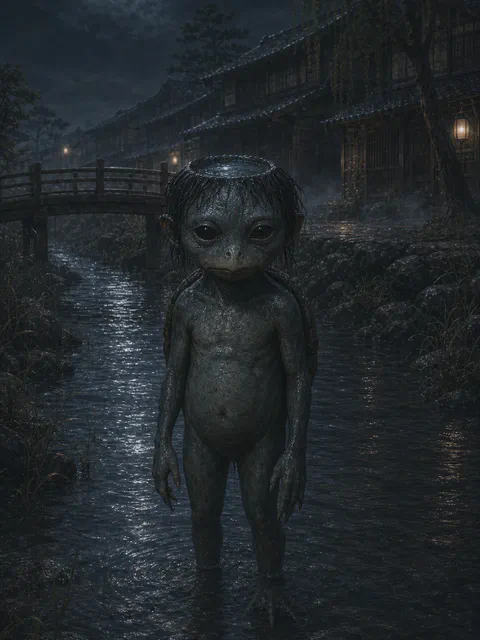
A child-sized water yokai whose strength lives in the water held by the dish on its head.
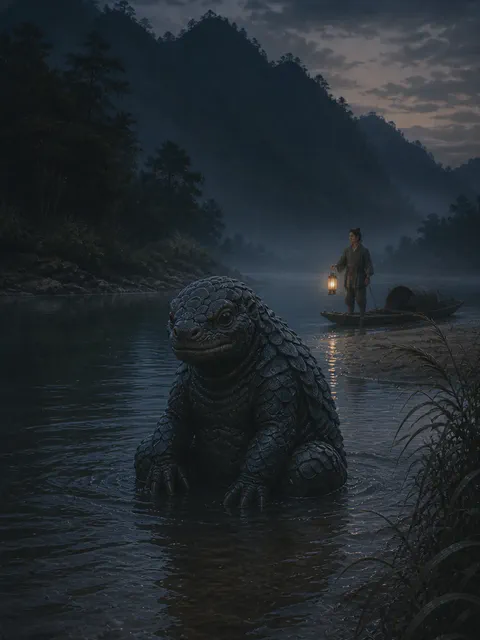

Suiko
水虎(すいこ)
A Chinese pharmacological encyclopedia describes a river creature the size of a small child, armoured in scales that arrows cannot pierce, which keeps its body underwater and lets only its two tiger-pawed knees break the surface.