
Kasha: It Wasn't Always a Cat
火車(かしゃ) Kasha ASCII: Kasha
Also known as: Kuwasha
Pronunciation: KAH-shah
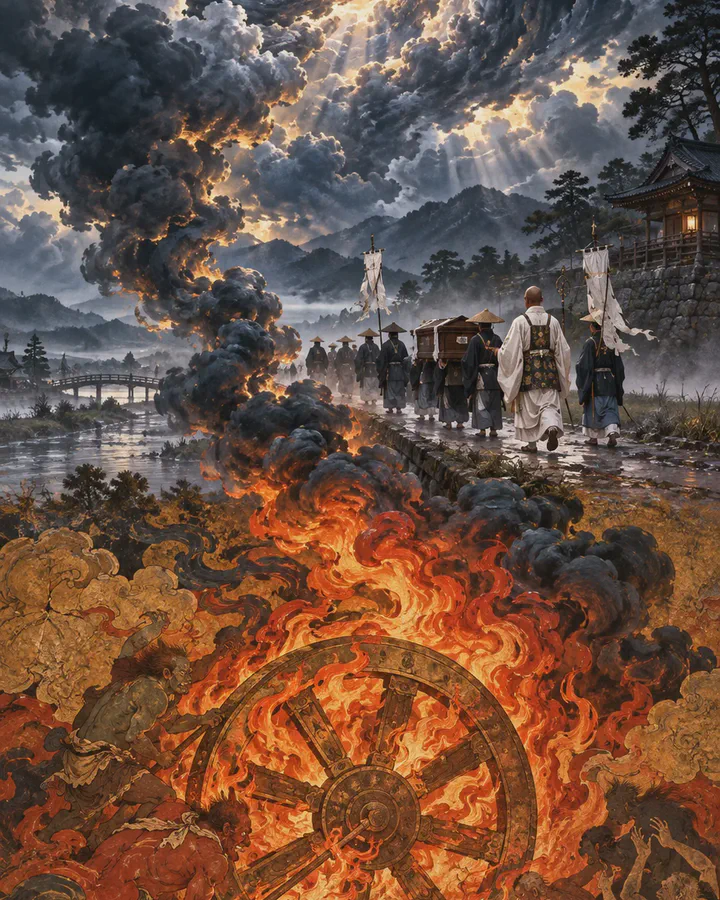
Kasha began as the Buddhist fire cart that came for sinners at the hour of death. By the late sixteenth century it was a thing in the thunderstorm that stole the dead from funerals, and only from about the late seventeenth century was it said to be a cat.
Quick Facts
- Habitat
- Sky, Temple shrine, Road
- Region
- unspecified, Miyazaki
- Recorded period
- Heian–Kamakura Buddhist tales, late 16th century, Edo period, modern folklore records
- Nature
- Harmful
- Danger rating
The danger rating is an editorial summary made for readability. It is not an objective measure found in folklore sources.
Watch the Short
What is Kasha?
Ka is fire. Sha is a cart, a vehicle. A kasha is a burning cart.
Modern yokai books usually describe kasha as a monstrous cat that appears at funerals and snatches the body from the coffin. That is one late stage of a long history. The historian Katsuda Itaru traces how the burning cart became a corpse-stealer, and how the corpse-stealer became, among other things, a cat.
The cart of the dying
In Buddhist tales of the Heian and Kamakura periods, the fire cart belongs to the deathbed. As a sinner dies, a burning cart driven by the wardens of hell appears to carry them away. The tales use it as a sign of what a life has earned, and as a reason to die well, with the right prayers and practices.
In this form the kasha is not a creature at all. It is a vehicle, and what it carries is the soul of someone who deserved it.
Into the storm
In the Muromachi period, Katsuda argues, the fire cart moved outside the dying person’s room. A sudden storm at a funeral — black cloud, thunder, wind and rain — came to be read as the sign that the dead was going to hell.
By the late sixteenth century, stories appear in which the thunder itself carries off the body. Around the same time, tales spread of Zen monks driving the kasha away from a funeral.
Along the way the dead stop being necessarily wicked. The kasha becomes a danger to any funeral, a thing in the sky that might take the body from the procession.
Many faces
From about the late seventeenth century, the thing in the storm is often said to be a cat — an old cat, sometimes a temple cat. But the Edo period never settled on one answer. Kasha was also said to be a tanuki, a tengu, or a mōryō, a spirit that eats the dead.
Twentieth-century records keep both strands. The Miyazaki Prefectural History notes accounts from several places in Miyazaki of a body taken by kasha in the middle of a funeral. Elsewhere it is a cat, a dark cloud, a hundred-year-old creature, or simply a word for what happened.
Appearance
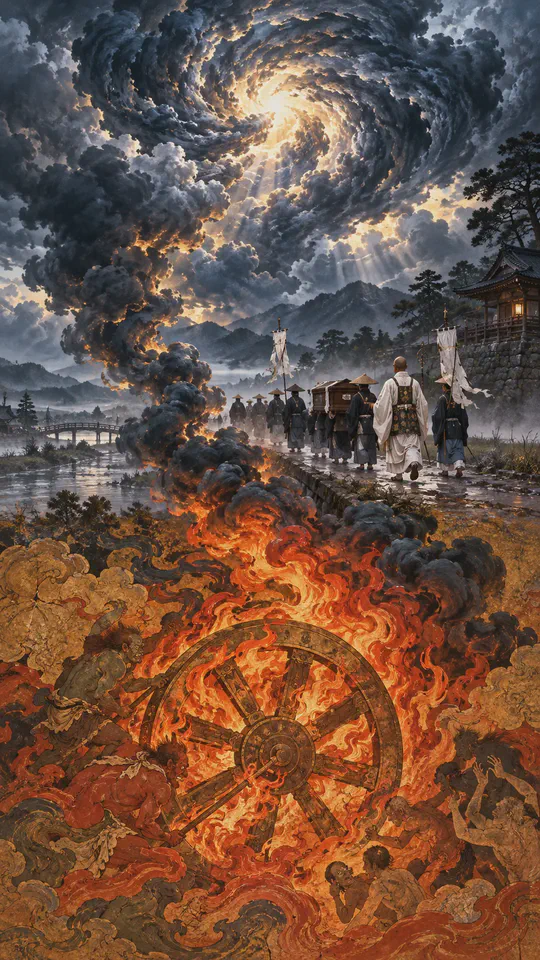
There is no single one. First a burning cart; then a storm; then a cat, a tanuki, or something unnamed in a cloud. Our illustration chooses the moment of change: a funeral on a wet road, the coffin closed, and a burning wheel in a sky that is just turning black.
Behavior and abilities
- It comes at death. In every form, its business is the dead.
- It takes the body. From the late sixteenth century on, the threat is to the corpse, not the soul.
- It brings weather. Black cloud, thunder, and sudden rain announce it.
Weaknesses and countermeasures
From the late sixteenth century, the answer is a monk: Zen priests in many tales drive the kasha off from the coffin. Folk practice added others, such as keeping cats away from a body before the funeral.
Fire cart and later imagery
Documented history. A Buddhist fire cart that fetches sinners at death (Heian–Kamakura); a storm read as the sign of damnation (Muromachi); thunder that steals bodies, and monks who drive it off (late sixteenth century); a creature identified as a cat from about the late seventeenth century, and also as a tanuki, tengu, or mōryō; twentieth-century records of bodies taken during funerals.
Later imagery. Today kasha is almost always a cat — huge, burning, and leaping on the coffin — and often merged with the two-tailed nekomata.
The longer history is stranger than the cat. What came for the dead kept changing shape, because the fear of what might happen to a body on its last journey stayed the same.
Sources and further reading
- Academic paper The Birth of the Kasha (external link) Katsuda Itaru; Bulletin of the National Museum of Japanese History 174 From the Buddhist fire cart of the dying to a creature that snatches corpses from funerals; thunderstorms as the sign of damnation in the Muromachi period; thunder stealing bodies by the late sixteenth century; Zen monks defeating it; the cat identification from about the late seventeenth century, alongside tanuki, tengu, and mōryō.
- Academic paper Those who saw the kasha (external link) CiNii Research The fire cart in Heian and Kamakura rebirth tales, tied to sin and deathbed practice.
- Fieldwork collection Kasha, record C4510097-000 (external link) International Research Center for Japanese Studies Miyazaki Kenshi (1992). In several places in Miyazaki, a corpse was said to have been taken by a kasha during a funeral.
Related yokai
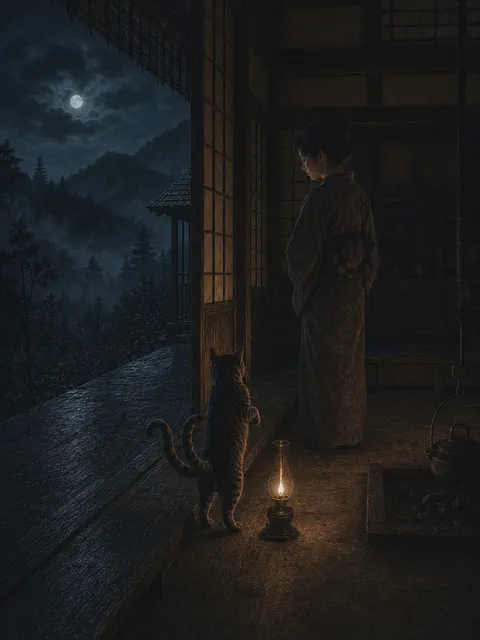
Nekomata
猫又(ねこまた)
A 1931 Kagawa record describes an aging cat whose tail divides in two and that rises to dance on its hind legs.
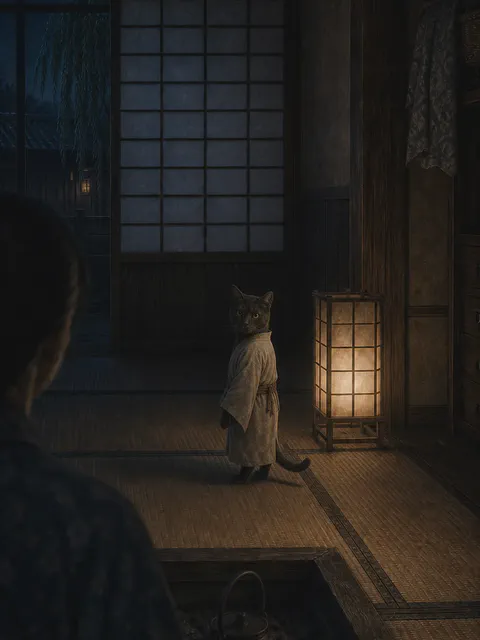
Bakeneko
化け猫(ばけねこ)
Stories of old cats that speak, perform, dress like people or take human form—and the separate cat yokai they keep getting confused with.
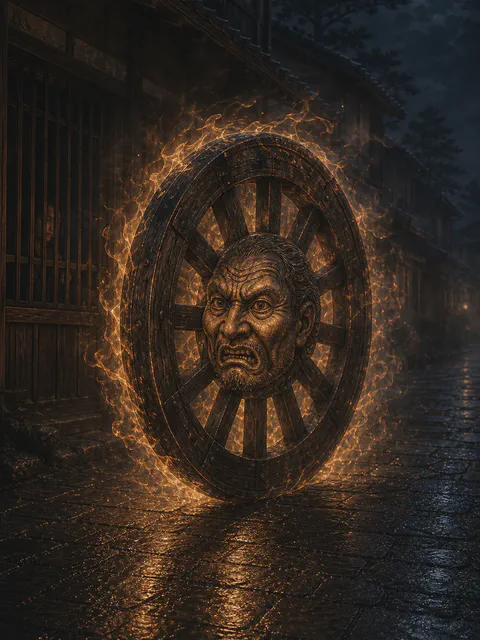
Wanyūdō
輪入道(わにゅうどう)
In Toriyama Sekien's 1779 picture book, a single ox-cart wheel rolls through the night by itself — and anyone who sees it is said to lose their soul.