
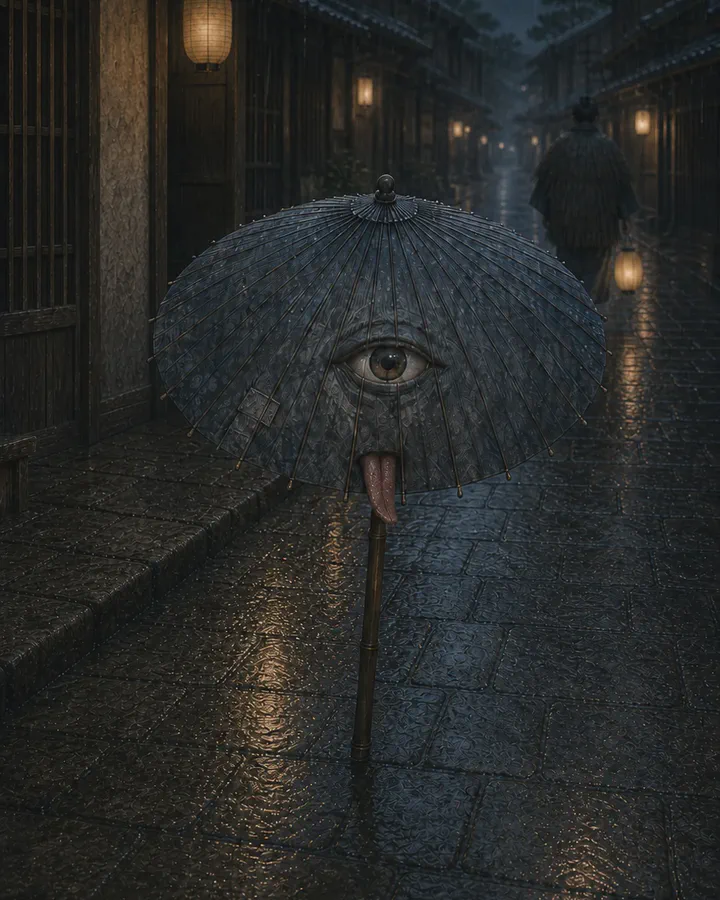
Karakasa-kozō: The Umbrella That Opens One Eye
唐傘小僧(からかさこぞう) Karakasa-kozō ASCII: Karakasa-kozo
Also known as: Kasa-obake, Kasa ippon ashi
Pronunciation: kah-rah-kah-sah koh-zoh
An 1857 Osaka print shows a kabuki actor playing a one-legged umbrella monster — the clearest history of a yokai known through pictures rather than encounters.
Quick Facts
- Habitat
- Street, Road, House
- Region
- Osaka
- Recorded period
- 1857 woodblock print, modern popular imagery
- Nature
- Mixed
- Danger rating
The danger rating is an editorial summary made for readability. It is not an objective measure found in folklore sources.
Watch the Short
What is Karakasa-kozō?
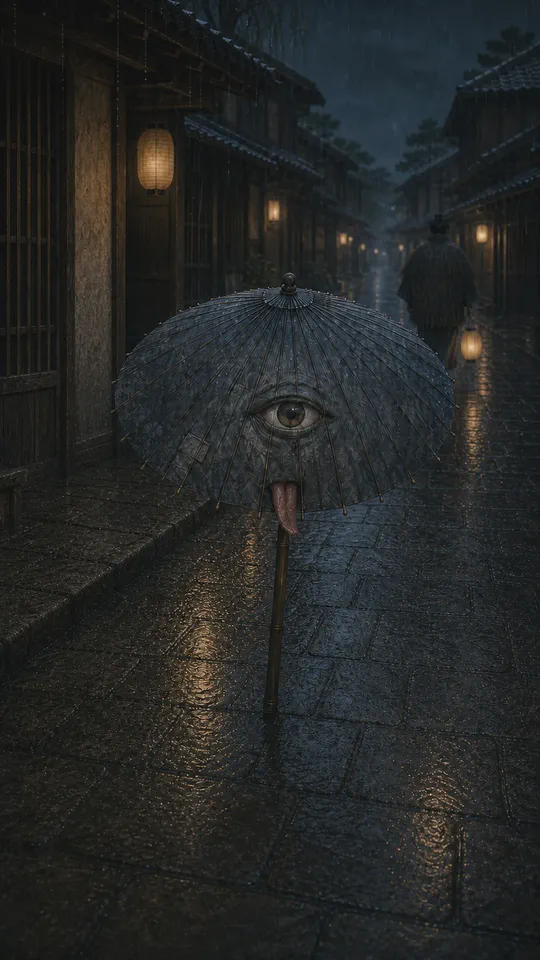
Karakasa-kozō — “the umbrella boy,” also called kasa-obake — is probably the most recognizable yokai in Japan and one of the hardest to document. Everyone can picture it: a battered paper umbrella standing on one leg, with a single eye and a lolling tongue.
What it does not have is the thing most yokai in this series have — a collected account tying it to a place, a date, and a witness. Its clearest history is visual. The record featured here is an 1857 Osaka woodblock print by Gosōtei Hirosada, held by the Metropolitan Museum of Art, titled Kasa ippon ashi (“One-Legged Umbrella Monster”): a kabuki actor performing the creature on stage, one leg bound up so he can hop on the other.
That is a crucial distinction. The source shows a role, not an encounter.
Appearance
Our illustration follows the familiar form while keeping it grounded in worn material reality: a faded blue-grey oiled-paper umbrella with torn panels, water stains, and hand-sewn repairs; thick bamboo ribs; a wooden ferrule; and a single leg continuous with the handle.
A single eye sits at the center of the canopy, and the tongue is thin, short, and dull greyish-pink rather than a lurid red banner. It has no arms, hands, torso, clothing, or wooden sandals. The unease should come from an ordinary discarded object moving on its own, not from cartoon features.
Behavior and abilities
The pictorial tradition gives it a small, comic-uncanny repertoire: it hops irregularly on one leg, closing distance on a rainy street; it opens and shuts to reveal the eye; and it puts out its tongue to startle whoever it has caught up with.
No source in our registry gives it killing, cursing, abduction, or devouring. Its character is closer to ambush and mischief than to menace — one of the few yokai in this series more likely to make you shout than run.
Folklore accounts and regional variations
The karakasa-kozō belongs to the world of tsukumogami, the idea that long-used household tools can acquire life and animation. It appears in picture scrolls, in games of the “hundred tales,” in printed collections, and on stage, spreading through images and performances rather than through village accounts.
This is worth stating plainly, because popular articles frequently supply the missing legend — a specific province, a specific haunted household, a specific vengeance. Our source set does not support any of that. Nor does it support the confident rule, often repeated, that any tool becomes a yokai on its hundredth birthday; that is a tidy generalization of a much looser idea.
Weaknesses and countermeasures
None are documented. There is no charm, no salt, no sutra, and no destruction ritual in the sources — which follows naturally from the fact that no recorded harm needs preventing.
Traditional folklore and later imagery
Documented tradition. A tool-spirit known primarily through pictures and performance, including an 1857 Osaka print of a kabuki actor playing a one-legged umbrella monster. Its history is one of images circulating and becoming standard.
Later imagery. The single eye, the long tongue, and the wooden sandal that later art often adds have become so fixed that the karakasa-kozō now functions as the mascot of Japanese yokai in general — cheerful, rounded, and printed on souvenirs. We keep the eye and the tongue because they are how the creature is known, without claiming the 1857 stage print as the origin of every feature. The older strangeness is still available if you want it: something you threw away, upright in the rain, watching.
Sources and further reading
- Museum “One-Legged Umbrella Monster” (Kasa ippon ashi), 1857 (external link) Gosōtei Hirosada; The Metropolitan Museum of Art An Osaka woodblock print of a kabuki actor performing a one-legged umbrella monster with one leg bound. A theatrical role, not an encounter record.
- Database Database of Yokai Images (怪異・妖怪画像データベース) (external link) International Research Center for Japanese Studies Image database used to compare how a motif was depicted across artists and periods.
- Library The World of Yokai through Toriyama Sekien's Yokai Encyclopedias (external link) National Diet Library Image Bank Surveys rokurokubi images by multiple artists, including female and male examples.
Related yokai
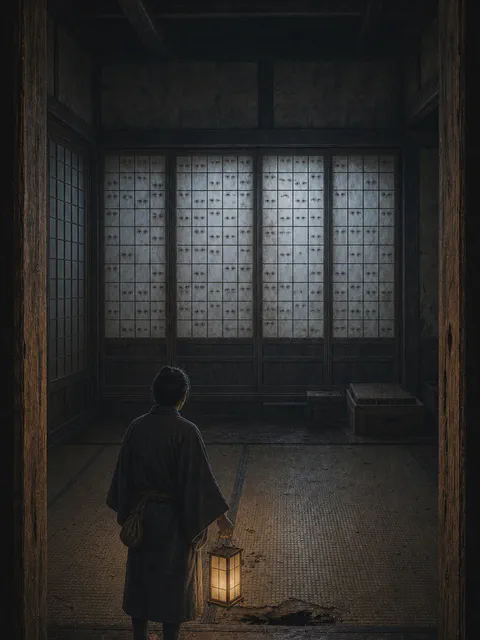
Mokumokuren
目目連(もくもくれん)
Rows of human eyes appear across old shoji in Toriyama Sekien's 1781 picture-book image.
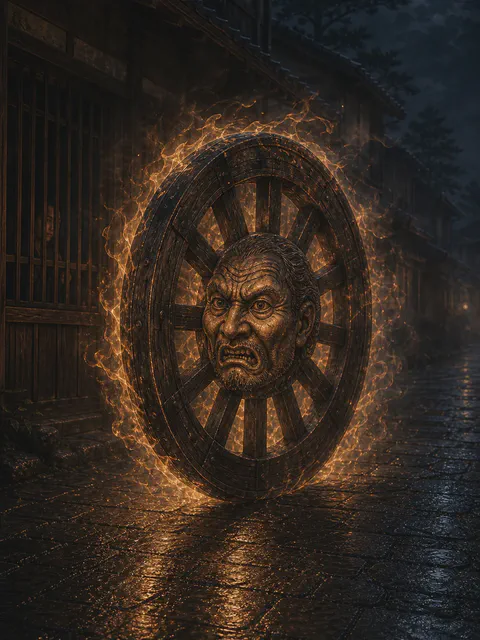
Wanyūdō
輪入道(わにゅうどう)
In Toriyama Sekien's 1779 picture book, a single ox-cart wheel rolls through the night by itself — and anyone who sees it is said to lose their soul.