
Kamaitachi: The Cut You Never See Coming
鎌鼬(かまいたち) Kamaitachi ASCII: Kamaitachi
Pronunciation: kah-mah-EE-tah-chee
A 1955 Nagano record describes a weasel-like being so fast no one has seen it — known only by the clean cut it leaves on a stumbling traveler's shin.
Quick Facts
- Habitat
- Mountain, Road
- Region
- Nagano, Chichibu (Saitama), Miyagi, Niigata
- Recorded period
- 1955 folklore record, 20th-century folklore collections
- Nature
- Harmful
- Danger rating
The danger rating is an editorial summary made for readability. It is not an objective measure found in folklore sources.
Watch the Short
What is Kamaitachi?
Kamaitachi combines kama, a sickle, with itachi, a weasel — a name for an encounter more than a creature. A person walking outdoors stumbles, or simply feels something pass, and then finds a clean cut on their shin that they never felt being made and never saw delivered.
The account featured here was recorded in Nagano Prefecture in 1955. It calls the kamaitachi a kind of weasel and explains that it moves so fast that no one has ever seen its true form. What people find is the result: a cut on the shin, often suffered at the moment they fall.
Appearance
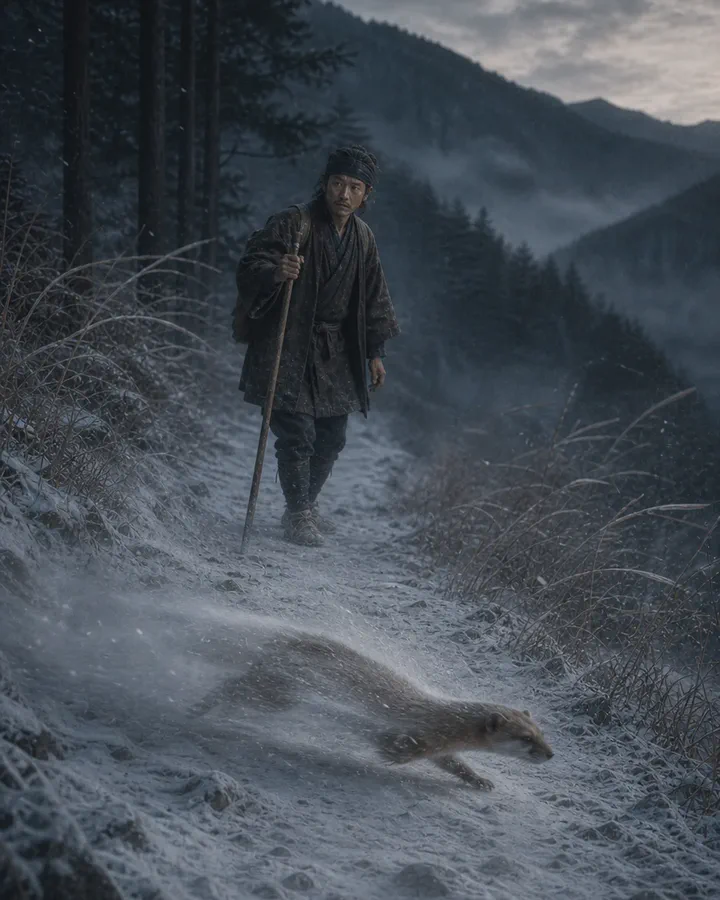
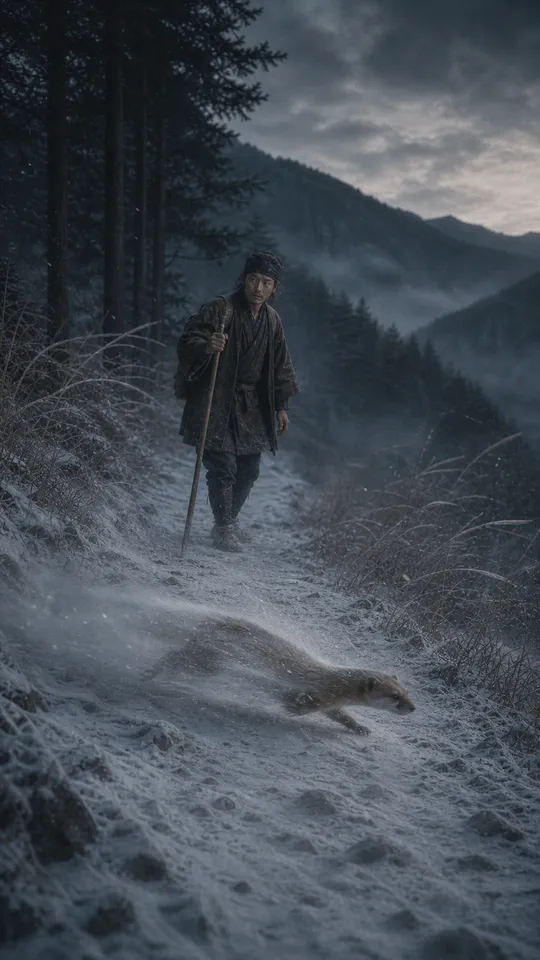
The Nagano record’s most striking feature is that it describes something defined by never being seen. The being is said to be a weasel — slender, low, and fast — but its speed is precisely why no witness account of its body exists.
Our illustration honors that logic: a single weasel-like shape blurring through a streak of wind-driven snow at shin height, more disturbance than animal. The snowy setting is our visual interpretation of a cold-season mountain road in Shinshū, not a condition stated in the record itself. We do not give the creature sickle blades, glowing eyes, or a monstrous body, because the sources do not.
Behavior and abilities
- Impossible speed. The defining trait in the Nagano record: it moves too fast to be seen at all.
- Cutting shins. It darts past travelers and cuts the lower leg, most often at the moment a person stumbles or falls.
- Strange wounds. Related records describe cuts shaped like a sickle’s edge, and wounds that were deep yet bled little and hurt less than they should have.
The kamaitachi does not speak, stalk, or haunt. The entire encounter is over before it is noticed — which is what separates it from almost every other roadside yokai.
Folklore accounts and regional variations
The same class of experience — an unexplained clean cut suffered outdoors — was explained differently from region to region. In records from Chichibu in Saitama, Miyagi, and Niigata, the cause is variously described as a passing wind, a whirlwind, a god, or an unseen beast, rather than a weasel. The name kamaitachi itself is applied unevenly across these records.
That spread is the real subject of this yokai: communities across central and northern Japan agreed on the wound but not on the cause. A cutting wind and an invisible weasel are different answers to the same alarming question, and the records preserve both without reconciling them.
Weaknesses and countermeasures
The 1955 Nagano record offers no defense at all — no charm, no gesture, no safe path. Other regions kept remedies of their own, but those answers grew out of their own explanations for the wound, and none of them was ever offered to a traveler on a Nagano mountain road.
Traditional folklore and later imagery
Documented tradition. A weasel-like being, or in other regions a wind, whirlwind, god, or unseen beast, blamed for clean cuts on the shins of people who stumble outdoors; too fast to be seen; wounds sometimes said to be sickle-shaped or strangely bloodless.
Later imagery. The famous image of three weasels working as a team — one who knocks the traveler down, one who cuts, and one who applies medicine — is a well-known later formulation, and it is not a rule shared by the regional records cited here. Modern fiction goes further still, arming the kamaitachi with visible sickle-blade limbs and wind magic. Those designs make a good character, but the older records are more unsettling: whatever it is, you will never see it.
Sources and further reading
- Fieldwork collection Kamaitachi account from Nagano (1955), record 0160017 (external link) International Research Center for Japanese Studies The 1955 Nagano record used as the main source; a weasel-like being too fast to be seen that cuts shins, often as a person falls.
- Fieldwork collection Kamaitachi account from Chichibu, Saitama, record 1240021 (external link) International Research Center for Japanese Studies A regional account with its own explanation of the cutting encounter.
- Fieldwork collection Kamaitachi account from Miyagi, record C0411095-000 (external link) International Research Center for Japanese Studies A regional account differing from the Nagano record.
- Fieldwork collection Kamaitachi account from Niigata, record C1510068-000 (external link) International Research Center for Japanese Studies A regional account differing from the Nagano record.
- Fieldwork collection Kamaitachi account, record 1490023 (external link) International Research Center for Japanese Studies Includes wound descriptions such as sickle-shaped cuts with little bleeding.