Jorōgumo: The Spider of Jōren Falls
絡新婦(じょろうぐも) Jorōgumo ASCII: Jorogumo
Also known as: 女郎蜘蛛
Pronunciation: joh-roh-GOO-moh
At a waterfall in Shizuoka, a spider winds one fine thread around a man's foot—and reveals enough strength to tear a mulberry stump from the earth.
Quick Facts
- Habitat
- River, Forest
- Region
- Shizuoka, Izu, Jōren Falls
- Recorded period
- 1934 folklore record, 1989 prefectural collection, 1990 local account
- Nature
- Harmful
- Danger rating
The danger rating is an editorial summary made for readability. It is not an objective measure found in folklore sources.
Watch the Short
What is Jorōgumo?
Jorōgumo is a name associated with supernatural spiders and spider-women in Japanese stories. It is often introduced today as a beautiful woman who lures men before revealing a spider’s body. That image is memorable, but it combines materials from different periods and places into a single standardized creature.
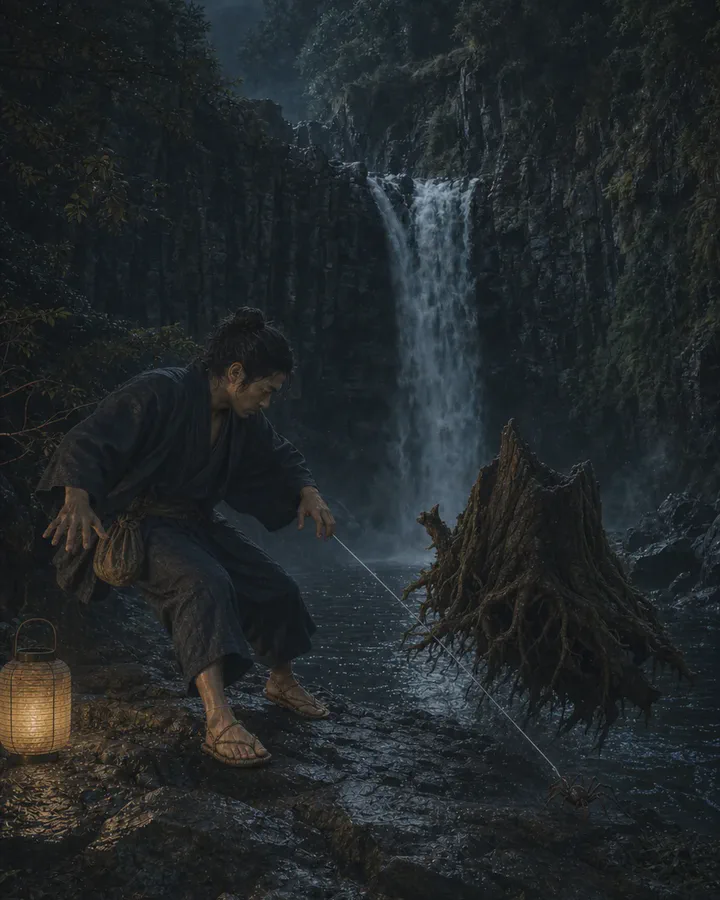
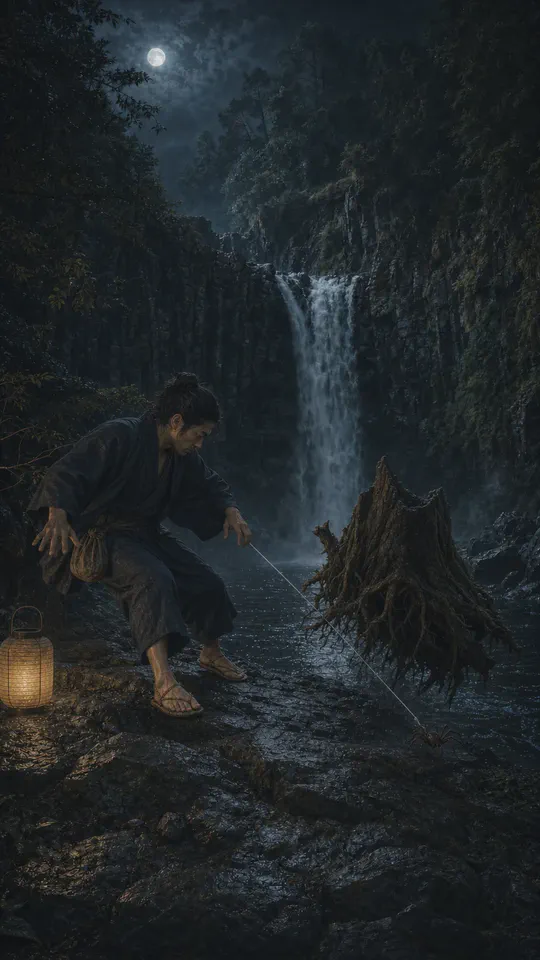
The account featured here is more specific. It belongs to Jōren Falls in the Izu area of Shizuoka Prefecture. In records of this local tradition, a person rests near the waterfall while a spider quietly winds thread around his foot. He notices the thread, removes it and loops it around a mulberry stump. The stump is then pulled from the ground and taken into the water.
The story does not need a giant spider or a human-spider hybrid to establish danger. Its central image is a thread fine enough to overlook and strong enough to reveal what would have happened if it had remained around the man’s ankle.
Appearance
In the thread-and-stump episode, the active creature is described as a spider. The cited accounts do not require an enormous body, a woman’s torso attached to eight legs, or a seductive disguise. A small spider and an almost invisible line are enough to create the encounter.
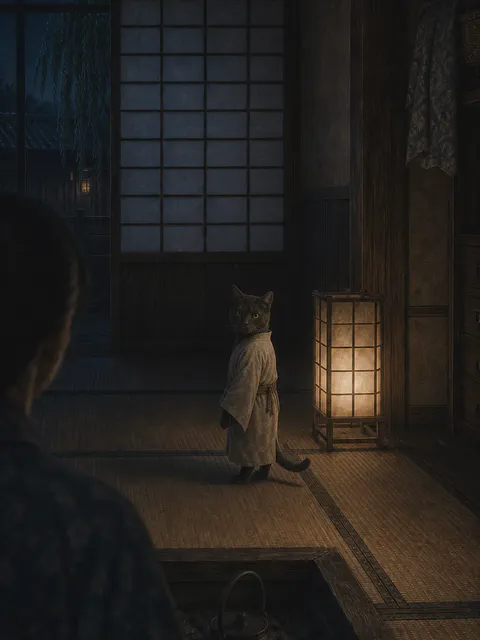
A later local account adds another image. In that version, the spirit of the falls appears as a beautiful woman and returns an axe that a descendant has dropped into the water. That female form belongs to the site’s continuing tradition. In the thread-and-stump account the spider is simply a spider.
The spelling also deserves care. The name can appear as 絡新婦 or 女郎蜘蛛. The latter is also used for real spiders. Folklore, zoological naming and later popular imagery overlap here, which means a living Trichonephila clavata in a garden proves nothing about what the stories described.
Behavior and abilities
The spider works without immediately alarming its target. It winds thread around the resting person’s foot while he is beside the waterfall. The danger is discovered only because he looks down and notices what is happening.
Moving the thread exposes its power. Once it is transferred to the mulberry stump, the pull tears the plant free and carries it toward or into the pool. The supernatural force therefore remains largely offstage. The waterfall itself becomes the source of the pull, while the silk connects the human world to whatever rules the water.
Accounts connected with Jōren Falls identify the jorōgumo as the master or spirit of the falls. That does not establish that every jorōgumo in Japan lives under a waterfall or behaves in exactly the same way. It tells us how one named landscape, one spider tradition and one warning about care near deep water became inseparable.
Folklore accounts and regional setting
A version published in 1934 places the encounter at Jōren Falls and describes a young man transferring the spider’s thread from his foot to a mulberry stump. A later prefectural folklore collection preserves the same basic pattern with a farmer and a cut mulberry stump.
Another account recorded around the end of the twentieth century continues the story through a descendant. After an axe falls into the water, a beautiful woman associated with the spider spirit returns it. This episode broadens the character of the waterfall’s master, but it is best read as a later related account rather than inserted into the earlier moment at the stump.
Jōren Falls is not a generic fantasy backdrop. The roar of the water, the deep pool and the forested terrain explain why a nearly invisible thread can carry such force in the imagination. The legend maps supernatural agency onto a real place where footing, current and depth already demand caution.
Weaknesses and countermeasures
In the Jōren Falls story, the person survives by quietly taking the thread off his foot and placing it around the stump. The action is less a magical weakness than a practical redirection: the pull continues, but another object receives it.
That response belongs to this particular narrative rather than to spider spirits in general. Other supernatural spider tales may use different settings, motives and outcomes and may offer no countermeasure at all.
Traditional folklore and later imagery
Documented Jōren Falls tradition. A spider winds silk around a person’s foot beside the waterfall. He transfers the thread to a mulberry stump, which is pulled from the earth and into the water. Later local material identifies a beautiful female spirit with the falls, but that episode is recorded separately.
Broader and later imagery. Fiction, illustration, games and online summaries often turn Jorōgumo into a seductive woman with a giant spider body, web-filled lair and a fixed method of hunting men. Such imagery may draw from other spider-transformation stories, but it has crowded out the small local account it descends from. Our short keeps the spider small, the thread fine and the waterfall’s hidden force at the center.
Sources and further reading
- Fieldwork collection Spider-thread account at Jōren Falls, record 1230229 (external link) International Research Center for Japanese Studies Describes a spider winding thread around a young man's foot and a mulberry stump being pulled into the waterfall.
- Fieldwork collection Jorōgumo as the master of Jōren Falls, record C0222091-000 (external link) International Research Center for Japanese Studies A Shizuoka prefectural account connecting the waterfall's spider master with a farmer and a mulberry stump.
- Fieldwork collection Later Jōren Falls spider-spirit account, record 0030390 (external link) International Research Center for Japanese Studies A related local account in which the spider spirit appears as a beautiful woman and returns a dropped axe.
- Library Reference inquiry into the textual basis of Jorōgumo stories (external link) National Diet Library Collaborative Reference Database Reviews sources behind widely repeated Jorōgumo descriptions and cautions against unsupported combinations.
- Museum The Jorōgumo of Jōren Falls (external link) Izu City Museum Local cultural-history introduction to the spider legend associated with Jōren Falls.