
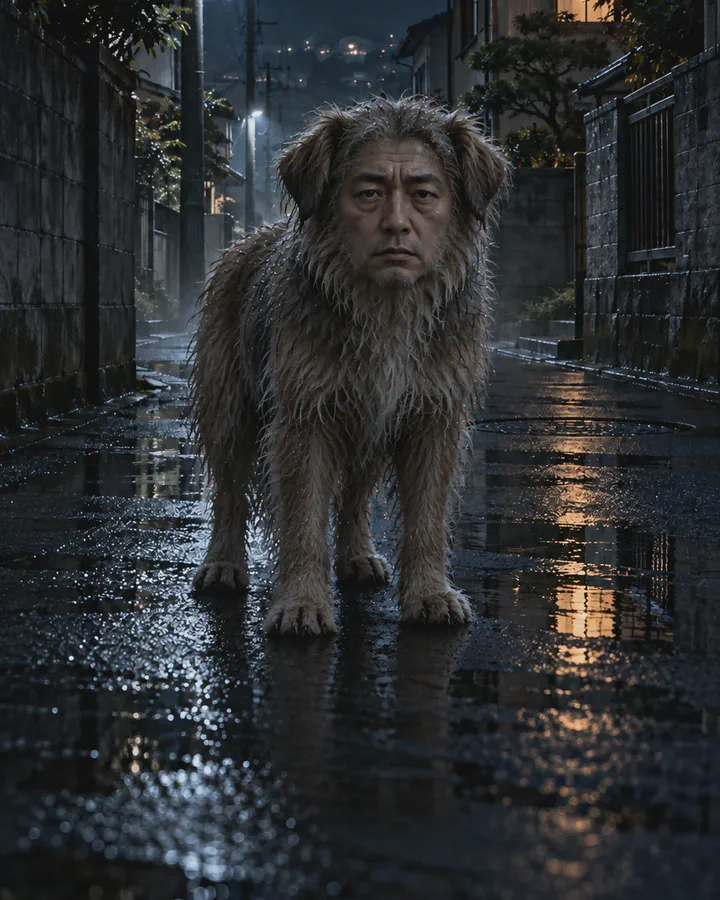
Jinmenken (人面犬): The Human-Faced Dog That Fled the Rumours
Japan's 1989 urban legend, and a first-grader's version of it
人面犬(じんめんけん) Jinmenken ASCII: Jinmenken
Also known as: Human-faced dog
Pronunciation: jeen-MEN-ken
Jinmenken (人面犬, “human-face dog”) is a dog with a man’s face — a modern Japanese urban legend that swept through schoolchildren and then the media around 1989–90. In the famous version it runs alongside cars on the expressway at a hundred kilometres an hour and turns to look at the driver. In Yamagata a first-grader had his own: the dog had lived in Tokyo, but people made such a fuss about it that it ran away to Yamagata for some peace.
Quick Facts
- Habitat
- Street, Road
- Region
- Tokyo, Yamagata
- Recorded period
- 1989–90 rumour, 1992 folklore record
- Nature
- Unknown
- Danger rating
The danger rating is an editorial summary made for readability. It is not an objective measure found in folklore sources.
Watch the Short
What is Jinmenken?
You are driving on the expressway at night and a dog is running alongside the car. It is keeping up — at a hundred kilometres an hour. You look over, and it looks back, and it has the face of a middle-aged man. Or: you find a stray going through the rubbish behind the shops, and when you shine a light on it, it lifts a man’s face and says, Leave me alone.
That was the jinmenken, the human-faced dog, and in 1989 and 1990 every schoolchild in Japan knew about it. In January 1990 the weekly Asahi Journal ran a piece on it as a case of a children’s rumour network that had pulled the mass media in after it; a doctoral thesis on children’s rumours later gave it a chapter of its own. It is not a sighting. It is a record of what people said.
What does jinmenken mean?
The name is written 人面犬: jin, a person; men, a face; ken, a dog. The human-face dog. It is pronounced jeen-MEN-ken. Like the kuchisake-onna a decade before it, the name is a plain description of the one thing every version shares.
The dog in Yamagata
In 1992 the folklorist Takahashi Toshihiro published notes on the rumours going round Yamagata. A first-grader told him that the human-faced dog had lived in Tokyo, but people had made so much fuss about it that it had run away to Yamagata. Another child knew where it appeared: around Nanokamachi, in the middle of Yamagata city.
That is the most interesting version on record. The rumour had become so loud that, in a child’s telling, even the monster wanted somewhere quieter.
Appearance
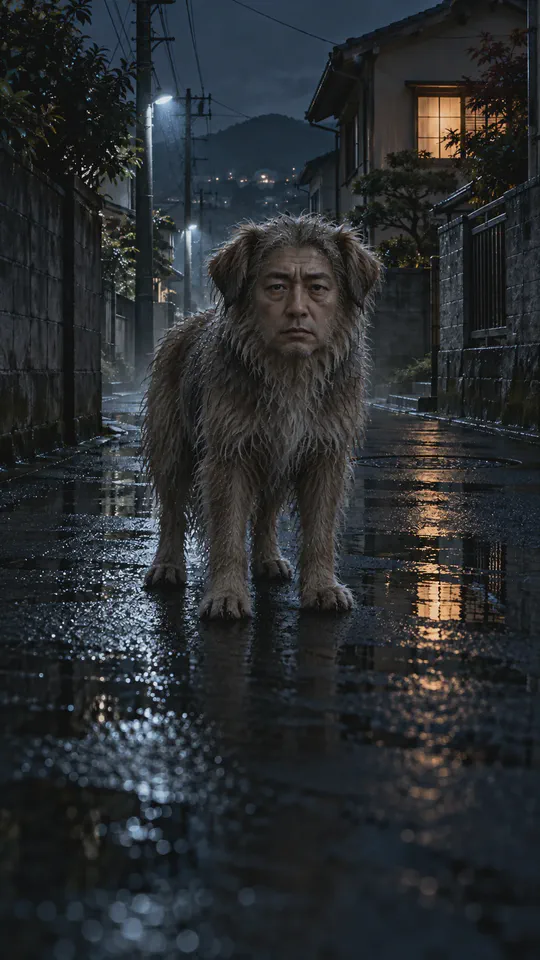
A dog’s body and a human face — usually a middle-aged man’s, sullen rather than frightening. Our illustration gives it a tired face on a small-town street at night.
Behavior and abilities
- It looks back at you. The shock of every version is the face.
- It speaks, in some versions. Usually to tell you to go away.
- It moves. On the expressway, in some tellings; out of Tokyo, in Yamagata.
Weaknesses and countermeasures
None are recorded. The jinmenken is almost never dangerous in the rumours. It is startling, rude, or simply sad.
Documented rumour and later imagery
Documented rumour. A human-faced dog rumour among Japanese children around 1989–90, reported in the press and studied afterward; a 1992 Yamagata record of a first-grader who said it had fled Tokyo because of the fuss, and of its haunt around Nanokamachi.
Later imagery. The jinmenken is now a staple of lists of Japanese urban legends, often given a single origin — an escaped laboratory experiment, a man and his dog killed together in a crash — or linked to Edo-period sideshow puppies with human faces. None of those connections is established by the records. What the Yamagata note keeps is the strangest detail of all: a rumour so big that its own subject went looking for peace and quiet.
Sources and further reading
- Fieldwork collection Jinmenken, record 1140605 (external link) International Research Center for Japanese Studies Takahashi Toshihiro, Seikō Minzoku 139 (1992), Yamagata: a first-grader said the human-faced dog fled Tokyo because of all the fuss.
- Fieldwork collection Jinmenken, record 1140608 (external link) International Research Center for Japanese Studies Same article: it appears around Nanokamachi in Yamagata city.
- Library "Jinmenken: the rumour network" (Asahi Journal 32/1, 1990) (external link) CiNii Research Bibliographic record for a January 1990 article on children's rumour networks and the media; text not consulted.
- Academic paper "Children's rumours" (doctoral thesis, Kanagawa University, 1999) (external link) Miyamoto Naokazu; CiNii Research Thesis with a chapter analysing the Jinmenken rumour; bibliographic record only.
- Reliable secondary How Jinmenken was loved by the media and multiplied (external link) Kuro Shirō; web Mu Retrospective on period magazines, used only for the highway-racing variant.
Where it was recorded
- 1992
Nanokamachi, Yamagata city, Yamagata
Modern rumour
First-grader: the dog fled Tokyo because of the fuss
- 1989
Tokyo, Tokyo
Modern rumour
Centre of the 1989–90 human-faced dog rumour
Places named in the records behind this article. Coordinates are approximate. View on the map
Records behind this article
On the timeline
- 1989–90 The human-faced dog
In the glossary
Related yokai

Kuchisake-onna
口裂け女(くちさけおんな)
Kuchisake-onna is not an old yokai. She is a rumour that swept through Japanese schoolchildren in 1978–79: a masked woman asking 'Am I pretty?' Almost every other detail changed from school to school.

Teke Teke
テケテケ
Teke Teke is a modern school ghost story, best known as the upper half of a woman who drags herself along on her elbows. Its origin cannot be traced, and one recorded version from a Kobe high school puts it in a mirror instead.